















































 HOME
HOME

-

Ceramic PCB for Humanoid Robot joint actuators
2026 04,07 -
LTCC PCB Surprises: What Most People Miss
2025 12,09 -
Step-by-Step Guide to DPC PCB Design for Sensor Systems
2025 12,03 -
Ceramic PCBs Essential Benefits and Applications
2025 12,01 -
How Al2O3 DPC Ceramic Substrate PCB Enhances Heat Dissipation in Modern Electronics?
2025 11,28 -
How to Choose Between Ceramic, FR4, and Metal Core PCBs
2025 11,27 -
DPC Ceramic PCB Materials: Surprising Science Inside
2025 11,26 -
Wire bondable 2-layer Alumina substrates PCB | Bstceramic PCB
2025 09,22 -
Silicon Nitride Substrate, Silicon Nitride Ceramic Substrate Formula
2025 05,08 -
What is thick film ceramic PCB?
2023 08,02
Aluminum Nitride Ceramic Substrates in Electronic Market: Size, Growth, Properties, and Applications
Thermal management is now a key design factor in power electronics, EV systems, high-power LEDs, RF devices, and semiconductor packaging. As electronic products become smaller and more powerful, traditional substrate materials often reach their thermal limits.
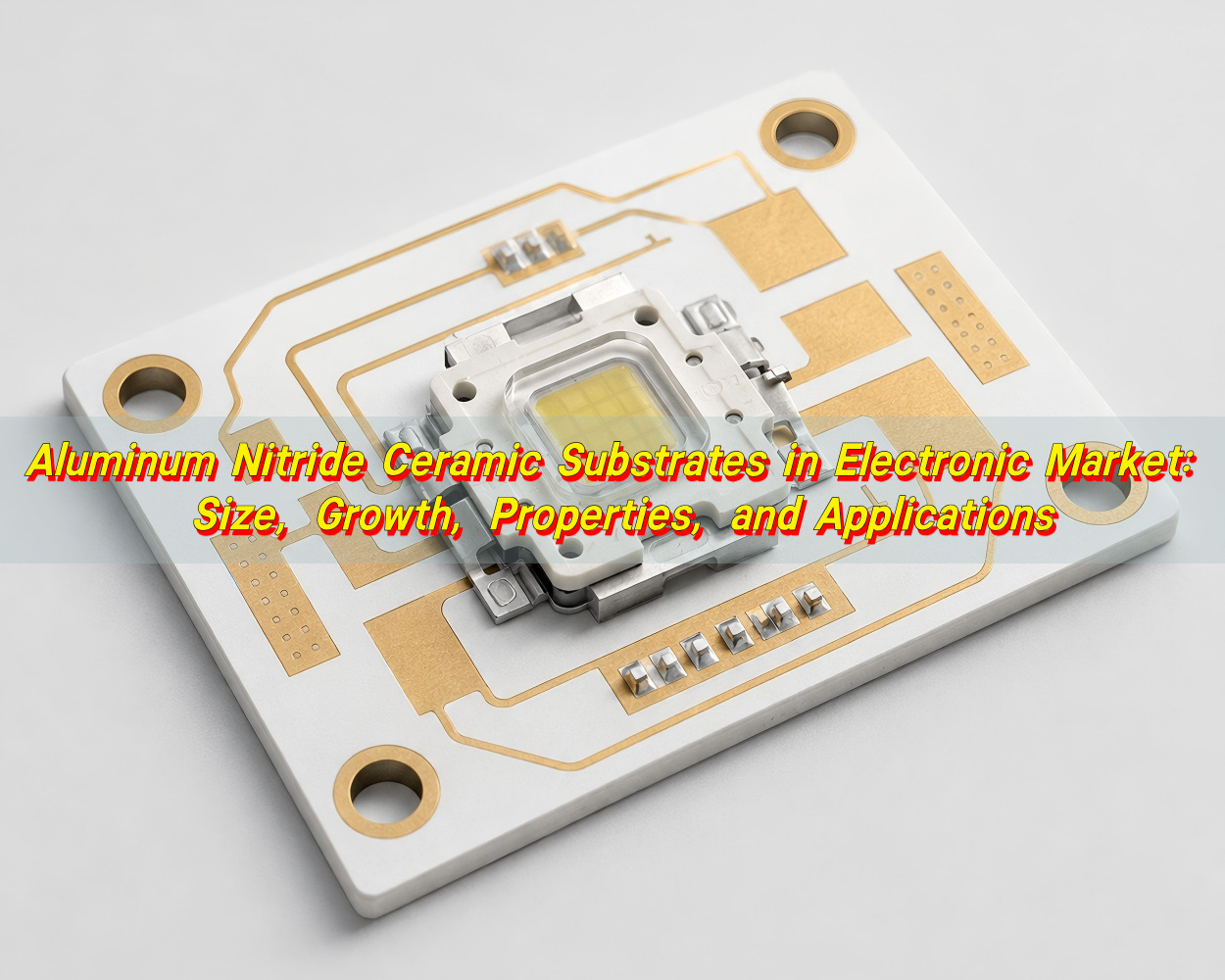
This is where the aluminum nitride ceramic substrate becomes important. Aluminum nitride, also called AlN, is a high-performance ceramic material with high thermal conductivity, electrical insulation, and good dimensional stability. It helps transfer heat away from active devices while keeping electrical isolation between circuit layers and components.
In the electronics market, aluminum nitride substrates are mainly used in applications where heat, voltage, reliability, and package size must be controlled at the same time. They are common in power modules, LED packages, laser modules, RF circuits, automotive electronics, and semiconductor devices.
What Is an Aluminum Nitride Ceramic Substrate?
An aluminum nitride ceramic substrate is a ceramic base used to support electronic circuits, chips, or power components. It provides mechanical support, electrical insulation, and heat transfer.
In a high-power circuit, heat is usually generated around chips, copper traces, solder joints, and power devices. If this heat stays near the source, device temperature rises and reliability decreases. An aluminum nitride substrate helps move heat from the component to the cooling structure, such as a heat sink, metal base, or module housing.
An aluminum nitride ceramic pcb usually refers to a circuit board made on an AlN ceramic base. Conductive layers can be formed through thick film, thin film, DPC, DBC, AMB, or other ceramic circuit processes. The right process depends on line width, copper thickness, current load, thermal demand, and assembly method.
How Large Is the Aluminum Nitride Ceramic Substrate Market?
The aluminum nitride ceramic substrate market is growing as electronic systems require better heat dissipation and higher reliability.
Market data varies by reporting scope. Some reports focus on aluminum nitride ceramic substrates used in electronics. Some cover only aluminum nitride substrates. Others include the broader ceramic substrate market, which also contains alumina, silicon nitride, and other ceramic materials.
According to Market Research Future, the aluminum nitride ceramic substrates market in electronics was valued at about USD 2.05 billion in 2024. It is projected to reach about USD 4.12 billion by 2035, with a CAGR of about 6.57% from 2025 to 2035.
Intel Market Research gives a narrower estimate for the global aluminum nitride substrates market. It reports a market size of about USD 172 million in 2025 and forecasts about USD 283 million by 2034, with a CAGR of about 7.2%.
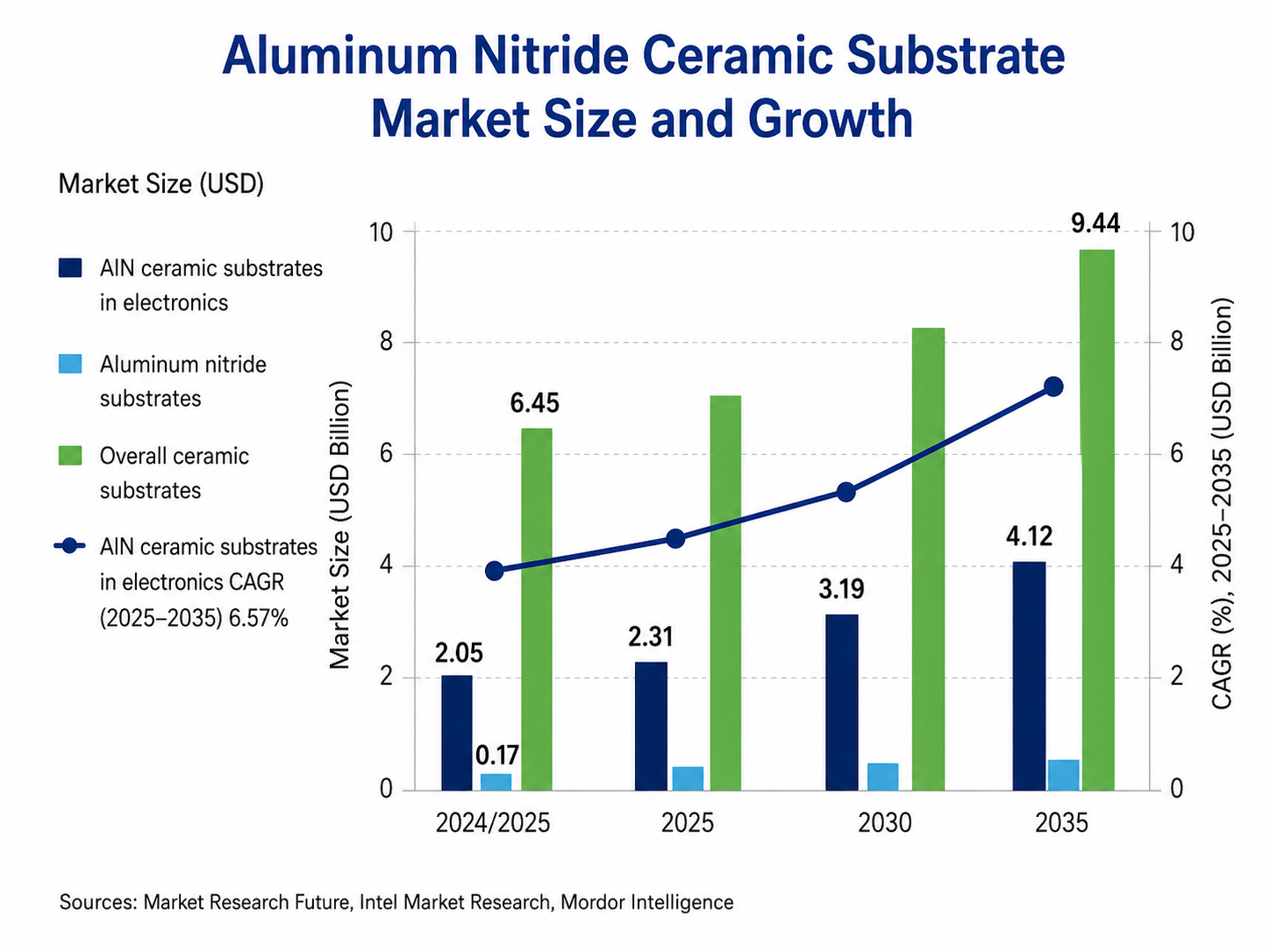
The wider ceramic substrate market is larger. Mordor Intelligence estimates the ceramic substrate market at USD 6.45 billion in 2025 and forecasts USD 9.44 billion by 2031, with a CAGR of about 6.54%.
| Market Scope | Estimated Size | Forecast | CAGR |
|---|---|---|---|
| AlN ceramic substrates in electronics | USD 2.05 billion in 2024 | USD 4.12 billion by 2035 | About 6.57% |
| Aluminum nitride substrates | USD 172 million in 2025 | USD 283 million by 2034 | About 7.2% |
| Overall ceramic substrates | USD 6.45 billion in 2025 | USD 9.44 billion by 2031 | About 6.54% |
These figures show that aluminum nitride substrates are a specialized but growing segment. Their demand comes mainly from high-power and high-reliability electronics, rather than low-cost general PCB applications.
Why Is the Aluminum Nitride Ceramic Substrate Market Growing?
The market is growing because electronic devices are becoming smaller, faster, and more power-dense. This creates stronger demand for substrate materials that can manage heat while maintaining electrical insulation.
Electric Vehicles
EV systems use inverters, onboard chargers, DC-DC converters, motor controllers, and battery-related power electronics. These systems need stable thermal performance under high current, high voltage, and repeated temperature changes.
Aluminum nitride ceramic substrates help power devices transfer heat efficiently while maintaining insulation. This makes them suitable for EV power modules and automotive electronic systems.
SiC and GaN Power Devices
SiC and GaN devices support higher switching frequency, higher efficiency, and higher operating temperature than traditional silicon devices. Their performance advantages also create stricter thermal requirements.
AlN is used in these applications because it provides high thermal conductivity and good thermal stability. It can support compact power module designs where organic PCB materials may not provide enough thermal performance.
Renewable Energy Systems
Solar inverters, wind power converters, energy storage systems, and industrial power supplies need stable operation under continuous load. These systems generate heat during power conversion.
An aluminum nitride substrate can improve heat flow from power semiconductors to the cooling structure. This supports higher reliability in long-running power electronics.
High-Power LED and Laser Modules
LED chips and laser diodes often generate heat in a small area. If the heat is not removed effectively, brightness, optical stability, and service life can be affected.
AlN ceramic substrates provide a short thermal path, making them useful for high-power LEDs, UV LEDs, laser modules, optical communication devices, and automotive lighting.
5G, RF, and Microwave Electronics
RF and microwave devices require stable thermal and electrical behavior. Heat can affect signal stability, component life, and module performance.
Aluminum nitride ceramic materials are used in RF power amplifiers, microwave circuits, radar modules, and communication equipment where heat dissipation and dimensional stability are important.
Semiconductor Packaging
Semiconductor packages are becoming more compact and thermally demanding. AlN has a coefficient of thermal expansion close to silicon, which helps reduce thermal stress between the chip and substrate.
This makes AlN useful for chip carriers, package bases, heat-spreading substrates, and other advanced packaging structures.
What Are the Key Aluminum Nitride Ceramic Properties?
The main value of AlN comes from its material properties. Engineers usually evaluate aluminum nitride ceramic properties through thermal, electrical, mechanical, and reliability factors.
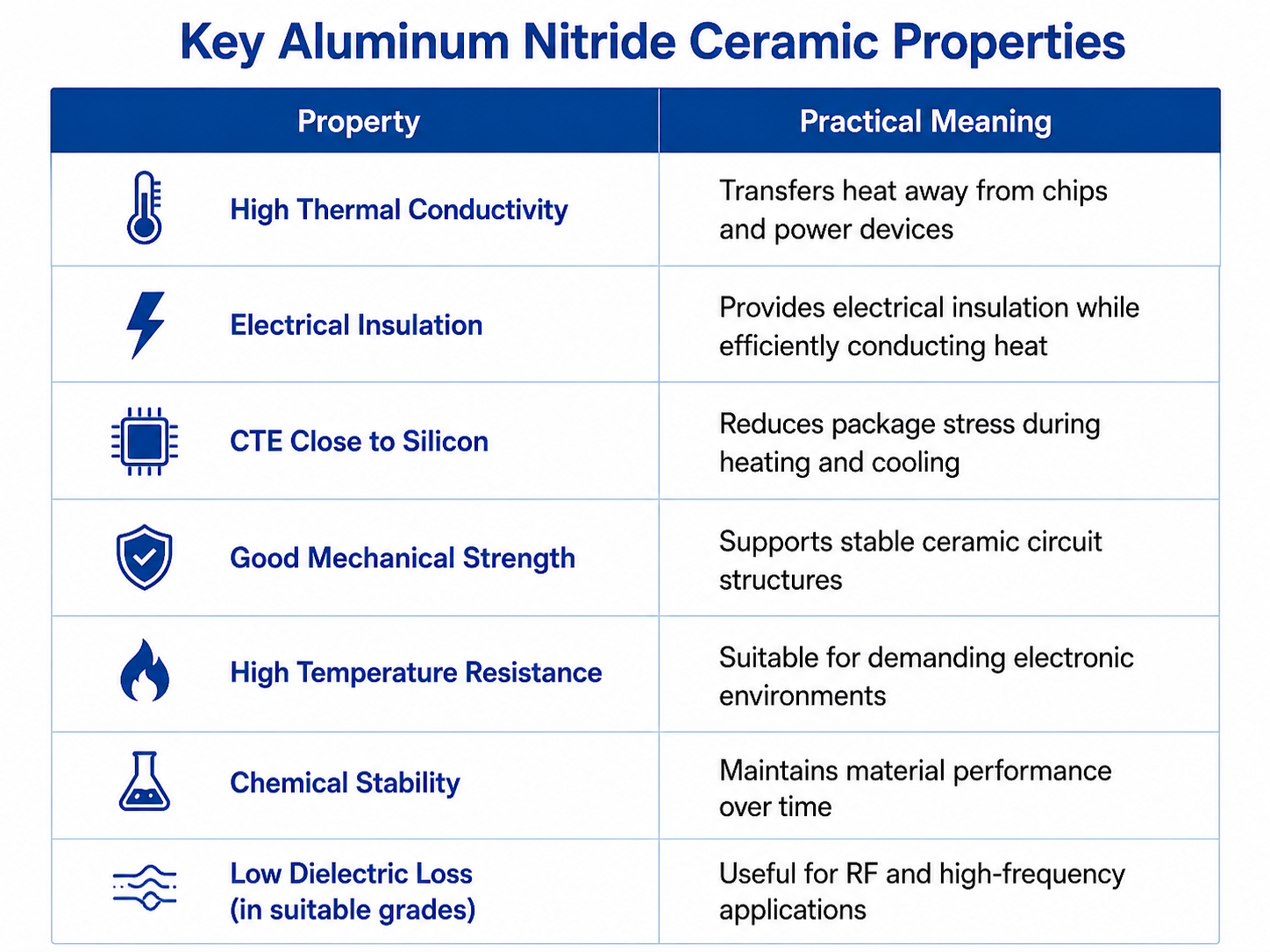
| Property | Practical Meaning |
| High thermal conductivity | Transfers heat away from chips and power devices |
| Electrical insulation | Supports heat dissipation without electrical shorting |
| CTE close to silicon | Helps reduce package stress during heating and cooling |
| Good mechanical strength | Supports stable ceramic circuit structures |
| High temperature resistance | Suitable for demanding electronic environments |
| Chemical stability | Helps maintain material performance over time |
| Low dielectric loss in suitable grades | Useful for selected RF and high-frequency applications |
Commercial AlN materials often provide thermal conductivity around 170 W/m·K or higher, depending on purity, formulation, sintering quality, and supplier grade. The actual value should be confirmed from the material datasheet.
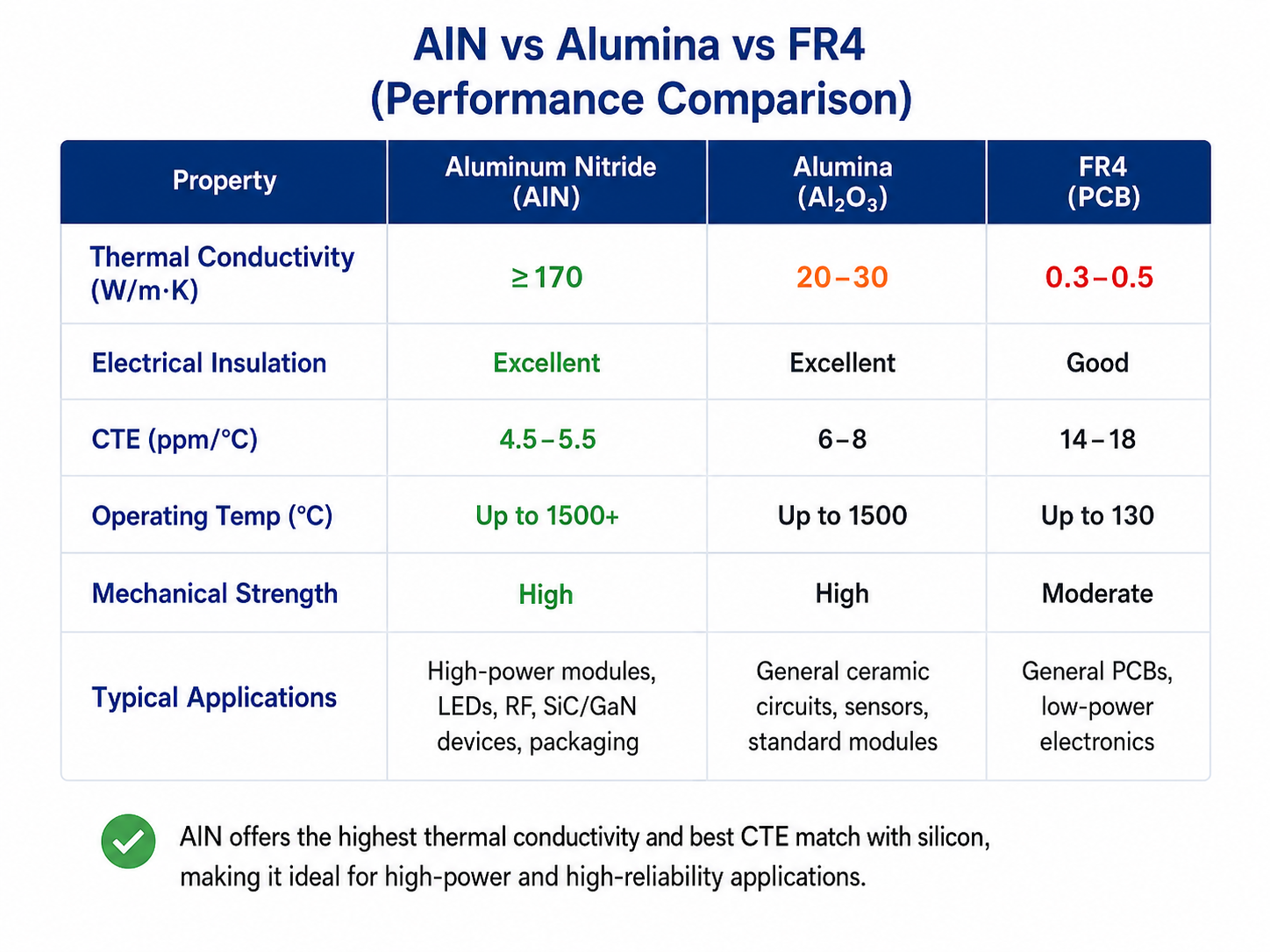
Compared with FR4, AlN has much higher thermal conductivity. Compared with alumina ceramic, AlN also provides a stronger thermal path. This is the main reason it is selected for high-power electronic applications.
Where Are Aluminum Nitride Substrates Used in Electronics?
Aluminum nitride substrates are used in electronic products where heat control, insulation, and reliability are critical.
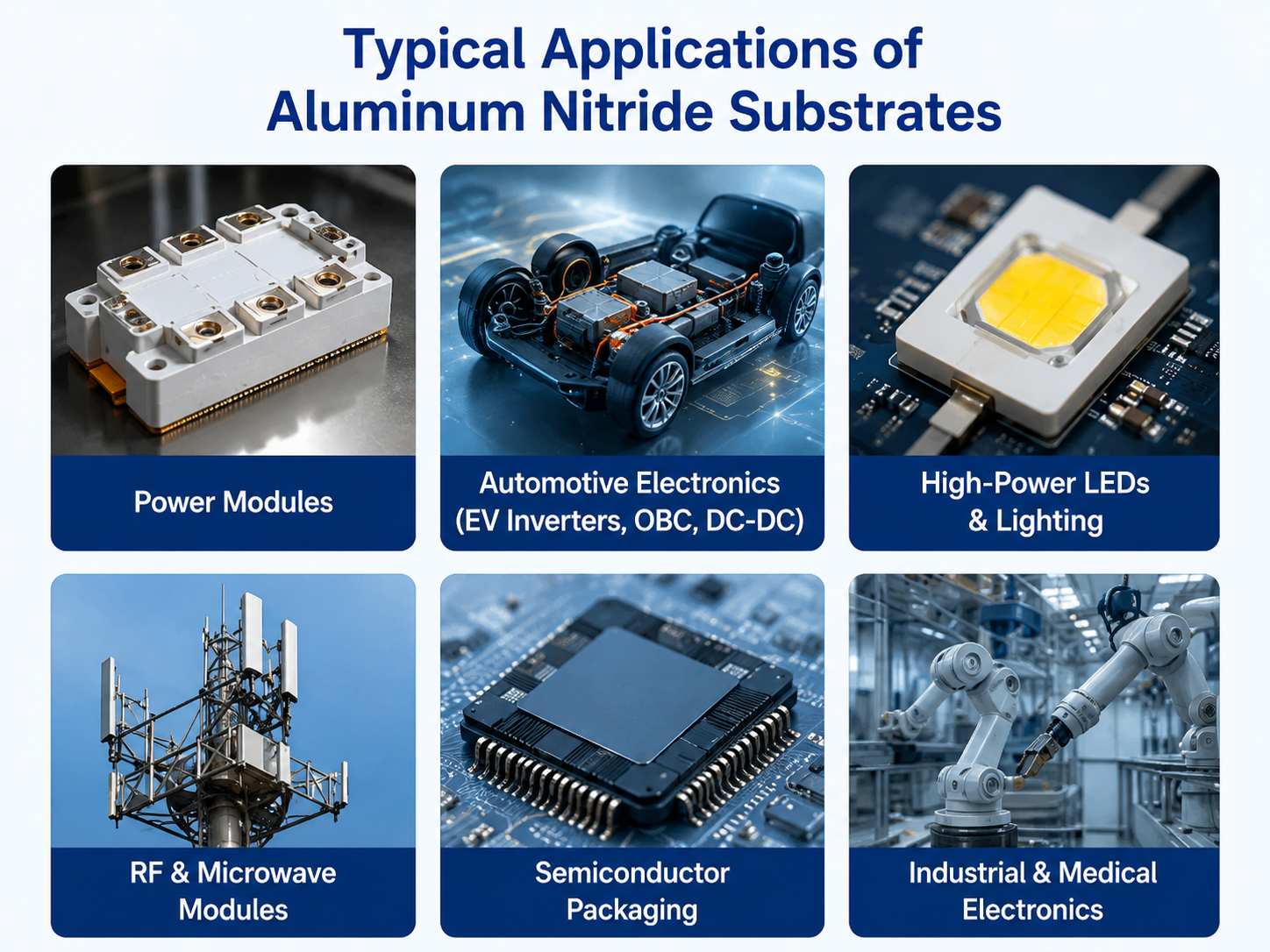
Power Electronics
Power modules, MOSFET modules, IGBT modules, SiC modules, GaN devices, converters, and inverters use AlN when heat density is high. The substrate helps conduct heat away from power components while keeping electrical isolation.
Automotive Electronics
Automotive power systems face vibration, high voltage, thermal cycling, and long service life requirements. AlN ceramic substrates are used in EV inverters, onboard chargers, DC-DC converters, motor control modules, and other high-power automotive electronics.
LED and Optical Devices
High-power LEDs, UV LEDs, laser diodes, and optical communication modules require efficient heat dissipation. AlN supports stable light output and helps control junction temperature.
RF and Microwave Modules
RF power amplifiers, microwave circuits, radar components, and 5G communication modules can use AlN because of its thermal stability and suitable electrical behavior.
Semiconductor Packaging
AlN is used as a chip carrier, package substrate, insulating heat spreader, or module base. Its thermal conductivity and CTE compatibility make it suitable for high-performance semiconductor packages.
Industrial and Medical Electronics
Industrial drives, power supplies, sensor modules, and medical electronic systems may use AlN where stable performance and long-term reliability are required.
Aluminum Nitride Ceramic Substrate vs Alumina Ceramic Substrate
Alumina is widely used in ceramic circuit applications because it is stable, cost-effective, and easy to process. However, its thermal conductivity is much lower than that of aluminum nitride.
AlN is selected when thermal performance becomes a key design requirement.
| Item | Alumina Ceramic | Aluminum Nitride Ceramic |
| Thermal conductivity | Moderate | High |
| Cost | Lower | Higher |
| Electrical insulation | Good | Good |
| CTE match with silicon | Acceptable | Better |
| Processing difficulty | Lower | Higher |
| Typical use | General ceramic circuits, sensors, standard modules | Power modules, LEDs, RF devices, semiconductor packages |
The choice depends on the design target. Alumina is suitable for many standard ceramic circuits. Aluminum nitride is more suitable for compact, high-power, and high-heat applications.
Aluminum Nitride Ceramic PCB vs FR4 PCB
FR4 is the standard material for many PCB products. It is economical, easy to fabricate, and suitable for general electronic circuits. The limitation of FR4 is thermal conductivity. In high-power circuits, heat can remain near components and increase operating temperature. This can affect reliability, especially in compact layouts.
An aluminum nitride ceramic pcb is more suitable when the project requires:
- High heat dissipation
- Electrical insulation
- High-temperature stability
- Compact power design
- Better thermal cycling performance
- Reliable operation under high power density
FR4 remains suitable for control circuits, signal boards, consumer electronics, and low-power assemblies. AlN is mainly used when thermal performance becomes a limiting factor.
What Manufacturing Processes Are Used for Aluminum Nitride Ceramic PCBs?
AlN ceramic circuits can be produced by several processes. The process choice depends on circuit precision, copper thickness, current capacity, bonding strength, and application environment.
Thick Film AlN Substrate
Thick film technology uses screen printing and firing to form conductive patterns on the ceramic surface. It is suitable for circuits with moderate line precision and stable production requirements.
Thin Film AlN Substrate
Thin film technology provides finer circuit patterns and better dimensional control. It is used in RF, microwave, sensor, and precision electronic applications.
DPC AlN Substrate
DPC, or Direct Plated Copper, forms copper layers on the ceramic surface through deposition and plating. It supports fine circuits, good adhesion, and strong thermal performance. It is often used in LEDs, sensors, semiconductor packages, and compact power electronics.
DBC AlN Substrate
DBC, or Direct Bonded Copper, bonds copper directly to the ceramic substrate. It supports thicker copper and higher current capacity, making it suitable for power modules.
AMB AlN Substrate
AMB, or Active Metal Brazing, provides strong copper-to-ceramic bonding. It is often used in high-reliability power modules, especially where thermal cycling and mechanical stress are important.
How to Select the Right Aluminum Nitride Substrate?
Selecting an AlN substrate requires more than checking thermal conductivity. The whole structure should be reviewed.
Key selection points include:
- Thermal conductivity grade
- Substrate thickness
- Copper thickness
- Line width and spacing
- Surface finish
- Operating voltage
- Creepage and clearance
- Thermal cycling requirement
- Metallization method
- Assembly process
- Prototype or mass production volume
For high-current circuits, copper thickness and trace width are important. For semiconductor packaging, surface flatness, CTE matching, and metallization quality matter more. For LED modules, the thermal path from chip to substrate is the main focus.
A practical selection method is to start from the heat source, power level, electrical isolation, assembly method, and reliability target. The substrate material and process should match these requirements.
Why Are Aluminum Nitride Ceramic Substrates More Expensive?
Aluminum nitride ceramic substrates cost more than FR4 and alumina substrates because the material and process requirements are higher.
AlN powder preparation, ceramic sintering, machining, metallization, and inspection all require strict process control. Ceramic materials are also more difficult to cut, drill, grind, and plate than organic PCB laminates.
The metallization process adds further cost. Copper, nickel, gold, silver, or other metal layers must bond reliably to the ceramic surface. DPC, DBC, AMB, and thin film processes require specialized equipment and tighter control than standard PCB fabrication.
For high-power and high-reliability applications, the higher cost is often justified by better thermal performance, longer service life, and improved module stability.
Future Market Trends for Aluminum Nitride Substrates
The demand for aluminum nitride substrates is expected to grow with the development of high-performance electronics.
Key trends include:
- Wider use of EV power modules
- Growth of SiC and GaN devices
- Expansion of renewable energy systems
- Higher power density in industrial electronics
- More compact semiconductor packages
- Growth of 5G, RF, and microwave modules
- Increasing demand for high-power LEDs and laser devices
These trends share one requirement: better thermal control in smaller and more demanding electronic systems. This supports the long-term use of AlN ceramic substrates in high-value applications.
Custom Aluminum Nitride Ceramic PCB Manufacturing Support
A custom aluminum nitride ceramic PCB project should begin with a technical review. Important items include substrate thickness, copper thickness, circuit pattern, line spacing, hole design, surface finish, assembly method, and working environment.
For power electronics, the review should focus on current capacity, insulation distance, thermal path, copper bonding, and thermal cycling. For LEDs and optical devices, the main points are die attach area, surface flatness, heat transfer path, and assembly compatibility. For RF devices, pattern accuracy and material stability should be checked carefully.
BSTCeramicPCB supports custom ceramic PCB and ceramic substrate solutions, including alumina ceramic PCB, aluminum nitride ceramic PCB, DPC ceramic PCB, DBC ceramic substrate, thick film ceramic substrate, and thin film ceramic substrate. Customers can send Gerber files, drawings, BOM, copper thickness requirements, substrate thickness, and thermal requirements for engineering review before production.
FAQs About Aluminum Nitride Ceramic Substrates
What is an aluminum nitride ceramic substrate used for?
It is used in power modules, high-power LEDs, RF devices, laser modules, EV electronics, semiconductor packaging, and other applications that require heat dissipation and electrical insulation.
What is an aluminum nitride ceramic PCB?
It is a ceramic circuit board made with an aluminum nitride base material and conductive circuit layers. It is used in high-thermal-performance electronic applications.
What are the main aluminum nitride ceramic properties?
Key properties include high thermal conductivity, electrical insulation, good thermal stability, mechanical strength, and CTE compatibility with silicon.
Is aluminum nitride better than alumina ceramic?
Aluminum nitride provides higher thermal conductivity than alumina. Alumina is more cost-effective for standard ceramic circuits, while AlN is better for high-heat applications.
Why are aluminum nitride substrates used in power electronics?
They help transfer heat away from power devices while maintaining electrical insulation. This is important for power modules, converters, and inverters.
Can aluminum nitride ceramic substrate replace FR4 PCB?
It can replace FR4 in high-power or high-temperature applications. FR4 remains suitable for general low-power circuits.
Why is aluminum nitride ceramic substrate expensive?
The cost comes from high-performance ceramic material, controlled sintering, difficult machining, metallization, and strict inspection requirements.
What files are needed for custom aluminum nitride ceramic PCB production?
Common files include Gerber files, drawings, substrate thickness, copper thickness, surface finish, quantity, tolerance requirements, and assembly information.
Conclusion:
The aluminum nitride ceramic substrate market is growing because electronic products need better thermal performance, higher reliability, and smaller package size. EV power systems, SiC and GaN devices, renewable energy converters, high-power LEDs, RF modules, and semiconductor packages are key demand drivers.
AlN ceramic combines high thermal conductivity, electrical insulation, thermal stability, and good CTE compatibility with silicon. These properties make it suitable for high-power and high-reliability applications.
BSTCeramicPCB supports custom aluminum nitride ceramic substrate and ceramic PCB manufacturing for power electronics, LEDs, EV systems, RF modules, semiconductor packaging, and other high-thermal-demand applications.
If you need engineering support for material selection, copper thickness, ceramic thickness, surface finish, or process feasibility, please send your Gerber files, drawings, BOM, or technical requirements to sales@bstceramicpcb.com. Our team will help review your project before production.
 Products
 About us
 Contact us