
































 HOME
HOME


-

Ceramic PCB for Humanoid Robot joint actuators
2026 04,07 -
LTCC PCB Surprises: What Most People Miss
2025 12,09 -
Step-by-Step Guide to DPC PCB Design for Sensor Systems
2025 12,03 -
Ceramic PCBs Essential Benefits and Applications
2025 12,01 -
How Al2O3 DPC Ceramic Substrate PCB Enhances Heat Dissipation in Modern Electronics?
2025 11,28 -
How to Choose Between Ceramic, FR4, and Metal Core PCBs
2025 11,27 -
DPC Ceramic PCB Materials: Surprising Science Inside
2025 11,26 -
Wire bondable 2-layer Alumina substrates PCB | Bstceramic PCB
2025 09,22 -
Silicon Nitride Substrate, Silicon Nitride Ceramic Substrate Formula
2025 05,08 -
What is thick film ceramic PCB?
2023 08,02
AI-Driven Process Control for DPC Ceramic PCB Yield Improvement in Colombia’s Advanced Electronics Market
Published:
As Colombia expands its industrial electronics, renewable energy, LED lighting, and telecom infrastructure sectors, the demand for high-reliability DPC (Direct Plated Copper) ceramic PCBs is increasing steadily. However, DPC substrates are technically sensitive products where small variations in plating thickness, surface roughness, laser structuring accuracy, or ceramic sintering stability can significantly affect production yield.
In recent years, manufacturers serving the Colombian market have begun implementing AI-driven process control systems to improve yield rates, reduce scrap, and ensure consistent electrical and thermal performance. For DPC ceramic PCBs, artificial intelligence is not simply a trend — it is becoming a practical solution to stabilize complex manufacturing variables.
This article explores:
- How AI-driven process control enhances DPC yield
- Colombian technical and industry expectations
- Quality measurement standards
- Industry-specific applications
- Key engineering considerations
- Why BSTCERAMICPCB is strategically positioned to support Colombian buyers
Quick Navigation (For Crawlers & Readers)
- The Role of AI in DPC Ceramic PCB Yield Improvement
- Colombian Technical Requirements and Measurement Standards
- Industry Applications Driving Yield Sensitivity
- Key Technical Factors Affecting DPC Yield in Colombia
- Why BSTCERAMICPCB Is a Strategic Partner
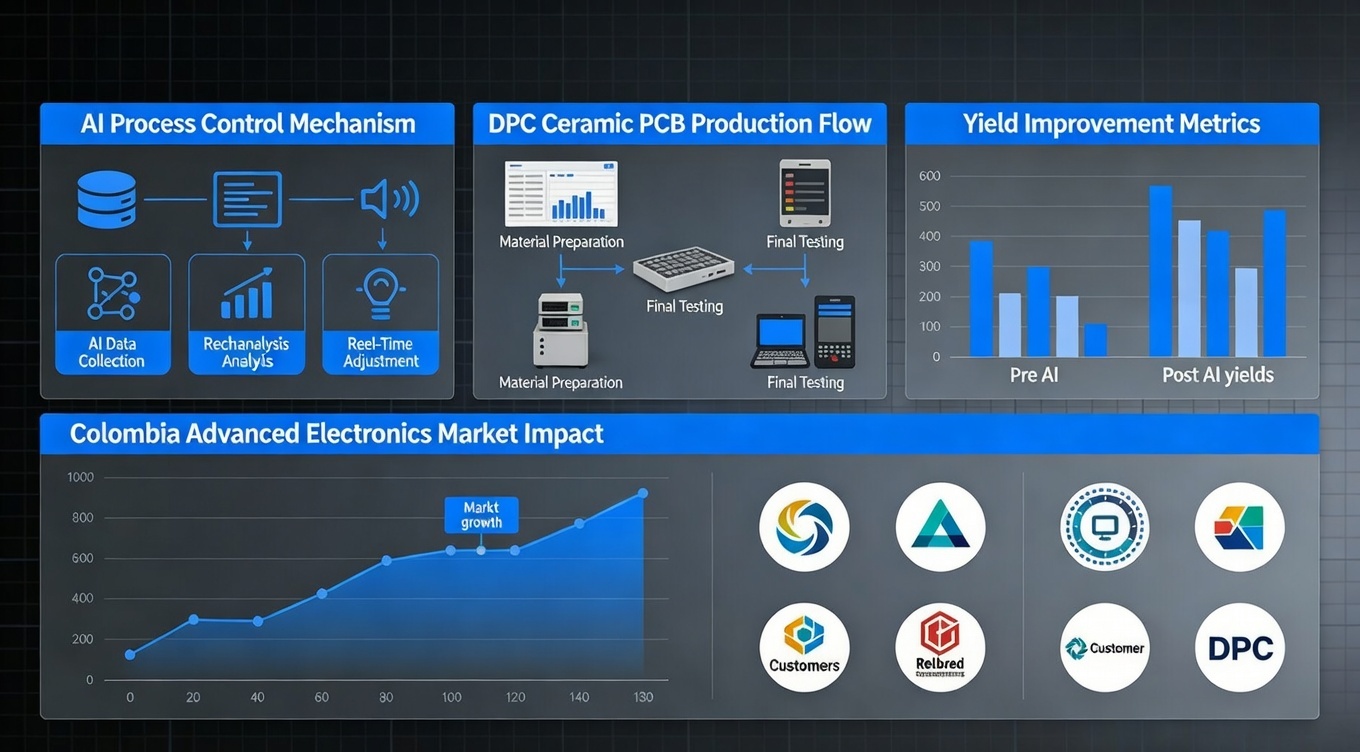
DPC ceramic PCB production is a multi-step process involving ceramic substrate preparation, thin-film metallization, laser patterning, electroplating, and surface finishing. Each stage introduces potential yield loss points. Traditional quality control methods rely on statistical process control (SPC) and manual sampling, but these approaches often react to defects after they occur.
AI-driven process control changes this dynamic.
Instead of reactive inspection, AI systems monitor process parameters in real time, including:
- Copper plating thickness variation
- Electrolyte chemistry balance
- Laser energy consistency
- Surface contamination levels
- Temperature fluctuations in plating baths
Through machine learning algorithms, the system detects patterns invisible to human operators and predicts deviations before they lead to scrap.
For Colombian importers and OEMs, this translates into:
- Higher batch-to-batch consistency
- Reduced defect ratios
- More predictable lead times
- Lower hidden quality costs
In DPC manufacturing, yield improvement directly reduces production cost per board. Since ceramic substrates are more expensive than FR4, even a 3–5% yield improvement can significantly affect total procurement budgets.
At BSTCERAMICPCB, AI-driven process monitoring integrates with plating lines and laser systems to continuously optimize parameter stability. This ensures that customers in Colombia receive DPC boards with consistent copper adhesion strength, uniform line definition, and reliable thermal conductivity.
For readers exploring our technical capability, you may internally link to:
- DPC Ceramic PCB Capability Page
- Ceramic PCB Manufacturing Process Overview
- Quality Control & Inspection Systems
These pages typically generate strong engagement and can improve article conversion flow.
Colombian Technical Requirements and Measurement Standards for DPC Ceramic PCBs
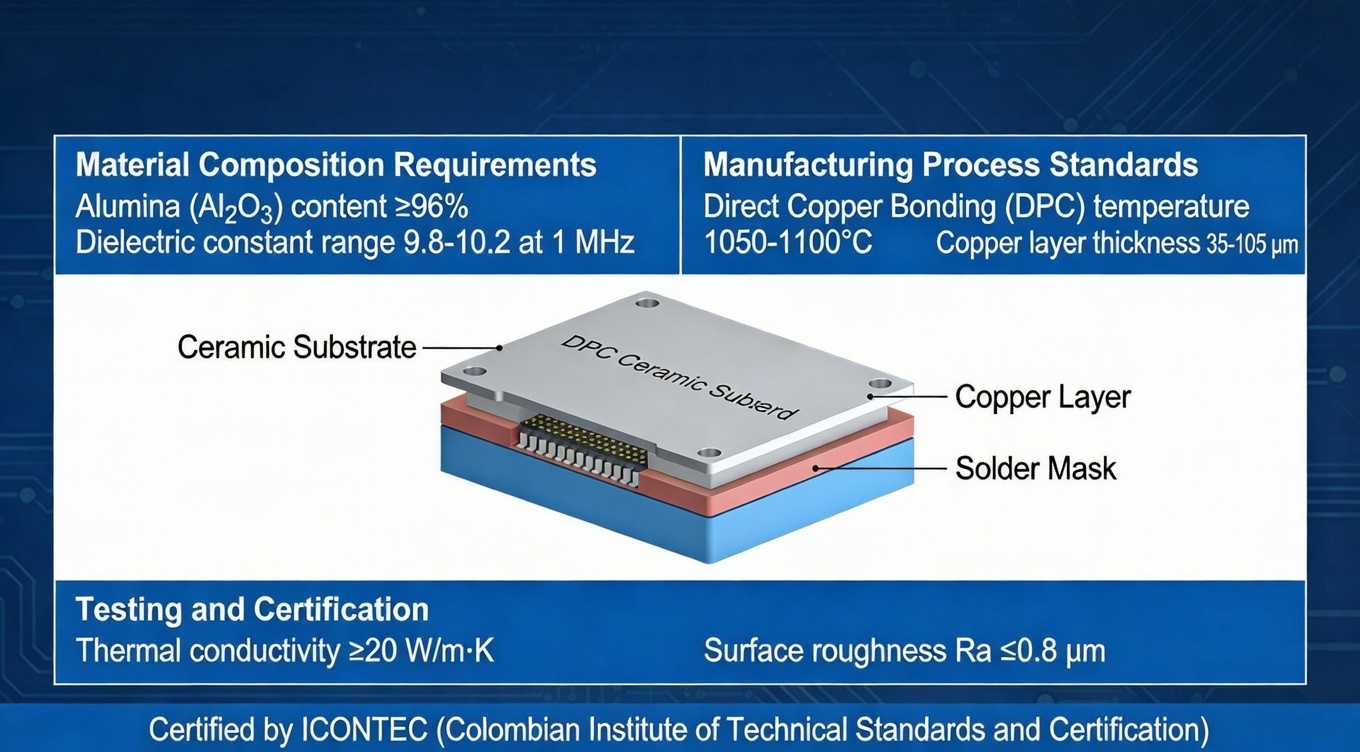
Although Colombia does not publish a standalone national DPC ceramic PCB standard, procurement requirements are generally aligned with international frameworks such as:
- IPC standards (especially IPC-6012 and IPC-6018)
- IEC insulation and reliability requirements
- UL flame resistance certification
- Automotive ISO frameworks when applicable
For the Colombian market, DPC ceramic PCBs are widely used in:
- LED lighting systems
- Power conversion modules
- Telecom base station modules
- Industrial automation controllers
T
echnical requirements commonly include:
1. Line Width and Spacing Accuracy
DPC technology allows fine copper traces (often 50–75 μm range). Colombian buyers serving telecom and LED drivers typically require strict control of:
- Minimum line width tolerance
- Edge definition after laser patterning
- No overplating or underplating
AI-based optical inspection systems improve yield by automatically identifying deviations in real time.
2. Copper Thickness Stability
Copper thickness affects both current-carrying capability and thermal dissipation. Colombian industrial power electronics customers typically specify:
- 10–300 μm copper options
- Uniformity across panel surface
- Adhesion strength testing
AI process control reduces plating thickness fluctuation, a common yield-loss factor.
3. Thermal Performance
Colombia’s LED and renewable energy markets operate in warm climates. DPC boards must maintain:
- Stable thermal conductivity
- Minimal delamination risk
- Low thermal resistance interfaces
AI monitoring helps maintain ceramic densification stability during substrate preparation, directly influencing thermal performance.
4. Electrical Reliability
High-voltage insulation and dielectric breakdown testing are crucial for power electronics. AI-based statistical modeling predicts risk zones before final testing, improving pass rates.
By integrating predictive analytics into DPC production, manufacturers can meet Colombian technical expectations more consistently, reducing shipment rejection risks.
Industry Applications in Colombia Driving Yield Sensitivity
Yield improvement is not merely a manufacturing metric — it directly affects industry-level performance.
LED Lighting Industry
Colombia’s growing commercial lighting and infrastructure projects demand:
- Long operational lifespan
- Stable thermal dissipation
- High lumen efficiency
DPC ceramic PCBs outperform traditional MCPCBs, but only when plating uniformity and ceramic integrity are maintained. AI control ensures minimal microcracks and plating inconsistencies.
Telecom and 5G Infrastructure
RF modules require precision copper geometry and consistent impedance. Minor variation can degrade signal integrity. AI-assisted laser alignment and plating control enhance reproducibility.
Renewable Energy and Power Conversion
Solar inverters and power converters require:
- High current handling
- Stable insulation resistance
- Resistance to humidity
Yield consistency ensures boards meet reliability benchmarks across production batches.
Industrial Automation
Automation systems require long-term stability. AI-driven yield improvement reduces latent defect risk.
For Colombian OEMs, consistent supply quality reduces:
- Assembly downtime
- Field returns
- Warranty claims
Key Technical Factors Affecting DPC Yield in Colombia
Improving yield requires understanding root causes.
A. Laser Structuring Stability
Laser power drift affects trace accuracy. AI monitors beam stability and auto-adjusts parameters.
B. Plating Chemistry Balance
Electroplating bath imbalance causes thickness variation. AI predicts chemical shifts and signals correction before quality degradation.
C. Ceramic Surface Preparation
Improper surface activation reduces copper adhesion. Machine learning tracks process deviations and correlates them with adhesion test data.
D. Environmental Factors
Humidity and temperature affect plating and drying stages. AI-based climate monitoring stabilizes production environments.
For Colombian importers, these improvements translate into:
- More stable incoming quality
- Reduced inspection burden
- Faster approval cycles
BSTCERAMICPCB integrates multi-level inspection:
- AOI systems
- X-ray analysis
- Thickness mapping
- Adhesion testing
AI-supported yield optimization ensures long-term supply reliability.
Why BSTCERAMICPCB Is a Strategic Partner for Colombian DPC Projects
When evaluating suppliers, Colombian buyers typically assess:
- Technical depth
- Process stability
- Lead time reliability
- Engineering communication
- Documentation transparency
BSTCERAMICPCB offers:
- AI-driven plating control systems
- Precision laser structuring
- Full-process digital traceability
- Customized copper thickness solutions
- Support for LED, telecom, and power sectors
Our engineering team collaborates with customers during:
- Early DFM evaluation
- Thermal and electrical requirement analysis
- Prototyping optimization
- Mass production yield improvement
If you are sourcing DPC ceramic PCBs for Colombia and require:
- Stable fine-line copper
- Predictable plating thickness
- High thermal performance
- Reduced production risk
We invite you to submit your Gerber files and specifications through our RFQ page.
Our team will provide a technical feasibility review and yield optimization proposal tailored to your application.
Conclusion
AI-driven process control is reshaping DPC ceramic PCB manufacturing. For the Colombian electronics market, yield improvement is not just about cost reduction — it is about reliability, supply stability, and long-term performance.
By integrating predictive analytics, real-time monitoring, and advanced inspection systems, DPC manufacturers can significantly enhance production consistency.
BSTCERAMICPCB combines advanced process control with deep ceramic PCB expertise, offering Colombian customers a dependable manufacturing partner for high-performance DPC applications.
 Products
 About us
 Contact us