





















































 HOME


-

Ceramic PCB for Humanoid Robot joint actuators
2026 04,07 -
LTCC PCB Surprises: What Most People Miss
2025 12,09 -
Step-by-Step Guide to DPC PCB Design for Sensor Systems
2025 12,03 -
Ceramic PCBs Essential Benefits and Applications
2025 12,01 -
How Al2O3 DPC Ceramic Substrate PCB Enhances Heat Dissipation in Modern Electronics?
2025 11,28 -
How to Choose Between Ceramic, FR4, and Metal Core PCBs
2025 11,27 -
DPC Ceramic PCB Materials: Surprising Science Inside
2025 11,26 -
Wire bondable 2-layer Alumina substrates PCB | Bstceramic PCB
2025 09,22 -
Silicon Nitride Substrate, Silicon Nitride Ceramic Substrate Formula
2025 05,08 -
What is thick film ceramic PCB?
2023 08,02
What Is Al₂O₃ Thermal Conductivity? 96% vs. 99% Alumina Thermal Conductivity
Published:
When designing electronic systems that generate heat—such as power modules, LED lighting, automotive electronics, or industrial control devices—thermal conductivity becomes one of the most critical material parameters. Among ceramic substrates, alumina (Al₂O₃) remains the most widely used option due to its balanced performance, cost efficiency, and manufacturing maturity.
This article provides a comprehensive explanation of Al₂O₃ thermal conductivity, how it compares to other ceramic materials like AlN and BeO, and how to choose the right alumina ceramic substrate for your thermal requirements.
What Is Al₂O₃ Thermal Conductivity?
Al₂O₃ thermal conductivity refers to the ability of alumina ceramic to transfer heat from a heat source to a heat sink or ambient environment. It is typically measured in W/m·K (watts per meter-kelvin).
As a ceramic material, alumina conducts heat primarily through phonon vibration rather than free electrons (as in metals). While its thermal conductivity is lower than metals such as copper or aluminum, it is significantly higher than standard FR4 PCB materials.
This makes alumina ceramic substrates ideal for applications requiring:
- Electrical insulation
- Moderate to high thermal dissipation
- Mechanical strength
- High-temperature stability

Why Thermal Conductivity Is Important for Heat Dissipation?
Thermal conductivity directly impacts:
- Component lifespan
- Electrical stability
- System reliability
- Power density capability
Poor heat dissipation can lead to:
- Thermal runaway
- Solder joint fatigue
- Semiconductor degradation
- Unexpected system failure
By using a ceramic substrate with suitable Al₂O₃ thermal conductivity, heat can be efficiently transferred away from power devices such as IGBTs, MOSFETs, and LEDs.
Typical Thermal Conductivity of Alumina Ceramic Substrate
The thermal conductivity of alumina ceramic varies depending on purity, grain size, and manufacturing process.
|
Alumina Grade |
Thermal Conductivity (W/m·K) |
|
92% Al₂O₃ |
18–20 |
|
95% Al₂O₃ |
20–22 |
|
96% Al₂O₃ |
22–24 |
|
99% Al₂O₃ |
28–30 |
For most ceramic PCB applications, 96% and 99% alumina are the most commonly used grades.
96% vs. 99% Alumina Thermal Conductivity
96% Alumina
- Thermal conductivity: ~22–24 W/m·K
- Excellent cost-performance ratio
- Widely used in LED modules, power resistors, and consumer electronics
- Easier to machine and metallize
99% Alumina
- Thermal conductivity: ~28–30 W/m·K
- Lower impurity content → better phonon transfer
- Higher mechanical strength and dielectric performance
- Preferred for higher power density and harsher environments
If your design requires higher heat dissipation but does not justify the cost of AlN, 99% Al₂O₃ is often the optimal compromise.
Why Is Alumina Thermal Conductivity Lower Than AlN?
Alumina has a polycrystalline structure with more phonon scattering at grain boundaries. In contrast:
- Aluminum Nitride (AlN) has stronger covalent bonding
- Lower lattice vibration resistance
- Higher intrinsic phonon velocity
As a result:
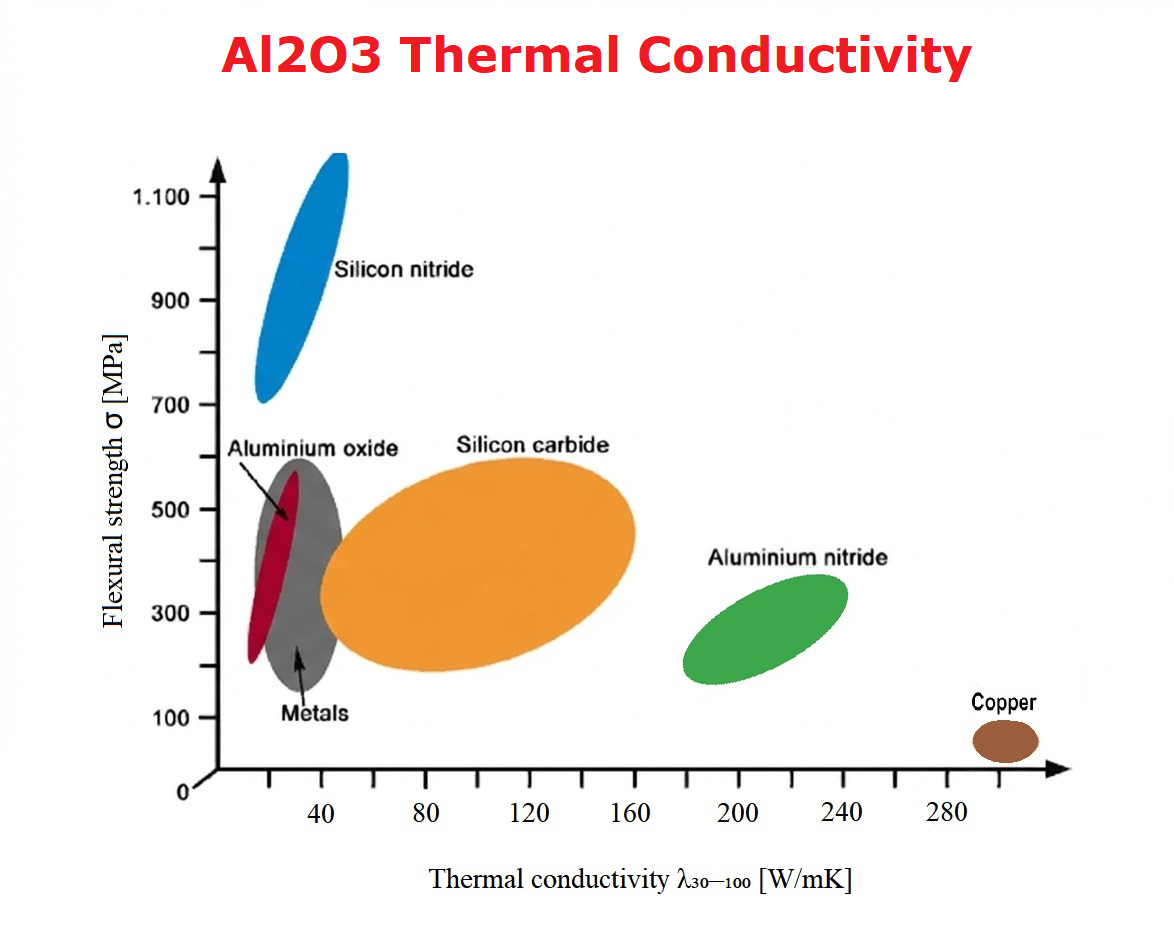
- Al₂O₃ thermal conductivity: 20–30 W/m·K
- AlN thermal conductivity: 140–180 W/m·K
However, alumina remains popular due to:
- Much lower cost
- Easier processing
- Higher chemical stability
- Better supply chain availability
Is Al₂O₃ Thermal Conductivity Enough for High-Power Applications?
Yes—within defined limits.
Alumina ceramic substrates are well-suited for:
- Medium-power LED lighting
- Automotive ECUs
- Industrial power supplies
- RF modules
- Thick-film hybrid circuits
However, for:
- Extremely high power density
- High-frequency power switching
- Advanced EV power modules
Materials like AlN or direct-bonded copper (DBC) may be more appropriate.
What Factors Affect Al₂O₃ Thermal Conductivity?
Several variables influence actual thermal performance:
- Purity Level – Higher Al₂O₃ content improves heat transfer
- Grain Size – Larger, uniform grains reduce phonon scattering
- Porosity – Lower porosity increases conductivity
- Sintering Process – Temperature and dwell time matter
- Thickness – Thinner substrates dissipate heat faster
- Metallization Layer – Copper or silver thickness impacts heat spreading
A well-manufactured 99% alumina substrate can outperform poorly processed higher-grade materials.
How Does Al₂O₃ Compare with AlN and BeO in Thermal Performance?
|
Material |
Thermal Conductivity (W/m·K) |
Cost |
Safety |
|
Al₂O₃ |
20–30 |
Low |
Excellent |
|
AlN |
140–180 |
High |
Excellent |
|
BeO |
250–330 |
Very High |
Toxic |
Why Al₂O₃ is still dominant:
- Best cost-to-performance ratio
- No toxicity concerns
- Mature manufacturing ecosystem
- Stable electrical insulation
What Are Common Applications Relying on Alumina Thermal Conductivity?
Al₂O₃ ceramic substrates are widely used in:
- LED lighting modules
- Ceramic PCBs for power electronics
- Automotive sensor substrates
- Hybrid ICs
- Thick-film and thin-film circuits
- Power resistors
- RF and microwave components
- Industrial heating elements
These applications benefit from moderate thermal conductivity combined with excellent insulation.
How to Choose the Right Alumina Ceramic Based on Thermal Requirements?
When selecting an alumina ceramic substrate, consider:
- Power density (W/cm²)
- Operating temperature
- Heat sink integration
- Electrical isolation requirements
- Cost constraints
- Reliability standards (AEC-Q, MIL, etc.)
General guideline:
- ≤10 W/cm² → 96% Al₂O₃
- 10–20 W/cm² → 99% Al₂O₃
- ≥20 W/cm² → Consider AlN or DBC
Why Choose Bstceramic as Your Al₂O₃ Ceramic PCB Manufacturer?
Bstceramic specializes in high-performance alumina ceramic substrates and ceramic PCBs, offering:
- 96% & 99% Al₂O₃ substrates
- Custom thickness and dimensions
- DPC / DBC / thick-film metallization
- Tight thermal conductivity control
- ISO-certified manufacturing
- Support for prototyping to mass production
Whether you need cost-effective alumina ceramic PCBs or high-reliability thermal solutions, Bstceramic delivers consistent quality and engineering support.
 Products
 About us
 Contact us