


















































 HOME
HOME


-

Ceramic PCB for Humanoid Robot joint actuators
2026 04,07 -
LTCC PCB Surprises: What Most People Miss
2025 12,09 -
Step-by-Step Guide to DPC PCB Design for Sensor Systems
2025 12,03 -
Ceramic PCBs Essential Benefits and Applications
2025 12,01 -
How Al2O3 DPC Ceramic Substrate PCB Enhances Heat Dissipation in Modern Electronics?
2025 11,28 -
How to Choose Between Ceramic, FR4, and Metal Core PCBs
2025 11,27 -
DPC Ceramic PCB Materials: Surprising Science Inside
2025 11,26 -
Wire bondable 2-layer Alumina substrates PCB | Bstceramic PCB
2025 09,22 -
Silicon Nitride Substrate, Silicon Nitride Ceramic Substrate Formula
2025 05,08 -
What is thick film ceramic PCB?
2023 08,02
Ceramic PCB RFQ Checklist: Files and Specifications Needed for an Accurate Quote
Published:
What Do We Need to Quote a Ceramic PCB?
For most projects, the quotation package should include the following:
| RFQ Item | Information to Provide |
|---|---|
| Manufacturing files | Gerber/ODB++, drill data, fabrication drawing |
| Ceramic substrate | Al₂O₃, AlN, Si₃N₄, or open for recommendation |
| Substrate thickness | Nominal thickness and tolerance |
| Metallization | DPC, DBC/DCB, AMB, thin film, thick film, or open |
| Copper | Finished thickness and number of sides |
| Board dimensions | Overall size, holes, slots, cutouts |
| Fine features | Minimum line width and spacing |
| Surface finish | Required finish or downstream assembly process |
| Testing | Electrical, dimensional, reliability requirements |
| Quantity | Prototype, pilot, and production volume |
| Lead time | Target delivery date |
This information is usually enough for engineering to review the project and identify any missing requirements before pricing.
Ceramic PCB RFQ File Checklist
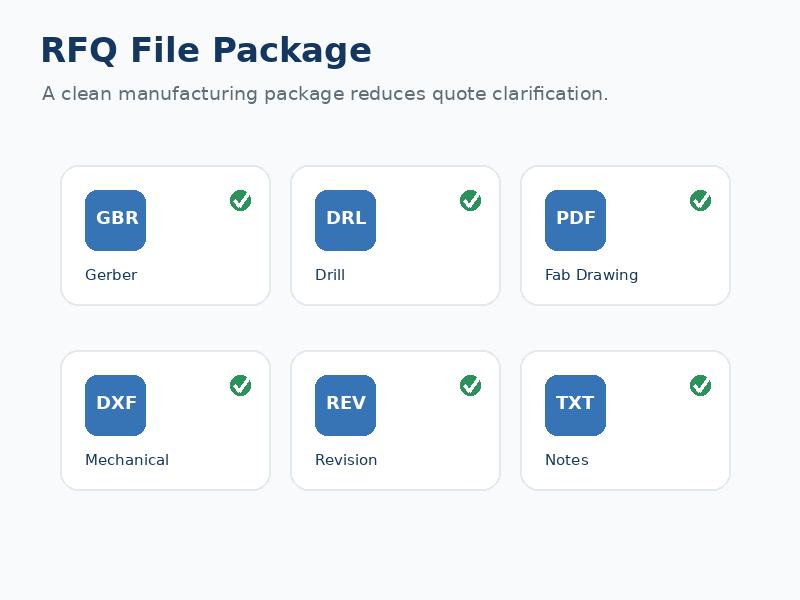
A complete manufacturing package should normally include:
- Gerber or Gerber X2
- ODB++ if available
- NC drill data
- Fabrication drawing
- Mechanical drawing or DXF
- Netlist if required
- Current part number and revision
- Special process or construction notes
The fabrication drawing should define information that cannot be read reliably from the artwork, such as:
- Ceramic material
- Ceramic thickness
- Copper thickness
- Metallization technology
- Critical dimensions
- Tolerances
- Flatness
- Surface finish
- Testing requirements
Make sure the revision shown on the drawing matches the Gerber and mechanical files.
What Ceramic Substrate Information Should You Provide?
“Ceramic PCB” is not a complete material specification.
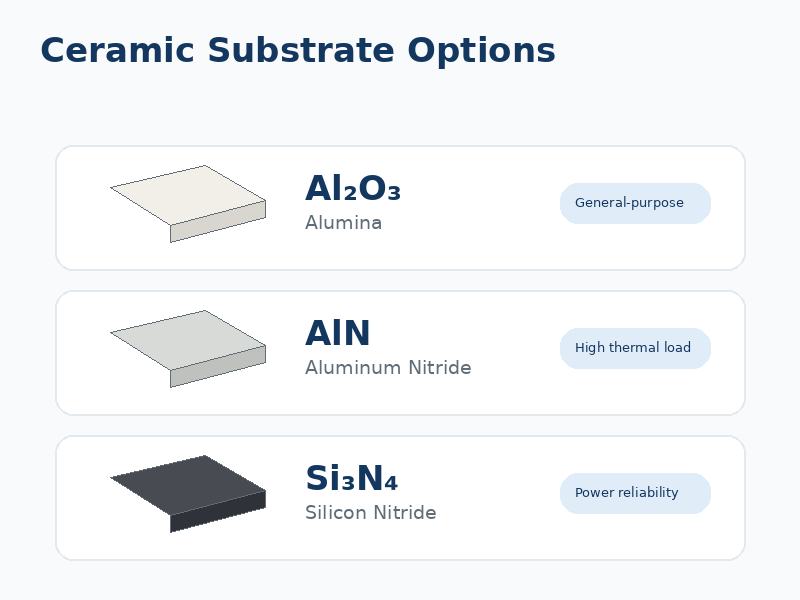
The RFQ should identify the ceramic material when it has already been selected.
Common options include:
| Material | Typical Use |
| Al₂O₃ | General ceramic circuits requiring electrical insulation and moderate thermal performance |
| AlN | Higher-power applications requiring better heat dissipation |
| Si₃N₄ | Demanding power modules requiring strong thermal and mechanical reliability |
Also specify:
- Material grade or purity, if controlled
- Substrate thickness
- Thickness tolerance
- Required thermal conductivity, if critical
- Electrical insulation requirement
- Single-sided or double-sided construction
If the material is still open, provide the operating power, current, voltage, temperature, thermal load, mechanical conditions, and assembly method.
What Metallization and Copper Requirements Should Be Defined?
Ceramic circuits can use different metallization technologies, including:
- DPC
- DBC/DCB
- AMB
- Thin film
- Thick film
These processes differ in copper construction, feature capability, thermal performance, and cost.
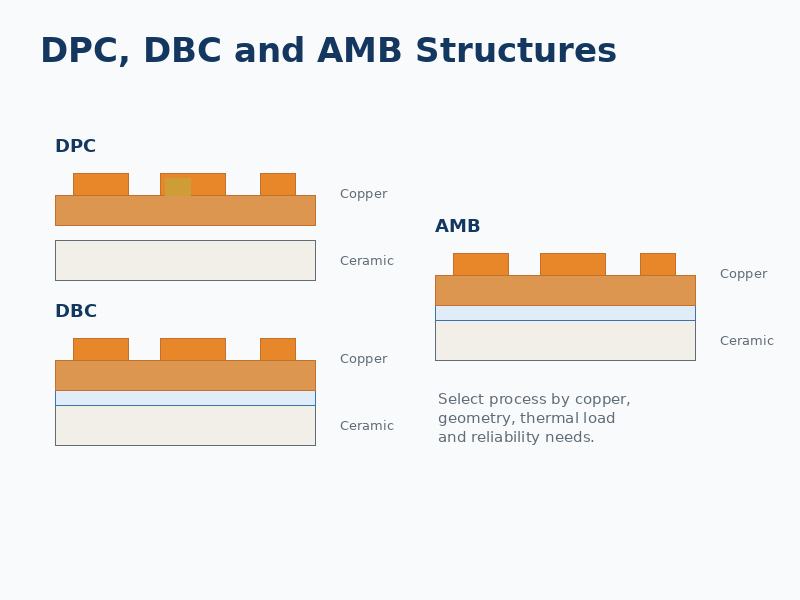
If the process is fixed, state it clearly.
For example:
AlN substrate, 0.635 mm, double-sided DPC, finished copper 70 μm.
At minimum, provide:
- Finished copper thickness
- Single-sided or double-sided copper
- Minimum line width
- Minimum spacing
- Current requirement
- Metallized hole requirements
If the process is not fixed, provide the required finished copper, geometry, electrical load, and application so the manufacturer can review the most suitable process.
What Dimensions, Tolerances, and Special Features Matter?
Critical mechanical requirements should be shown clearly on the fabrication drawing.
Typical items include:
- Overall board dimensions
- Ceramic thickness
- Hole diameter
- Hole position
- Slots
- Cutouts
- Irregular outlines
- Laser scribing
- Flatness
- Edge condition
- Allowable chipping, if controlled
Only apply tight tolerances where they are functionally necessary.
A mounting hole may need close positional control, while a non-critical outer edge may not. Excessively tight tolerances can increase manufacturing difficulty and inspection cost without improving the final assembly.
Which Ceramic PCB Design Rules Should Be Confirmed Before Quotation?
There is no single set of ceramic PCB design rules that applies to every ceramic technology.
Manufacturing limits vary with:
- Ceramic type
- Metallization process
- Copper thickness
- Substrate thickness
- Board size
- Hole structure
- Mechanical processing
The main parameters to confirm are:
| Parameter | Why It Matters |
| Minimum line width | May determine the suitable metallization process |
| Minimum spacing | Affects patterning capability |
| Copper thickness | Influences current capacity and achievable geometry |
| Hole size | May require different drilling or metallization processes |
| Copper-to-edge distance | Affects manufacturing margin |
| Board size | Influences material utilization |
| Critical tolerances | Affect process control and inspection |
For prototype projects, a DFM review before production can identify features that may increase cost or reduce yield.
Tell Us How the Ceramic PCB Will Be Assembled
The downstream assembly process can affect the required surface finish.
Tell the manufacturer if the board will be used for:
- SMT soldering
- Die attach
- Aluminum wire bonding
- Gold wire bonding
- Silver sintering
- Probe contact
- Power module assembly
Possible surface finishes may include:
- ENIG
- ENEPIG
- Nickel/gold
- Silver
- Bare or protected copper
- Application-specific bonding finishes
If the finish has already been qualified, specify it directly.
If not, provide the assembly or bonding method so the manufacturer can confirm compatibility.
What Testing and Quality Requirements Should Be Included?
State any non-standard inspection or reliability requirements during the RFQ stage.
Typical requirements include:
- Electrical continuity test
- Isolation or Hi-pot test
- Dimensional report
- Copper thickness measurement
- Plating thickness report
- Flatness inspection
- Crack or chip inspection
- Adhesion or peel testing
- Solderability
- Thermal cycling
- Material certificate
- Certificate of Conformance
- Lot traceability
Separate qualification testing from routine production inspection.
For example:
Prototype: thermal cycling + dimensional report
Production: electrical test + visual inspection + COC
This avoids adding unnecessary test cost to every production lot.
What Quantity and Lead-Time Information Should You Provide?
Quantity affects both setup cost and unit pricing.
A useful RFQ may include:
| Stage | Example Quantity |
| Prototype | 10 pcs |
| Pilot build | 100 pcs |
| Production | 500 pcs |
| Annual forecast | 5,000 pcs |
Also provide:
- Target prototype date
- Expected production timing
- Annual forecast
- Requested price breaks
If the project may enter production, include the expected volume even when the first order is only a prototype batch.
This helps the manufacturer evaluate both prototype feasibility and future production cost.
What Changes the Ceramic PCB Cost?
The main ceramic PCB cost drivers are:
| Cost Driver | Why It Affects Cost |
| Ceramic material | Different materials have different raw material and process costs |
| Substrate thickness | Non-standard thickness may affect sourcing |
| Metallization process | Different technologies require different production routes |
| Copper thickness | Heavier copper can increase process difficulty |
| Fine line/space | May require higher-precision processing |
| Board size | Affects material utilization |
| Holes and slots | Add laser or machining operations |
| Tight tolerances | Increase process and inspection requirements |
| Surface finish | Adds plating or finishing steps |
| Testing | Adds inspection time and reporting |
| Quantity | Changes setup cost per piece |
| Lead time | Expedite service may increase cost |
For an accurate ceramic PCB quote, send the actual design package rather than asking only for a general price per piece.
Ceramic PCB RFQ Template
Use this template for a new project.
Project Information
- Project name:
- Part number:
- Revision:
- Application:
Ceramic Substrate
- Ceramic material:
- Grade/purity:
- Substrate thickness:
- Board dimensions:
- Thermal requirement:
Circuit Construction
- Metallization process:
- Finished copper thickness:
- Single-sided / double-sided:
- Minimum line width:
- Minimum spacing:
- Hole requirements:
- Slots/cutouts:
Mechanical Requirements
- Critical dimensions:
- Critical tolerances:
- Flatness:
- Edge requirements:
Surface and Assembly
- Surface finish:
- Assembly method:
- Wire bonding / die attach requirements:
Quality
- Electrical testing:
- Dimensional inspection:
- Reliability testing:
- Required reports/certificates:
Commercial Information
- Prototype quantity:
- Production quantity:
- Annual forecast:
- Target lead time:
Attached Files
- Gerber:
- Drill:
- Fabrication drawing:
- Mechanical file:
- Other specifications:
Open Items
- Manufacturer recommendation requested for:
FAQs About Ceramic PCB RFQs
Are Gerber files enough for a ceramic PCB quote?
Usually not for a final production quote. The manufacturer also needs material, thickness, copper construction, tolerances, finish, quantity, and testing requirements.
What if I do not know which ceramic material to use?
Provide the operating power, thermal load, current, voltage, temperature, mechanical conditions, and assembly process. The manufacturer can then review the appropriate substrate material.
Do I need to specify DPC, DBC, or AMB?
Only if the process has already been selected. Otherwise, provide the copper thickness, line/space, thermal requirements, and application so the manufacturer can recommend a suitable process.
What has the biggest impact on ceramic PCB cost?
Material, metallization process, copper thickness, fine-line requirements, mechanical features, tolerances, testing, quantity, and lead time are usually the main cost drivers.
What should I provide for a ceramic PCB prototype quote?
Provide the manufacturing files, substrate and copper requirements, prototype quantity, testing requirements, and target delivery date. Include expected production volume if the project may move into mass production.
Can I request a quote before the design is completely finalized?
Yes. Mark uncertain items as open for manufacturer recommendation and provide the performance requirements behind them.
Why does the manufacturer need to know the assembly process?
The assembly method can affect surface finish, pad design, metallization, and cleanliness requirements. A board intended for SMT soldering may require different finishing considerations from one intended for die attach or wire bonding.
What commonly delays a ceramic PCB quotation?
Typical causes include missing substrate material, undefined copper thickness, inconsistent file revisions, unclear tolerances, missing mechanical data, undefined testing requirements, or no quantity and delivery information.
 Products
 About us
 Contact us