


































 HOME
HOME


-

Ceramic PCB for Humanoid Robot joint actuators
2026 04,07 -
LTCC PCB Surprises: What Most People Miss
2025 12,09 -
Step-by-Step Guide to DPC PCB Design for Sensor Systems
2025 12,03 -
Ceramic PCBs Essential Benefits and Applications
2025 12,01 -
How Al2O3 DPC Ceramic Substrate PCB Enhances Heat Dissipation in Modern Electronics?
2025 11,28 -
How to Choose Between Ceramic, FR4, and Metal Core PCBs
2025 11,27 -
DPC Ceramic PCB Materials: Surprising Science Inside
2025 11,26 -
Wire bondable 2-layer Alumina substrates PCB | Bstceramic PCB
2025 09,22 -
Silicon Nitride Substrate, Silicon Nitride Ceramic Substrate Formula
2025 05,08 -
What is thick film ceramic PCB?
2023 08,02
What Temperature Can Ceramic Withstand? Ceramic Melting Point Fahrenheit
Published:
When customers ask what temperature can ceramic withstand, the real answer depends on the ceramic type, product structure, atmosphere, thermal cycling, and attached materials. A plain ceramic substrate may tolerate far higher heat than a complete ceramic PCB, because copper, metallization, solder joints, components, and surface finishes usually set the practical limit.
For PCB and PCBA projects, the question is rarely “Will the ceramic melt?” It is more often “Will the board remain electrically stable, mechanically reliable, and manufacturable at the required working temperature?” This article explains ceramic temperature resistance from a practical engineering and purchasing viewpoint.
What Temperature Can Ceramic Withstand?
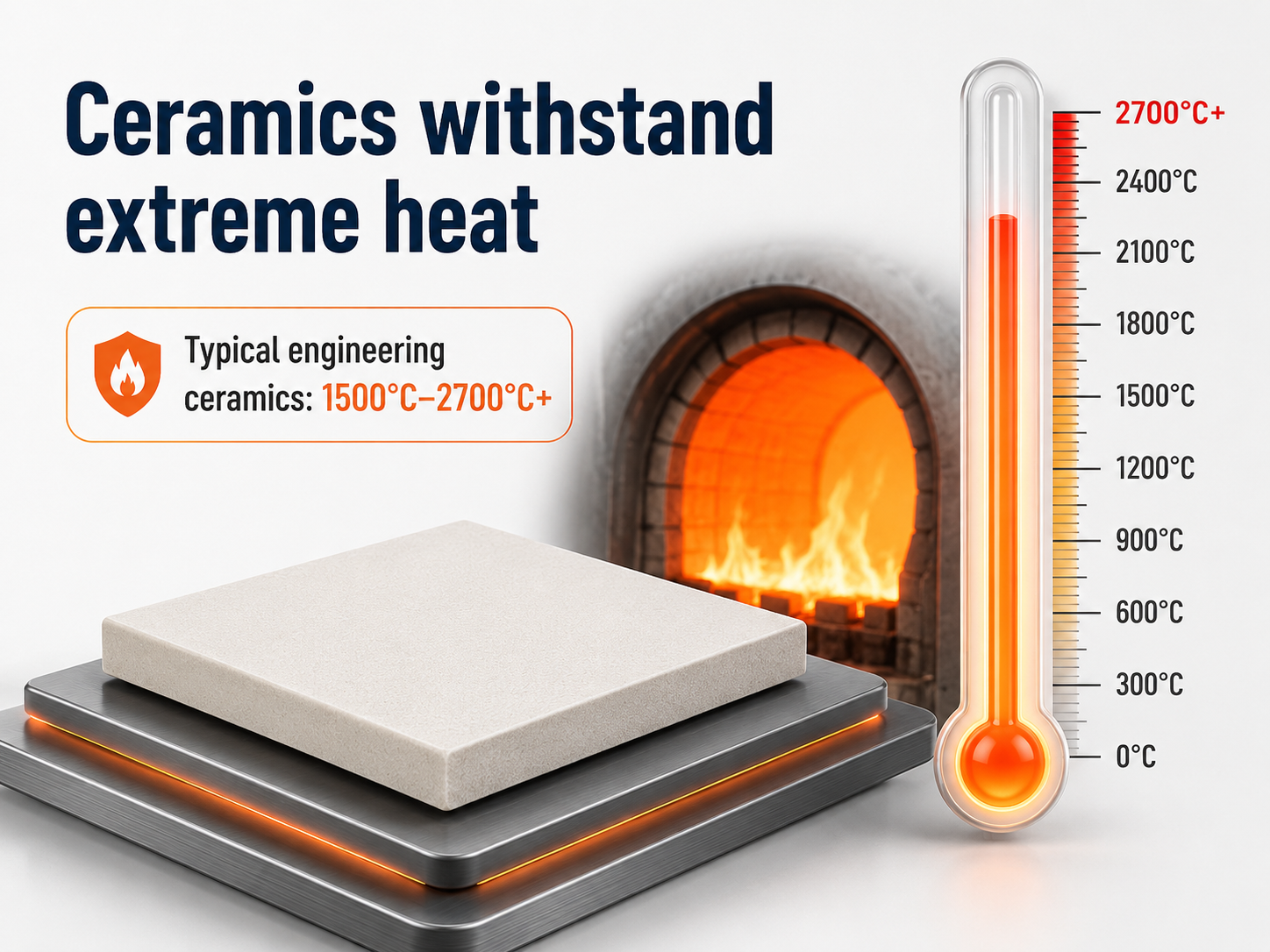
Most engineering ceramics can withstand much higher temperatures than plastics, FR4 laminates, and many metals. Common industrial ceramics often remain stable from several hundred degrees Celsius to more than 1,500°C, while ultra high temperature ceramics can work in environments above 2,000°C when properly designed.
However, “withstand” can mean different things:
| Meaning of “withstand” | What it really means in engineering | Why it matters |
|---|---|---|
| Short-term exposure | The material survives brief heat without cracking or melting | Useful for soldering, firing, brazing, or thermal shock tests |
| Continuous service temperature | The material works for long periods under heat | More important for real products |
| Melting point | The temperature where the material changes into liquid | Often much higher than the usable design limit |
| Thermal shock resistance | Ability to survive rapid heating or cooling | Critical for aerospace, furnaces, sensors, and power modules |
| Electrical stability at heat | Insulation, dielectric loss, and leakage remain controlled | Essential for ceramic PCB applications |
A ceramic part may have a melting point above 2,000°C but still fail earlier because of oxidation, phase change, thermal stress, or weak joining materials. For PCB use, the complete stack-up must be evaluated, not only the ceramic base.
Why Do Ceramics Handle High Temperatures?
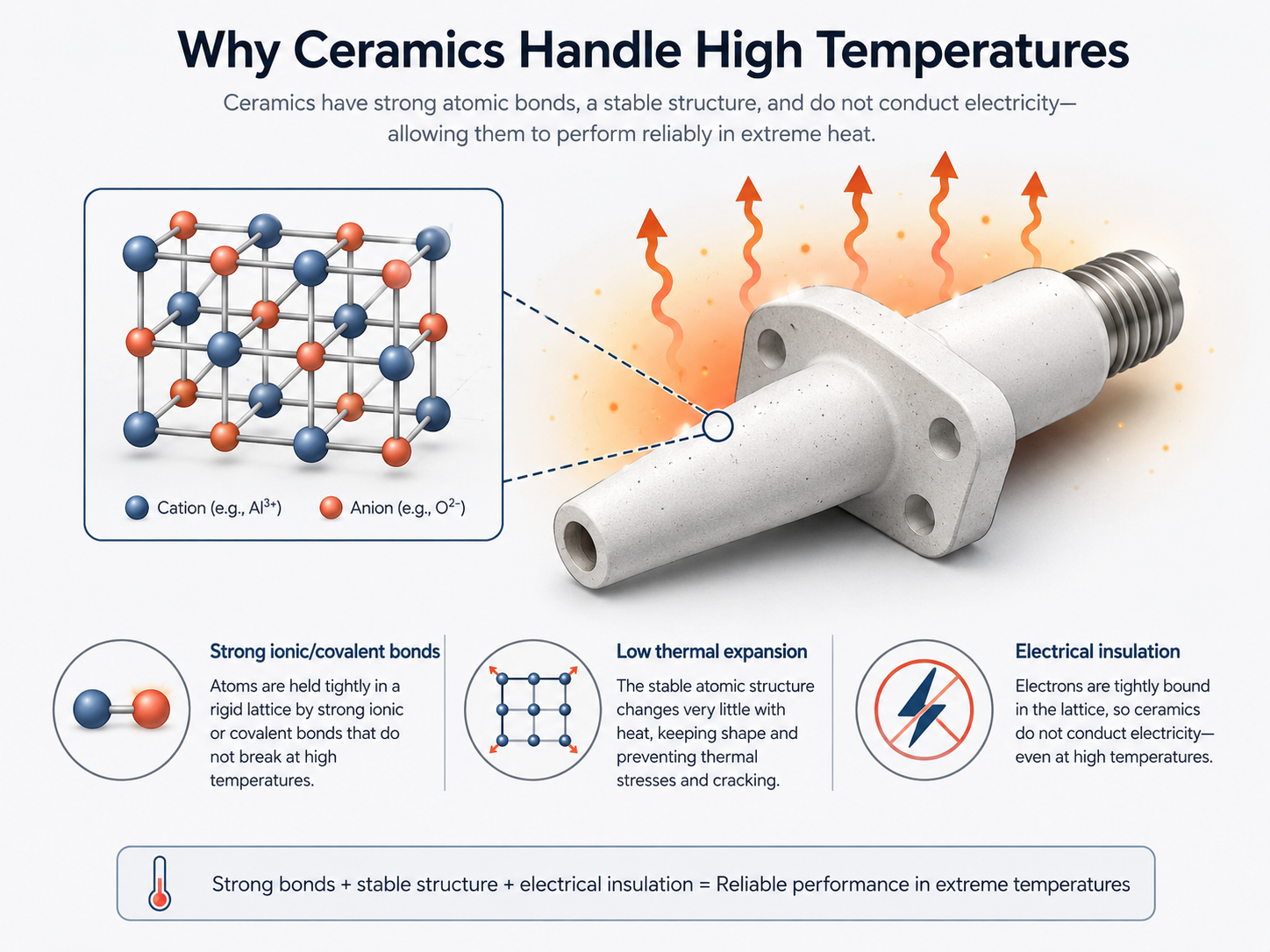
Ceramics handle high temperatures because their atoms are bonded by strong ionic and covalent bonds. These bonds require high energy to break, which gives ceramics high melting points, good hardness, and strong chemical stability.
Several properties make ceramics suitable for heat-heavy applications:
- High melting or decomposition temperature, especially in alumina, zirconia, silicon carbide, and diboride ceramics.
- Low thermal expansion, which reduces dimensional movement under heat.
- Good electrical insulation, even at elevated temperatures in many oxide ceramics.
- Chemical stability, especially in oxidizing or corrosive environments.
- High hardness and wear resistance, useful in furnace, aerospace, and industrial fixtures.
The trade-off is brittleness. Ceramics usually do not bend like metals. A ceramic part can survive very high heat but crack if the thermal gradient is too steep, the mounting design is too rigid, or the copper pattern creates uneven stress.
For ceramic PCB projects, thermal resistance is only one part of the decision. The design also needs suitable copper thickness, metallization adhesion, via structure, solder system, and component derating.
What Is the Melting Point of Common Ceramics?
Melting point is useful for material comparison, but it should not be used as the only design limit. The table below gives typical values for several well-known ceramics. Actual data can vary by purity, crystal phase, additives, porosity, and test method.
| Ceramic material | Typical melting point or high-temperature behavior | Typical use relevance |
| Alumina, Al₂O₃ | About 2,050–2,072°C / 3,722–3,762°F | Ceramic PCB substrates, insulators, furnace parts, wear parts |
| Mullite | About 1,850–1,890°C / 3,362–3,434°F | Kiln furniture, refractory parts, thermal shock applications |
| Zirconia, ZrO₂ | About 2,715°C / 4,919°F | Structural ceramics, sensors, thermal barrier coatings |
| Silicon carbide, SiC | Around 2,700°C / 4,892°F; often sublimates or decomposes rather than melting cleanly | Furnace parts, power semiconductor substrates, harsh environments |
| Zirconium diboride, ZrB₂ | About 3,247°C / 5,877°F | Ultra high temperature ceramics, aerospace leading edges |
| Hafnium diboride, HfB₂ | About 3,380°C / 6,116°F | Ultra high temperature ceramics, hypersonic and reentry applications |
Alumina is often reported around 2,050°C to 2,072°C, while ZrB₂ and HfB₂ are documented as ultra high temperature ceramics with melting points above 3,200°C.
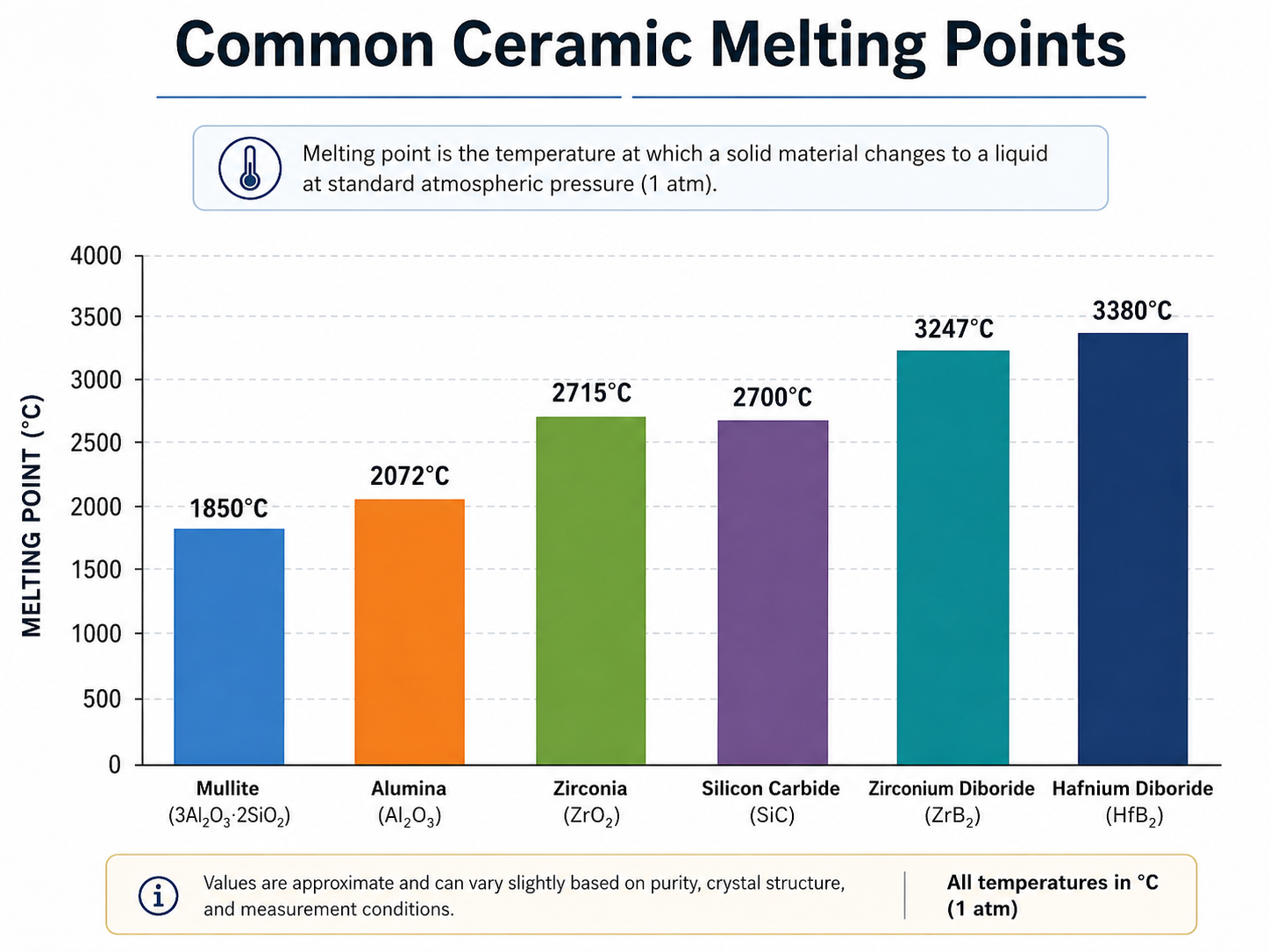
For customer decision-making, the practical takeaway is simple: a higher melting point does not automatically mean a better PCB material. Thermal conductivity, electrical insulation, copper bonding method, thermal cycling reliability, and cost often matter more.
What Is Ceramic Melting Point in Fahrenheit?
To convert ceramic melting point from Celsius to Fahrenheit, use this formula:
°F = °C × 9/5 + 32
Here are common ceramic melting point Fahrenheit values:
| Ceramic material | Celsius | Fahrenheit |
| Mullite | 1,850°C | 3,362°F |
| Alumina, Al₂O₃ | 2,072°C | 3,762°F |
| Silicon carbide, SiC | 2,700°C | 4,892°F |
| Zirconia, ZrO₂ | 2,715°C | 4,919°F |
| Zirconium diboride, ZrB₂ | 3,247°C | 5,877°F |
| Hafnium diboride, HfB₂ | 3,380°C | 6,116°F |
These Fahrenheit values are helpful for readers in the U.S. market, but they should be treated as material reference data, not final design limits. A ceramic PCB, ceramic package, or ceramic assembly may have a much lower allowable working temperature because of copper layers, solder joints, adhesives, surface finishes, or installed components.
What Temperature Can a Ceramic PCB Withstand?
A ceramic PCB can usually handle higher operating temperatures than FR4, but its real limit depends on the ceramic material and circuit construction. In many electronic projects, ceramic PCB temperature resistance is limited by metallization, solder, component ratings, and assembly materials rather than the ceramic substrate itself.
For practical purchasing, customers can think in these ranges:
| Ceramic PCB type | Practical temperature consideration | Common use case |
| Alumina ceramic PCB | Often selected for high insulation, moderate thermal conductivity, and stable heat resistance | LED modules, sensors, power electronics, heating circuits |
| Aluminum nitride ceramic PCB | Selected when high thermal conductivity is more important than low material cost | IGBT modules, laser diodes, high-power LEDs, RF power devices |
| Silicon nitride ceramic substrate | Selected for better mechanical toughness and thermal cycling reliability | EV power modules, traction inverters, demanding power packages |
| Thick-film ceramic circuit | Useful when resistor printing, heater patterns, or high-temperature metallization are needed | Ceramic heaters, sensors, industrial control |
| DBC / AMB ceramic substrate | Used for high-current and high-power modules with strong copper bonding | EV power modules, industrial power conversion |
In many ceramic PCB projects, a continuous working temperature around several hundred degrees Celsius may be more realistic than the substrate melting point. Some alumina ceramic PCB suppliers list operation around 350°C for certain constructions, while standard FR4 is usually governed by Tg values around 130–150°C, with high-Tg grades used when a higher margin is needed.
For quotation, customers should provide the expected continuous temperature, peak temperature, heating time, cooling rate, copper thickness, voltage, current, component type, and whether the environment is air, vacuum, inert gas, oil, or chemically active.
How Is Ceramic PCB Temperature Resistance Different from FR4 PCB?
The decision logic is straightforward: FR4 is cost-effective and suitable for most standard electronics, while ceramic PCB is used when heat, insulation, dimensional stability, or power density exceeds what organic laminates can comfortably handle.
| Factor | Ceramic PCB | FR4 PCB |
| Base material | Inorganic ceramic such as Al₂O₃, AlN, or Si₃N₄ | Glass fiber reinforced epoxy laminate |
| Heat resistance | Much higher substrate stability | Limited by resin Tg and decomposition behavior |
| Thermal conductivity | Higher, especially AlN and some ceramic substrates | Low, usually needs copper planes, vias, or heat sinks |
| Electrical insulation | Strong insulation at high temperature when properly designed | Good for standard electronics, but performance changes near and above Tg |
| Mechanical behavior | Hard, rigid, brittle | Tougher and easier to process |
| Cost | Higher material and processing cost | Lower cost and widely available |
| Best fit | Power modules, LEDs, sensors, RF, high-temperature electronics | Consumer electronics, control boards, communication devices, general PCBA |
Standard FR4 commonly has Tg around 130–150°C, while high-Tg FR4 uses higher-temperature resin systems. FR4 does not need to melt to become unreliable; above Tg, expansion increases and mechanical/electrical stability can drop.
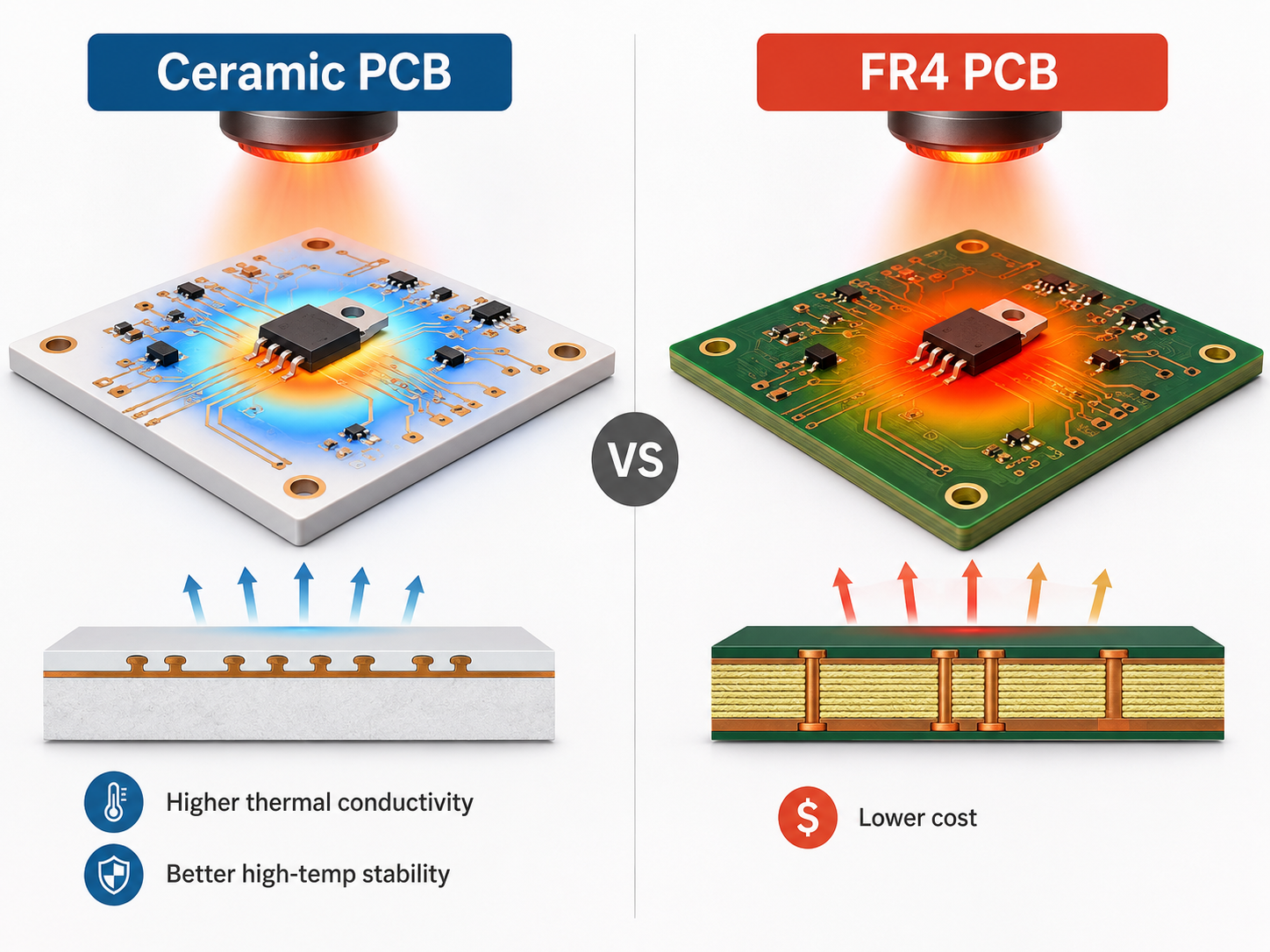
A ceramic PCB is not always necessary. If the product has moderate power, good airflow, enough copper area, and normal ambient temperature, FR4 or metal core PCB may be more economical. Ceramic becomes practical when the design needs high thermal conductivity, compact heat spreading, high insulation, low outgassing, or stable performance under elevated temperature.
What Ceramic PCB Materials Are Used for High-Temperature Applications?
The main ceramic PCB materials are alumina, aluminum nitride, and silicon nitride. Each material serves a different engineering purpose.
| Material | Main advantage | Limitation | Suitable customer projects |
| Alumina, Al₂O₃ | Balanced cost, insulation, heat resistance, mature processing | Lower thermal conductivity than AlN | LED, sensors, heaters, industrial electronics |
| Aluminum nitride, AlN | Very high thermal conductivity and CTE closer to silicon | Higher cost and process sensitivity | High-power LED, laser, IGBT, RF power |
| Silicon nitride, Si₃N₄ | Stronger toughness and thermal cycling resistance | Higher material and processing cost | EV power modules, automotive power electronics |
| Zirconia, ZrO₂ | High toughness and chemical stability | Lower thermal conductivity than AlN | Structural ceramic parts, special sensors |
| LTCC / HTCC ceramics | Multilayer ceramic interconnection and packaging | Design rules and materials differ from standard PCB | RF modules, ceramic packages, harsh-environment electronics |
AlN is widely valued in electronics because its thermal conductivity can be far higher than alumina, and it also offers electrical insulation. Kyocera notes that AlN can offer thermal conductivity up to 10 times higher than alumina in some ceramic material comparisons.
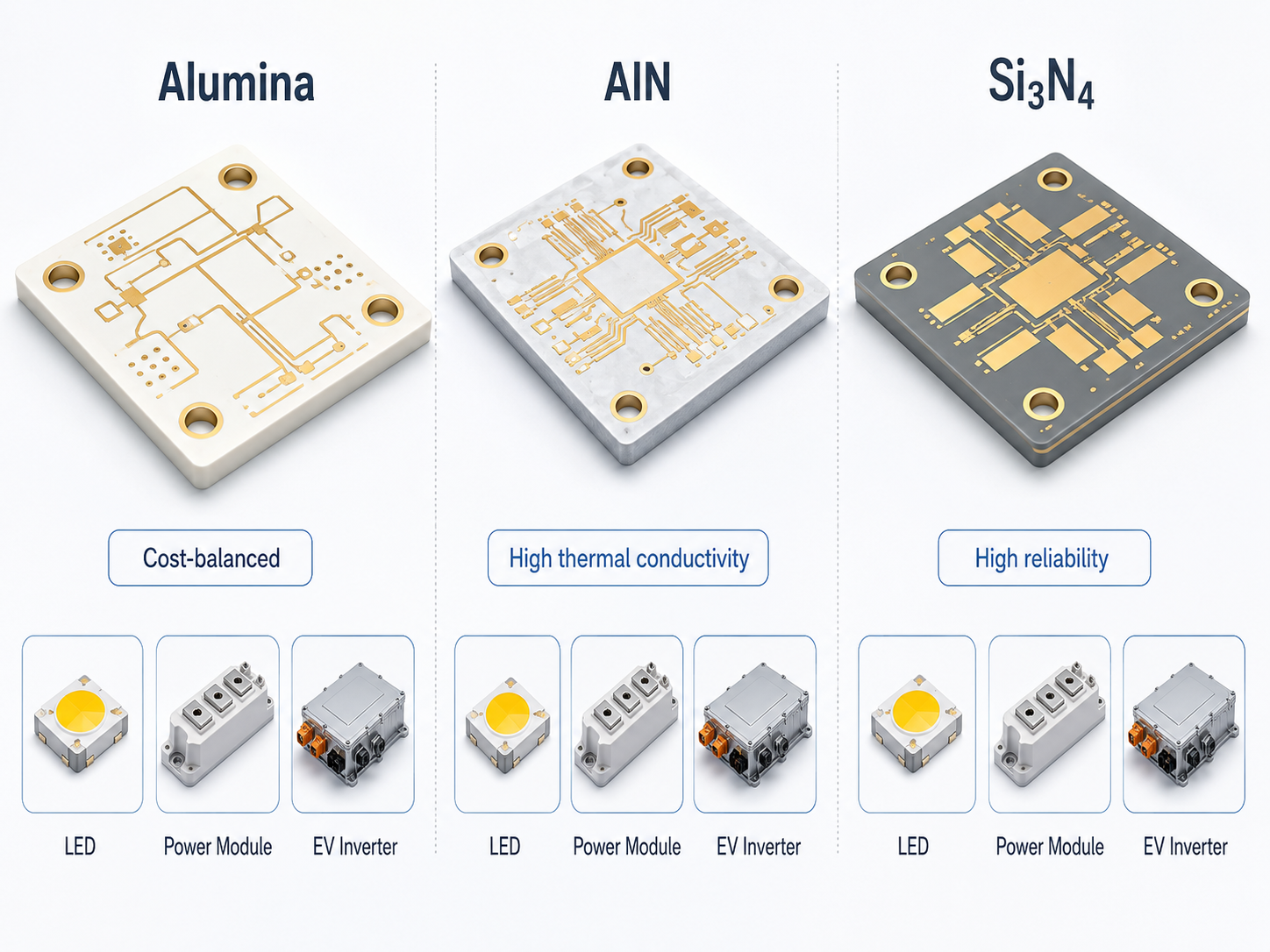
At BSTCeramicPCB material selection for ceramic PCB projects is usually reviewed together with copper structure, surface finish, via design, power density, and assembly requirements. This helps customers avoid overbuying an expensive material when alumina is enough, or under-specifying a substrate when AlN or silicon nitride is needed.
What Are Ultra High Temperature Ceramics?
Ultra high temperature ceramics, often called UHTCs, are advanced ceramic materials designed for extreme environments where conventional ceramics, metals, and polymers cannot survive. They usually include transition metal borides, carbides, and nitrides, such as ZrB₂, HfB₂, HfC, ZrC, and TaC.
UHTCs are not ordinary ceramic PCB materials. They are usually structural or thermal protection materials for environments above 2,000°C, especially where oxidation resistance, erosion resistance, and mechanical strength under heat are required.
Key features of ultra high temperature ceramics include:
- Melting points often above 3,000°C for some diborides and carbides.
- Good hardness and erosion resistance.
- Potential for use in sharp leading edges, nose tips, and thermal protection structures.
- Complex processing requirements, including densification, microstructure control, and oxidation-resistant additives.
NASA and Sandia reports identify zirconium diboride and hafnium diboride based ceramics as candidates for sharp leading edges and reentry or hypersonic thermal protection applications, with HfB₂ and ZrB₂ melting points above 3,000°C.
For electronics buyers, UHTCs are useful to understand, but they are rarely the first choice for ceramic PCB purchasing. Most ceramic PCB projects use alumina, aluminum nitride, silicon nitride, DBC, AMB, thick-film, LTCC, or HTCC technology instead.
Why Are Ultra High Temperature Ceramics Used in Aerospace Applications?
Ultra high temperature ceramics are used in aerospace because some flight conditions create intense aerodynamic heating, oxidation, and erosion at the same time. Sharp leading edges, nose tips, control surfaces, and hypersonic structures may see temperatures far beyond the range of typical alloys or polymer composites.
The aerospace value of UHTCs comes from three main points:
| Aerospace requirement | Why UHTCs help |
| Extreme surface temperature | Diboride and carbide ceramics can remain stable at temperatures above 2,000°C |
| Sharp leading edge design | High-temperature stability allows smaller radii than blunt thermal protection concepts |
| Oxidation and erosion resistance | UHTC composites can be engineered with additives such as SiC to improve surface protection |
| Low vapor pressure at high heat | Helps reduce material loss in extreme thermal environments |
| Structural stability | Useful where both heat and mechanical load are present |
NASA Tech Briefs describes UHTCs as materials of interest for hypersonic vehicle leading edges, where operating temperatures can exceed 2,000°C.
The limitation is not only temperature. Aerospace UHTC parts must also handle thermal shock, oxidation chemistry, manufacturing defects, and inspection requirements. A material with a very high melting point may still need careful composite design to survive real flight conditions.
What Applications Need High-Temperature Ceramic Materials?
High-temperature ceramic materials are used when standard metals, plastics, FR4 boards, or metal core PCBs cannot meet thermal, electrical, or chemical requirements.
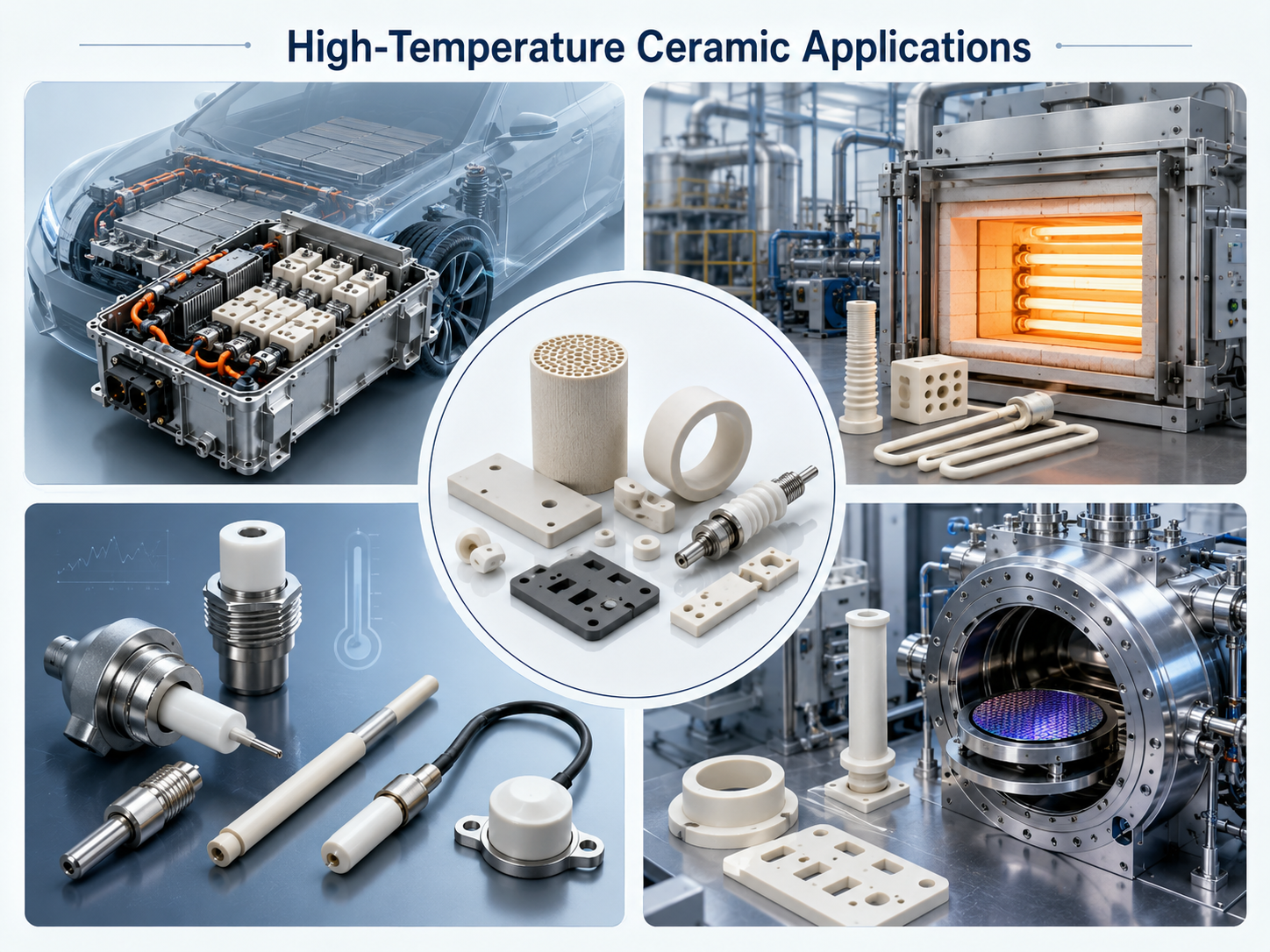
Common application areas include:
- Ceramic PCB and power electronics: high-power LEDs, laser diodes, IGBT modules, MOSFET modules, power converters, and RF power circuits.
- Automotive and EV systems: traction inverter substrates, battery management sensors, high-temperature control modules, and power module insulation.
- Aerospace and defense: thermal protection structures, sensor packages, high-temperature electronics, and hypersonic material systems.
- Industrial heating: ceramic heaters, heating plates, furnace sensors, ignition modules, and temperature control circuits.
- Medical and analytical equipment: stable ceramic substrates for devices requiring cleanliness, insulation, and dimensional stability.
- Semiconductor and vacuum equipment: ceramic insulators, packages, feedthrough-related structures, and low-outgassing components.
- Harsh-environment sensors: exhaust sensors, pressure sensors, oil and gas electronics, and high-temperature monitoring modules.
For PCB buyers, ceramic is worth considering when the design has one or more of these conditions: high power density, high local temperature, limited space for heat spreading, strong insulation requirements, thermal cycling, low outgassing, or long service life in harsh environments.
Before requesting a quote, prepare these details:
- Ceramic material preference, or the thermal/electrical target if the material is undecided.
- Board size, thickness, copper thickness, and layer count.
- Continuous and peak operating temperature.
- Voltage, current, power loss, and heat source location.
- Surface finish and assembly method.
- Thermal cycling profile and working atmosphere.
- Prototype quantity and expected mass production volume.
Conclusion
Ceramics can withstand high temperatures because of their strong atomic bonding, high melting points, and stable electrical insulation. Still, the right material depends on the actual product. Alumina is often practical and cost-balanced. AlN is better for high thermal conductivity. Silicon nitride is useful for demanding thermal cycling. Ultra high temperature ceramics serve extreme aerospace and structural environments, not typical PCB production.
For ceramic PCB or high-temperature PCBA projects, BSTCeramicPCB can help review material choice, manufacturability, copper structure, and quotation details before production. To discuss a project or request a quote, contact sales@bstceramicpcb.com
 Products
 About us
 Contact us