



















































 HOME
HOME


-

Ceramic PCB for Humanoid Robot joint actuators
2026 04,07 -
LTCC PCB Surprises: What Most People Miss
2025 12,09 -
Step-by-Step Guide to DPC PCB Design for Sensor Systems
2025 12,03 -
Ceramic PCBs Essential Benefits and Applications
2025 12,01 -
How Al2O3 DPC Ceramic Substrate PCB Enhances Heat Dissipation in Modern Electronics?
2025 11,28 -
How to Choose Between Ceramic, FR4, and Metal Core PCBs
2025 11,27 -
DPC Ceramic PCB Materials: Surprising Science Inside
2025 11,26 -
Wire bondable 2-layer Alumina substrates PCB | Bstceramic PCB
2025 09,22 -
Silicon Nitride Substrate, Silicon Nitride Ceramic Substrate Formula
2025 05,08 -
What is thick film ceramic PCB?
2023 08,02
96 vs 99.6 Alumina Substrate: Which Ceramic PCB Material Should You Choose?
Published:
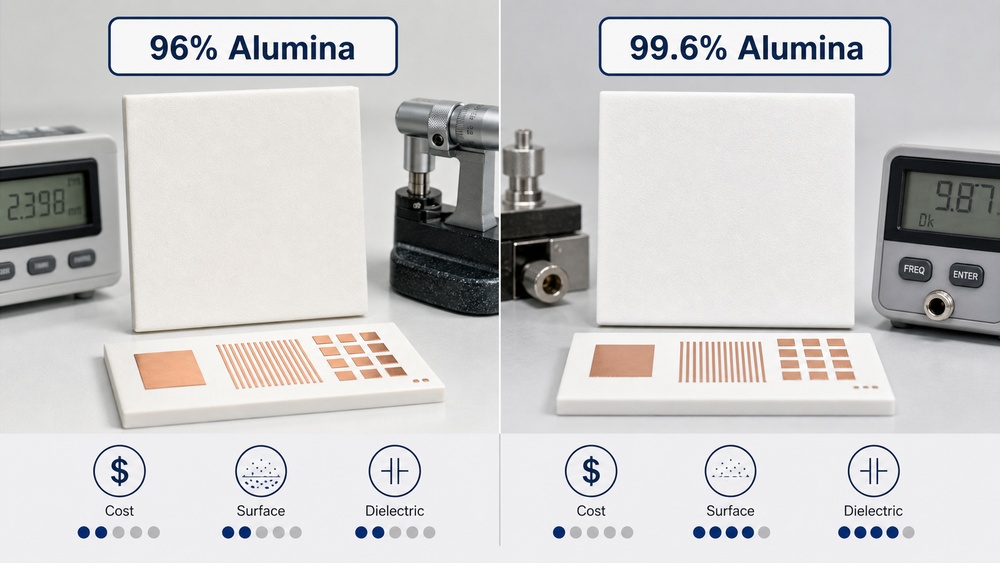
A 96 vs 99.6 alumina substrate comparison is usually not about choosing the highest purity by default. It is about matching ceramic purity, surface quality, dielectric behavior, copper metallization, cost and supply risk to the real operating conditions of a ceramic PCB or electronic substrate.
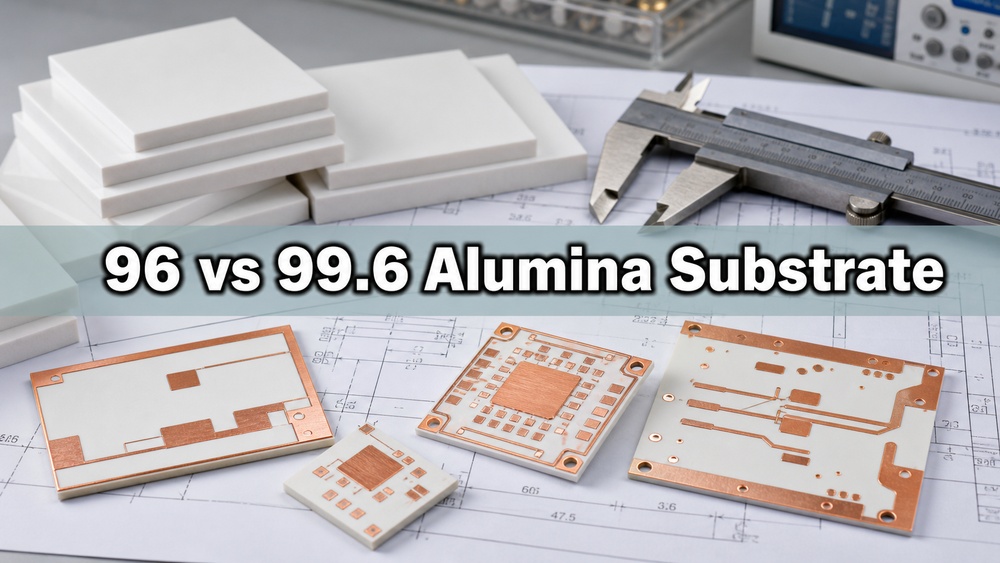
For most ceramic circuit projects, 96% alumina is the practical baseline because it is mature, economical and compatible with many thick film, DPC and ceramic PCB processes. 99.6% alumina becomes more attractive when the design needs better surface quality, lower dielectric loss, tighter high-temperature stability, cleaner material chemistry or a more controlled substrate for fine metallization. The best choice depends on what the substrate must do after copper, paste, vias, soldering and assembly are added.
What Is the Main Difference Between 96 and 99.6 Alumina Substrate?
The main difference is alumina purity and the amount of glassy phase or sintering additives in the ceramic body. A 96 alumina substrate is an engineering ceramic with enough Al2O3 content to provide good electrical insulation, mechanical strength and thermal stability while keeping cost and manufacturability under control. A 99.6 alumina substrate uses higher-purity alumina, which typically improves surface finish, dielectric loss behavior, chemical resistance and high-temperature consistency.
That does not mean 99.6% alumina is always the better ceramic PCB material. If the circuit uses broad conductors, moderate tolerances and a cost-sensitive production target, 96% alumina may deliver the required performance with shorter sourcing risk. If the circuit uses fine features, demanding insulation, high-frequency performance, vacuum compatibility or high-temperature exposure, the higher purity grade may be justified.
What Does 96 Alumina Substrate Mean?
A 96 alumina substrate usually means a fired ceramic body containing about 96% aluminum oxide with the remaining composition made of sintering aids and secondary phases. These additions help densification and process stability, which is one reason 96% alumina is widely used for electronic substrates, thick film circuits and many Alumina DPC ceramic substrate PCB applications.
Typical 96 alumina properties include good mechanical strength, high volume resistivity, a dielectric constant near the alumina range used in circuit design, and thermal conductivity that is much better than FR-4 but lower than AlN. Accuratus lists typical 96% alumina thermal conductivity at 25 W/mK, CTE at 8.2 x 10^-6/degC, dielectric constant at 9.0 at 1 MHz and flexural strength at 345 MPa. These figures are useful for comparison, but final values still depend on supplier formulation, thickness, surface finish and firing process.
What Does 99.6 Alumina Mean?
99.6 alumina means a higher-purity aluminum oxide ceramic with fewer secondary phases than standard 96% alumina. In practice, buyers look at 99.6% alumina when they need a smoother or cleaner ceramic surface, tighter material consistency, better high-temperature behavior, lower dielectric loss or a substrate suitable for demanding thin film, sensor, vacuum, RF-adjacent or precision electronic applications.
Many public material tables list 99.5% alumina rather than exactly 99.6%, so supplier data sheets must be checked before final design release. For reference, Accuratus lists typical 99.5% alumina thermal conductivity at 35 W/mK, CTE at 8.4 x 10^-6/degC, dielectric constant at 9.8 at 1 MHz and dissipation factor at 0.0002. These values show the direction of the difference: higher purity can improve several electrical and thermal parameters, but it also increases material and processing cost.
How Do 96 and 99.6 Alumina Properties Compare?
The most useful comparison is not one single property. Material selection should be based on the properties that affect the circuit failure mode: heat flow, dielectric margin, metallization adhesion, surface roughness, dimensional tolerance and cost. The table below uses typical public material data as a practical engineering reference, not as a substitute for a supplier-controlled data sheet.
| Selection Factor | 96 Alumina Substrate | 99.6 Alumina Substrate | Engineering Basis |
| Cost and availability | Usually more economical and widely available | Higher cost and sometimes longer sourcing lead time | Use 96% when performance margin is already enough. |
| Thermal conductivity | Often around the mid-20 W/mK range depending on grade | Can be higher in high-purity grades, supplier dependent | Check whether the ceramic layer is actually the thermal bottleneck. |
| Dielectric behavior | Good insulation for many ceramic PCB circuits | Often better for lower loss or tighter dielectric control | Use 99.6% when loss, leakage or insulation consistency is critical. |
| Surface quality | Suitable for many thick film and DPC structures | Better fit for finer metallization or smoother surface requirements | Define roughness and line/space before selecting the grade. |
| Manufacturing risk | Mature and practical for many production programs | May require tighter process control and higher material cost | Ask the supplier to review yield risk before quoting. |
How Different Are Their Thermal Conductivity and CTE Values?
Thermal performance depends on ceramic thickness, copper thickness, copper area, heat source size and the interface to the heat sink. Moving from 96% to high-purity alumina may improve through-substrate heat transfer, but it will not solve a poor copper layout, excessive dielectric thickness or an inefficient thermal interface.
CTE is also important because the ceramic must work with copper, solder, die attach materials, baseplates and component packages. The CTE difference between 96% and 99.6% alumina is usually not the largest design driver, but it matters when the circuit sees thermal cycling, large copper coverage or constrained mounting. For severe cycling, the discussion may need to include AlN or Si3N4 rather than only two alumina grades.
How Do Dielectric Constant and Electrical Insulation Affect Selection?
Both 96% and 99.6% alumina are strong electrical insulators, which is why alumina remains common in ceramic PCB and substrate applications. The difference becomes more important when the circuit has high voltage spacing, high-frequency signal behavior, low leakage requirements or tight impedance expectations.
For power or insulation-focused designs, the specification should define operating voltage, test voltage, ceramic thickness, creepage and clearance rather than material purity alone. For signal or sensor designs, dielectric constant, dissipation factor, surface finish and metallization method should be reviewed together. A higher-purity substrate can help, but it should be chosen because the electrical requirement needs it, not because the percentage looks better on paper.
How Do Surface Finish and Metallization Requirements Change?
Surface finish is one of the practical reasons to consider 99.6% alumina. Fine-line metallization, thin film structures, dense pads and precision sensor circuits are more sensitive to ceramic surface roughness, flatness and local defects. If the copper or metal layer must be uniform across small features, the substrate surface becomes part of the circuit design.
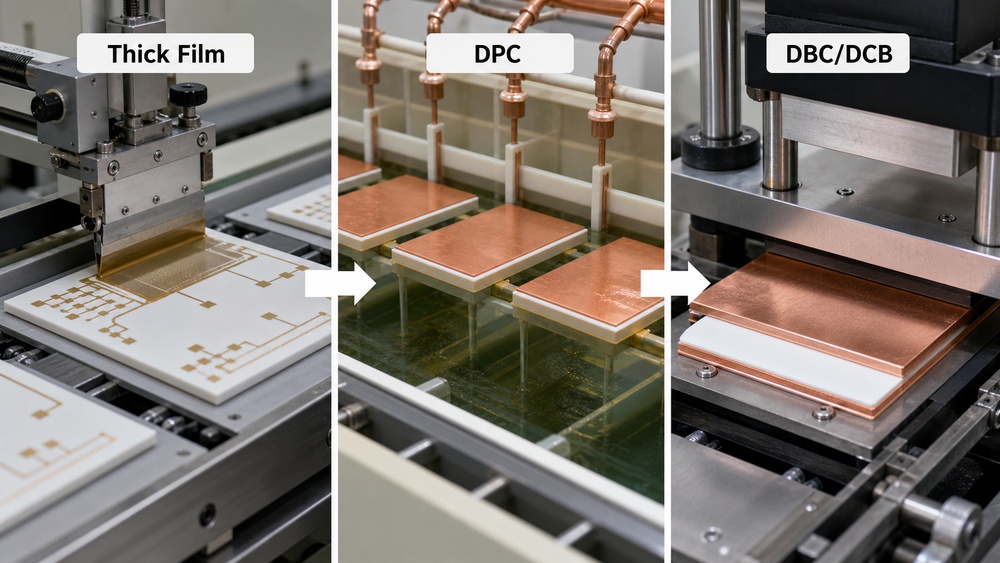
For thicker conductor patterns, heater traces, LED modules or robust industrial ceramic circuits, 96% alumina may be more than sufficient. For thin film ceramic PCB work, the RFQ should include surface roughness, flatness, conductor width, spacing, metal stack and inspection criteria. For DPC Al2O3 ceramic substrate circuit board projects, copper thickness, via plating and adhesion targets should be reviewed together with substrate grade.
Which Grade Works Better for Ceramic PCB Manufacturing?
For ceramic PCB manufacturing, 96% alumina is often the better starting point when the project needs reliable production, controlled cost and common processing routes. It is suitable for many thick film circuits, DPC ceramic boards, heater circuits, LED ceramic substrates, industrial controls and moderate-power electronic carriers.
99.6% alumina works better when the circuit is sensitive to surface quality, dielectric loss or contamination. It can be a stronger candidate for precision sensors, thin film metallization, vacuum-related assemblies, high-temperature measurement circuits, medical or analytical equipment, and selected high-reliability electronic substrates. The important step is to connect the material grade to a measurable requirement: not "better alumina," but better surface roughness, dielectric loss, temperature stability or process yield.
When Is 96 Alumina the More Practical Choice?
96 alumina is the more practical choice when the application needs a stable ceramic substrate without paying for purity that does not change the product outcome. This is common in prototypes, cost-sensitive production, moderate-power ceramic PCBs and circuits where conductor geometry is not extremely fine.
96% alumina is generally suitable when the design has enough thermal margin, standard insulation requirements, reasonable line/space, and no special vacuum or ultra-low-loss requirement. A 96% Al2O3 thick film ceramic substrate PCB is a good example of a practical ceramic circuit route when the performance target is clear and the project needs manufacturing efficiency.
When Is 99.6 Alumina Worth the Higher Cost?
99.6 alumina is worth the higher cost when the added purity reduces a real design or manufacturing risk. The most common reasons are finer metallization, smoother surface requirements, lower dielectric loss, higher material cleanliness, stronger high-temperature consistency or stricter electrical performance.
It may also be justified when a customer has already validated the design on high-purity alumina and wants to avoid requalification risk. In that case, changing to 96% alumina purely for cost reduction may create hidden costs in testing, reliability review or process adjustment. The correct decision is not only material price; it is the total cost of qualification, yield and field reliability.
How to Select Between 96 and 99.6 Alumina?
A practical selection process starts with the performance limit. If the limiting factor is cost, availability and standard ceramic PCB processing, 96% alumina is usually the first candidate. If the limiting factor is surface finish, dielectric loss, precision metallization or high-temperature stability, 99.6% alumina deserves review.
A documented 96 vs 99.6 alumina substrate selection should be supported by actual drawings, operating conditions and inspection requirements before production quotation.
| Project Condition | Recommended Starting Point | Engineering Basis |
| Standard ceramic circuit, moderate tolerance, cost focus | 96% alumina | Mature supply chain and stable processing for common ceramic circuits. |
| Fine-line metallization or thin film process | 99.6% alumina | Smoother surface and higher material consistency support finer metal features. |
| Moderate thermal load with stable mounting | 96% alumina | Thermal margin can be adequate when copper area and interface design are controlled. |
| Low-loss or high-precision electrical behavior | 99.6% alumina | Higher purity can support tighter dielectric performance. |
| Heavy copper power substrate | Review DBC/DCB, AlN or Si3N4 options | Cycling and heat-spreading risk may depend more on substrate structure than alumina purity. |
What RFQ Information Is Needed Before Quotation?
A useful RFQ should let the supplier judge material grade, metallization route and manufacturing risk. If the request only says "96 alumina" or "99.6 alumina," the quote may miss important cost drivers such as thickness tolerance, copper thickness, surface finish or test requirements.
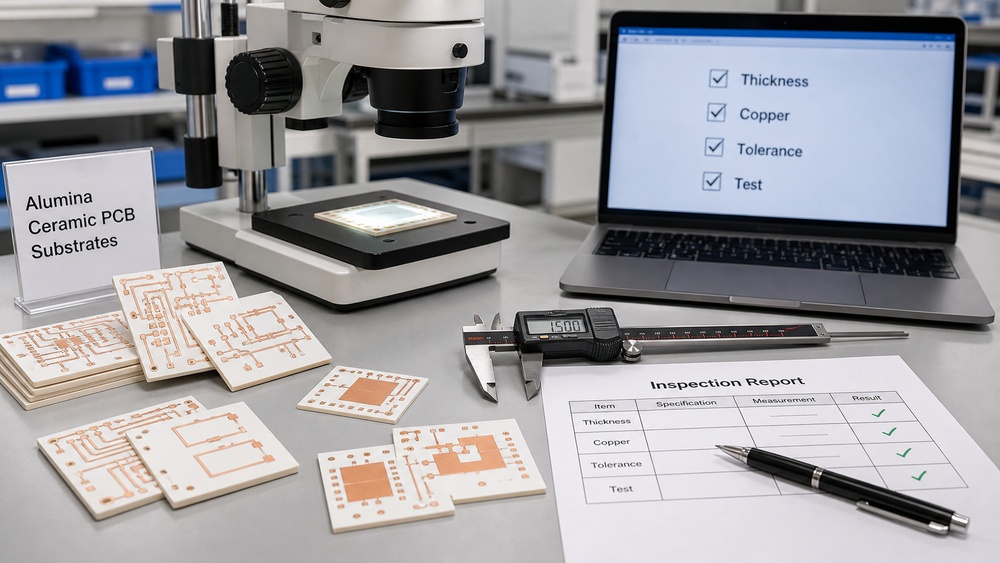
- Target substrate grade: 96% alumina, 99.6% alumina, or open for engineering review.
- Substrate thickness, outline size, hole size, slot details and dimensional tolerances.
- Metallization process: thick film, thin film, DPC, DBC/DCB or supplier recommendation.
- Copper or metal thickness, surface finish, conductor width, spacing and pad requirements.
- Operating voltage, dielectric test, insulation resistance and working temperature.
- Thermal load, mounting method, soldering or bonding process and expected environment.
- Prototype quantity, annual volume, inspection report needs and target lead time.
BSTCeramicPCB can review alumina ceramic substrate drawings for material grade, process route, copper design and quotation risk. For heavy copper or power applications, the review may also include DCB ceramic substrate PCB for power semiconductor structures when DPC or thick film is not the best fit.
FAQ About 96 vs 99.6 Alumina Substrate?
Is 99.6 alumina always better than 96 alumina?
No. 99.6% alumina can provide better purity-related performance, but 96% alumina is often more practical for standard ceramic PCB production. The right choice depends on surface finish, dielectric loss, operating temperature, cost and process route.
Does 99.6 alumina have higher thermal conductivity?
High-purity alumina grades often show higher thermal conductivity than standard 96% alumina, but values vary by supplier and density. Buyers should request the actual data sheet for the specific grade and thickness.
Is 96 alumina suitable for DPC ceramic PCB?
Yes, 96% alumina is commonly used for many DPC ceramic PCB applications when line width, copper thickness, via design and thermal load are within process capability.
When should I avoid choosing by purity alone?
Avoid choosing by purity alone when the real problem is copper layout, ceramic thickness, thermal interface, mounting stress or heavy copper cycling. In those cases, the full substrate structure matters more than the alumina percentage.
Can BSTCeramicPCB help compare 96 and 99.6 alumina for a project?
Yes. Send drawings, operating conditions, quantity, copper requirements and inspection needs to sales@bstceramicpcb.com. The engineering team can help review whether 96% alumina, 99.6% alumina or another ceramic substrate route is more realistic.
Conclusion
96% alumina is usually the practical choice for cost-sensitive ceramic PCB projects, standard thick film circuits, many DPC structures and moderate-performance electronic substrates. 99.6% alumina is better reserved for designs that need higher purity, smoother surface quality, tighter dielectric behavior or improved high-temperature consistency.
The best decision comes from the application requirement, not from the purity number alone. If you are comparing alumina substrate options for a ceramic PCB, send your drawing, substrate thickness, copper or metallization requirements, electrical test needs and quantity target to sales@bstceramicpcb.com. BSTCeramicPCB can review the material choice before quotation so the selected substrate matches the real manufacturing and reliability target.
 Products
 About us
 Contact us