






















































 HOME
HOME

-

Ceramic PCB for Humanoid Robot joint actuators
2026 04,07 -
LTCC PCB Surprises: What Most People Miss
2025 12,09 -
Step-by-Step Guide to DPC PCB Design for Sensor Systems
2025 12,03 -
Ceramic PCBs Essential Benefits and Applications
2025 12,01 -
How Al2O3 DPC Ceramic Substrate PCB Enhances Heat Dissipation in Modern Electronics?
2025 11,28 -
How to Choose Between Ceramic, FR4, and Metal Core PCBs
2025 11,27 -
DPC Ceramic PCB Materials: Surprising Science Inside
2025 11,26 -
Wire bondable 2-layer Alumina substrates PCB | Bstceramic PCB
2025 09,22 -
Silicon Nitride Substrate, Silicon Nitride Ceramic Substrate Formula
2025 05,08 -
What is thick film ceramic PCB?
2023 08,02
Alumina Density: Values, Grades and Ceramic PCB Performance
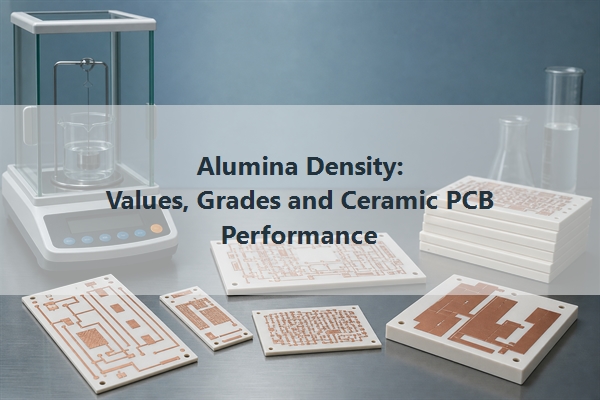
Alumina density is approximately 3.987 g/cm3 for pure alpha-alumina, while dense commercial ceramic grades commonly fall between about 3.6 and 3.95 g/cm3. The lower practical values reflect composition, sintering additives, and residual porosity. For ceramic PCB work, the correct number is the bulk density of the specified substrate grade, not the theoretical value of pure Al2O3 or the loose bulk density of alumina powder.
What Is the Density of Alumina?
The density of pure alpha-alumina is about 3.987 g/cm3 at room temperature. This equals approximately 3,987 kg/m3 or 0.144 lb/in3. A finished alumina ceramic substrate normally has a lower bulk density because it contains grain boundaries, sintering aids, secondary phases, and a small amount of residual porosity.
For PCB substrate calculations, use the value on the actual material data sheet. Representative commercial values are about 3.70-3.75 g/cm3 for many 94-96% alumina grades and about 3.85-3.92 g/cm3 for high-purity grades. These are typical ranges rather than universal specifications.
What Do Alumina Density Values Mean?
Different density terms describe different material states. A number is useful only when its definition and test method are known.
| Density term | What it describes | How to use it |
|---|---|---|
| Theoretical density | Density calculated for an ideal pore-free crystal structure; about 3.987 g/cm3 for alpha-Al2O3 | Reference value for phase analysis and relative-density calculations |
| Bulk density of sintered ceramic | Mass divided by the external volume of a finished ceramic, including internal pores | Use for substrate mass, incoming inspection, and comparison of the same material grade |
| Apparent solid density | Density of the solid portion under a defined liquid-displacement method | Use with the applicable standard and porosity result |
| Relative density | Measured bulk density divided by an agreed theoretical density, expressed as a percentage | Useful for judging densification when composition and reference density are controlled |
| Powder bulk density | Mass of loose or tapped powder divided by the container volume | Relevant to powder handling, not finished PCB substrate mass |
Alpha-alumina is the stable dense phase used for conventional fired alumina substrates. Gamma-alumina and activated alumina are porous, high-surface-area materials. Their powder or particle density figures should not be substituted for a dense alpha-alumina ceramic sheet.
Alumina Density by Purity Grade
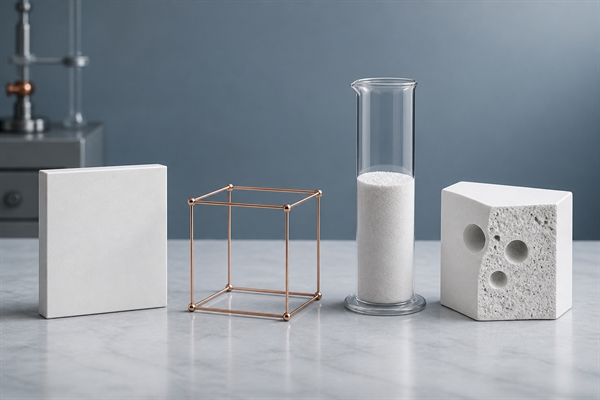
Purity is a useful first indicator, but it does not determine density by itself. Formulation, glass phase, grain structure, and firing conditions also matter. The following values are representative of published commercial data and should not replace a supplier-specific data sheet.
| Alumina material | Representative density | Practical interpretation |
|---|---|---|
| 94% alumina | About 3.70 g/cm3 | General technical ceramic with more secondary phase than high-purity grades |
| 96% alumina | About 3.70-3.75 g/cm3 | Common thick-film and general ceramic PCB substrate grade |
| 99-99.5% alumina | About 3.85-3.92 g/cm3 | Lower secondary-phase content and typically higher densification |
| 99.8-99.9% alumina | About 3.90-3.97 g/cm3 | High-purity material for demanding electrical, chemical, or surface requirements |
| Sapphire / single-crystal Al2O3 | About 3.97-3.99 g/cm3 | Nearly pore-free single crystal; not equivalent to a polycrystalline PCB substrate |
CoorsTek alumina data lists densities from roughly 3.70 g/cm3 for lower-purity technical grades to about 3.92 g/cm3 for high-purity materials. KYOCERA fine-ceramic material data shows a similar grade-dependent pattern. Differences between suppliers are normal because material codes are complete formulations, not purity percentages alone.
Why Does Alumina Density Vary?
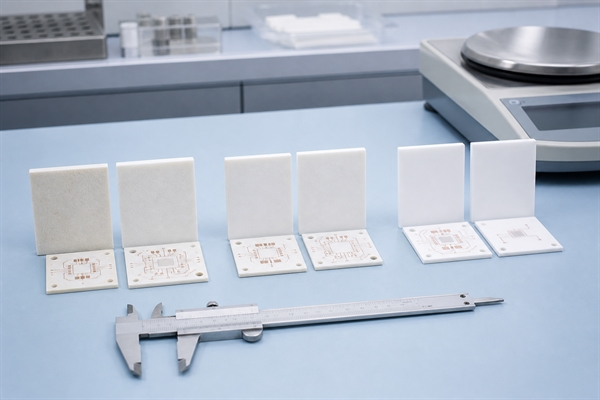
Finished density varies because both composition and processing control the final solid-to-pore ratio.
- Purity and additives: Lower-purity alumina contains glass-forming or mineral phases that change the theoretical density of the complete formulation.
- Green-body packing: Powder size distribution, granulation, binder content, and pressing uniformity determine how much shrinkage and pore removal are required during firing.
- Sintering profile: Peak temperature, hold time, atmosphere, and heating or cooling rates affect grain growth and pore closure.
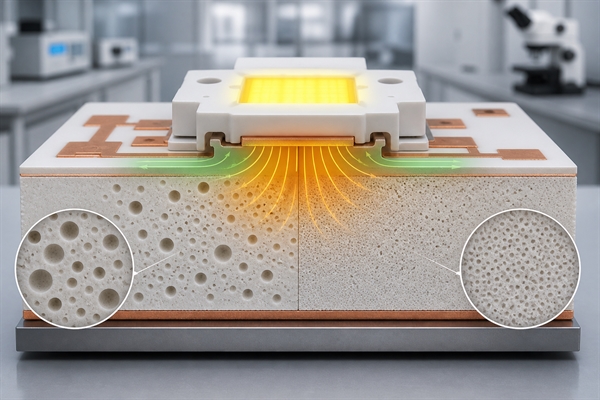
- Residual porosity: Closed and open pores reduce measured bulk density. Local pore clusters can also create weak or electrically inconsistent areas.
- Grain structure: Excessive grain growth can trap pores, while inadequate sintering leaves particle boundaries insufficiently bonded.
- Test method and temperature: Geometric and liquid-displacement methods can produce different results if edges, surface pores, coatings, or moisture are not handled consistently.
How Is Alumina Density Measured?
Regular, fully dense coupons can be checked by measuring dry mass and accurately calculating external volume. This geometric method is simple, but thickness variation, edge chamfers, holes, and surface roughness can introduce meaningful error in thin substrates.
Liquid displacement is preferred when the shape is irregular or when porosity information is required. ISO 18754:2020 covers bulk density, apparent solid density, apparent porosity, and geometric bulk density for fine ceramics. Its liquid-displacement method uses Archimedes' principle. The report should identify the method, immersion liquid, specimen conditioning, temperature, and whether surface-connected pores were included.
The basic geometric equation is:
Density = dry mass / external volume
Relative density requires another documented value:
Relative density (%) = measured bulk density / agreed theoretical density x 100
The agreed theoretical density must match the complete ceramic formulation. Dividing a 96% alumina substrate value by the pure alpha-Al2O3 density can be a useful approximation, but it is not a substitute for a formulation-specific reference.
How Does Alumina Density Affect Ceramic PCB Performance?
Density matters because it is an indicator of composition and porosity, but it is not a stand-alone performance specification.
| PCB concern | Density-related effect | What still needs separate verification |
|---|---|---|
| Substrate mass | Higher bulk density increases mass at the same dimensions | Actual thickness, outline, holes, metallization, and attached components |
| Mechanical reliability | Low density within one grade can indicate porosity or incomplete sintering | Flexural strength, fracture toughness, edge quality, and mounting stress |
| Thermal path | Pores interrupt heat flow, so improved densification often supports more consistent conductivity | Purity, grain boundaries, temperature, copper coverage, interface materials, and heat-sink design |
| Electrical insulation | Porosity and secondary phases can influence dielectric strength and leakage behavior | Dielectric strength, volume resistivity, dielectric constant, test voltage, frequency, and temperature |
| Metallization | Surface and near-surface pores can affect printed paste, plated copper, and adhesion uniformity | Surface roughness, cleanliness, metallization process, adhesion test, and thermal cycling |
| Dimensional consistency | Density variation can signal nonuniform shrinkage across a fired ceramic lot | Thickness tolerance, flatness, camber, hole position, and lot sampling |
For a simple mass example, a 50 x 50 x 0.635 mm bare substrate has a volume of 1.5875 cm3. At 3.72 g/cm3 it weighs about 5.91 g; at 3.90 g/cm3 it weighs about 6.19 g. The difference is only 0.29 g per piece, but it accumulates across large arrays or high-volume assemblies.
Density control is relevant in practical products such as a 96% Al2O3 thick-film ceramic substrate, a 96% alumina DPC substrate for sensors, and an alumina DPC ceramic substrate for LED modules. In each case, the material grade and metallization process must be qualified together.
How Does Alumina Compare with Other Ceramic Substrate Materials?
Density is useful for mass estimates, but it should not be treated as a performance ranking. Each substrate material solves a different thermal, mechanical, and cost problem.
| Material | Typical density | Main PCB selection reason | Important boundary |
|---|---|---|---|
| 96% alumina | About 3.70-3.75 g/cm3 | Balanced cost, insulation, stability, and broad process compatibility | Lower thermal conductivity than AlN |
| High-purity alumina | About 3.85-3.92 g/cm3 | Improved purity, surface, and electrical or thermal consistency | Higher purity does not automatically justify its cost in every circuit |
| Aluminum nitride | About 3.26-3.33 g/cm3 | Much higher thermal conductivity with electrical insulation | Material and metallization cost are higher; moisture handling matters |
| Silicon nitride | About 3.20-3.30 g/cm3 | High fracture toughness and thermal-cycle durability | Different metallization, availability, and cost profile |
| Zirconia | About 5.7-6.1 g/cm3 | High toughness and wear resistance | Low thermal conductivity and substantially higher mass |
What Density Should Be Specified for an Alumina PCB Substrate?
Specify the material grade first, then use density as one acceptance characteristic. A defensible material specification identifies the alumina purity or supplier grade, nominal substrate thickness, density definition, minimum or typical value, test method, and sampling basis. If porosity is critical, specify apparent porosity separately.
Do not use density as a shortcut for thermal conductivity, dielectric strength, flexural strength, or surface finish. Those properties require their own limits because two materials with similar bulk density can have different glass phases, grain structures, and electrical behavior.
For ceramic PCB manufacturing, the specification should also separate substrate requirements from circuit requirements. Copper or fired-paste thickness, adhesion, surface finish, flatness, hole quality, edge clearance, and thermal-cycle testing are not determined by alumina density alone.
What Are Common Alumina Density Specification Mistakes?
- Using 3.99 g/cm3 for every alumina substrate. This is the pure alpha-alumina reference, not a universal commercial ceramic value.
- Comparing powder bulk density with sintered density. Loose or tapped powder includes interparticle voids and may be far below the finished ceramic value.
- Assuming density proves purity. A measured number cannot identify the complete chemistry or additive system.
- Omitting the test method. Geometric and immersion methods can differ, especially for thin, porous, coated, or irregular specimens.
- Ignoring temperature and conditioning. Density data should normally be compared at a consistent room-temperature condition.
- Using density as the only quality check. A substrate can meet density while failing flatness, surface, strength, dielectric, or metallization requirements.
- Over-specifying high purity. A 96% grade may already meet the circuit's thermal, electrical, and reliability needs; a higher-density grade should solve a defined requirement.
What Are the Most Common Alumina Density Questions?
What is alumina density in kg/m3?
Pure alpha-alumina is about 3,987 kg/m3. A 96% alumina substrate is commonly around 3,700-3,750 kg/m3, while high-purity commercial grades are often around 3,850-3,920 kg/m3.
What is alumina density in g/cm3?
The theoretical alpha-Al2O3 value is about 3.987 g/cm3. Dense commercial alumina ceramics typically range from about 3.6 to 3.95 g/cm3 depending on grade and porosity.
What is alumina density in lb/in3?
Pure alpha-alumina is approximately 0.144 lb/in3. A 96% substrate at 3.72 g/cm3 is about 0.134 lb/in3, and a 3.90 g/cm3 high-purity grade is about 0.141 lb/in3.
What is the density of 96% alumina?
Many 96% alumina ceramic grades are approximately 3.70-3.75 g/cm3. Use the selected supplier's material code because additives and firing processes vary.
Is alumina ceramic brittle?
Yes. Alumina is hard and strong in compression but has limited fracture toughness compared with metals or zirconia. Density control reduces pore-related defects, but it does not make alumina immune to edge damage, impact, or mounting stress.
Is alumina considered a ceramic?
Yes. Alumina, or aluminum oxide, is an oxide ceramic widely used for electrical insulation, wear resistance, structural parts, and electronic substrates.
How hard is alumina ceramic?
Alumina is a very hard technical ceramic, but hardness depends on purity, grain structure, and test method. Density alone cannot establish a hardness value; the material data sheet should state the applicable Vickers or Knoop result.
Is alumina bulk density the same as sintered density?
For a fired ceramic part, bulk density usually means the mass divided by its external volume and is often described as sintered bulk density. Powder bulk density is a different property and must be labeled separately.
What is relative density in alumina?
Relative density is the measured bulk density divided by an agreed theoretical density, multiplied by 100%. The reference density must match the material composition for the result to be meaningful.
Does higher density always mean better alumina?
No. Within the same formulation, unexpectedly low density can indicate excess porosity. Across different grades, however, density changes with chemistry as well as porosity, so material suitability must be judged by all required thermal, electrical, mechanical, and manufacturing properties.
What Is the Practical Takeaway?
Alumina density is about 3.987 g/cm3 for pure alpha-Al2O3, but a real ceramic PCB substrate should be calculated and inspected using its grade-specific bulk density. For most PCB decisions, the useful questions are whether the value matches the named grade, how it was measured, and whether porosity, thermal, electrical, surface, and metallization requirements are controlled separately. To review an alumina substrate and circuit stack together, contact BSTCeramicPCB at sales@bstceramicpcb.com.
 Products
 About us
 Contact us