




















































 HOME
HOME

-

Ceramic PCB for Humanoid Robot joint actuators
2026 04,07 -
LTCC PCB Surprises: What Most People Miss
2025 12,09 -
Step-by-Step Guide to DPC PCB Design for Sensor Systems
2025 12,03 -
Ceramic PCBs Essential Benefits and Applications
2025 12,01 -
How Al2O3 DPC Ceramic Substrate PCB Enhances Heat Dissipation in Modern Electronics?
2025 11,28 -
How to Choose Between Ceramic, FR4, and Metal Core PCBs
2025 11,27 -
DPC Ceramic PCB Materials: Surprising Science Inside
2025 11,26 -
Wire bondable 2-layer Alumina substrates PCB | Bstceramic PCB
2025 09,22 -
Silicon Nitride Substrate, Silicon Nitride Ceramic Substrate Formula
2025 05,08 -
What is thick film ceramic PCB?
2023 08,02
Alumina Heat Conductivity: Values, Grades and PCB Applications
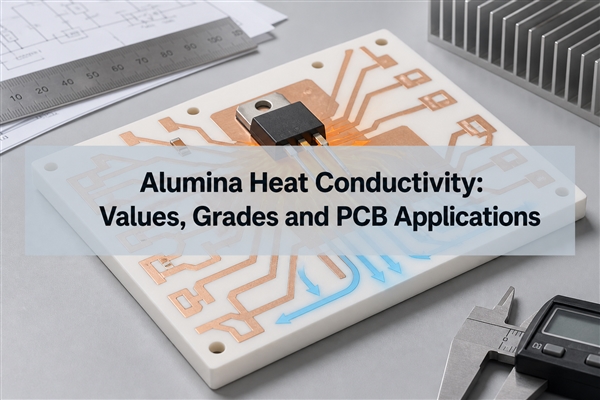
Alumina heat conductivity is typically about 20 to 30 W/m.K for electronic-grade ceramic PCB substrates at room temperature. The useful value, however, is the value for the specified alumina grade at the operating temperature, not a generic number copied from a material table. Purity, additives, porosity, test method, substrate thickness, metallization, and interface quality all affect the thermal result of a finished circuit.
What Is Alumina Heat Conductivity?
Heat conductivity, more formally thermal conductivity, measures how readily heat travels through a material. It is expressed in watts per meter-kelvin, written as W/m.K. A higher number means the material creates less resistance to heat flow when thickness and heat-transfer area are unchanged.
Alumina, or aluminum oxide (Al2O3), conducts heat much better than standard PCB laminates while remaining electrically insulating. This combination is why alumina is widely used as a ceramic PCB substrate. It can carry conductive traces and components while moving heat toward a heat sink without creating an electrical path through the ceramic.
Thermal conductivity is a bulk material property. It does not predict junction temperature by itself. The complete heat path also includes the component attach layer, copper or conductor paste, ceramic thickness, thermal interface material, baseplate, heat sink, airflow, and contact quality.
What Values Are Typical for PCB-Grade Alumina?
Room-temperature values differ by supplier and grade. The ranges below are suitable for early comparison, but the approved material data sheet should control design and purchasing.
| Alumina grade | Representative room-temperature range | Practical PCB interpretation |
|---|---|---|
| 90-95% Al2O3 | About 13-22 W/m.K | Economical grades; verify additives, electrical properties, and surface quality |
| 96% Al2O3 | About 24-26 W/m.K | Common balance of thermal performance, process compatibility, and cost |
| 97-99% Al2O3 | About 26-30 W/m.K | Useful when a specific grade also improves strength, finish, or dielectric performance |
| 99.5-99.9% Al2O3 | About 26-35 W/m.K | High-purity grades; the exact formulation matters more than the purity label alone |
Two datasheets can list different values for the same nominal purity without either being incorrect. Compare temperature, density, test method, surface condition, and product form before treating the numbers as equivalent.
Does Higher Alumina Purity Always Improve Heat Conductivity?
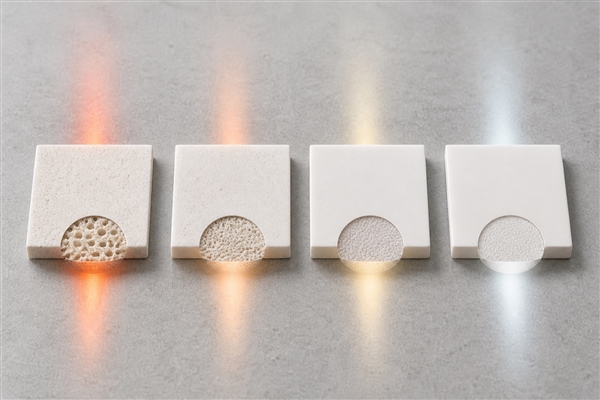
Not in a predictable straight line. Increasing alumina content generally reduces low-conductivity glassy phases, but the final value also depends on grain structure, pore content, sintering aids, density, and processing history. One 99.6% substrate may be rated at 26 W/m.K while another high-purity grade is rated at 30 W/m.K or above.
For ceramic PCB purchasing, purity should therefore be a material identifier rather than the only acceptance criterion. Specify both the grade and the minimum thermal conductivity required under stated conditions. If surface roughness, dielectric loss, flexural strength, or metallization adhesion also matters, include those requirements separately; a higher thermal value does not guarantee improvement in every property.
How Does Temperature Change Alumina Thermal Conductivity?
Alumina thermal conductivity normally decreases as temperature rises because increased lattice vibration scatters the phonons that carry heat through the ceramic. A room-temperature value should not be used unchanged in a high-temperature thermal model.
This matters when a board sees a cold start, soldering cycle, repeated power pulses, or continuous elevated operation. Request a conductivity-versus-temperature curve when the operating range is wide or the junction-temperature margin is small. At minimum, compare values at room temperature and near the highest steady-state substrate temperature.
Specific heat capacity is a different property. It describes how much energy is required to raise the material temperature; thermal conductivity describes how fast heat can move through it. Both affect transient heating, but they cannot be substituted for each other.
How Does Alumina Compare with AlN, Si3N4, and FR4?
Material selection should follow the limiting requirement. Alumina is attractive when moderate-to-good heat spreading, electrical insulation, proven metallization, and cost control matter together. AlN is selected when heat flux is the dominant constraint, while Si3N4 is often considered when mechanical reliability under power cycling is critical.
| Substrate material | Representative thermal conductivity | Electrical insulation | Main selection logic |
|---|---|---|---|
| FR4 | About 0.3-0.5 W/m.K through thickness | Yes | Low-cost circuitry without concentrated heat flux |
| Alumina Al2O3 | About 20-30 W/m.K for common PCB grades | Yes | Cost-effective ceramic circuits, sensors, LEDs, and moderate-power modules |
| Silicon nitride Si3N4 | Commonly about 60-90 W/m.K | Yes | High toughness and thermal-cycle reliability |
| Aluminum nitride AlN | Commonly about 140-200 W/m.K | Yes | Compact high-power devices requiring much lower ceramic thermal resistance |
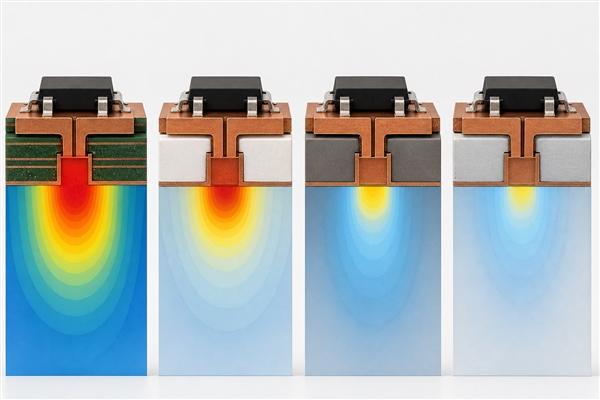
Do not choose solely from the conductivity column. CTE match, fracture toughness, dielectric loss, copper-bonding process, available thickness, surface finish, minimum feature size, and total cost can change the result.
Which PCB Applications Suit Alumina?
Alumina works best where a conventional laminate cannot provide enough heat transfer or electrical isolation, but the design does not justify the cost of AlN. Common applications include:
- LED modules and lighting controls with a defined heat path to the housing;
- power supplies, gate drivers, and moderate-power IGBT or MOSFET circuits;
- thick-film resistors, heaters, automotive sensors, and industrial control circuits;
- RF and microwave carriers that require stable geometry and a qualified low-loss alumina grade;
- medical and analytical equipment where electrical isolation, chemical stability, and dimensional control are required;
- laser-diode and optoelectronic assemblies when the device heat load remains within the alumina stack's verified thermal budget.
The correct question is not whether alumina is "thermally conductive." It is whether the complete board keeps the hottest device below its temperature limit at worst-case power, ambient temperature, and interface condition.
How Do DPC, DBC, and Thick-Film Structures Change Heat Flow?
Metallization can spread heat laterally before it enters the ceramic, but each process creates a different conductor thickness and interface structure.
| Construction | Thermal-path characteristic | Best-fit design situation |
|---|---|---|
| DPC | Fine plated features and controlled copper thickness support compact routing and local heat spreading | LEDs, sensors, optoelectronics, and precision circuits |
| DBC/DCB | Thick bonded copper spreads heat and carries high current, but copper balance and edge stress need review | IGBT, MOSFET, rectifier, inverter, and power-module circuits |
| Thick film | Fired conductor, resistor, and dielectric pastes enable integrated functions; paste conductivity is lower than bulk copper | Sensors, heaters, resistor networks, and industrial electronics |
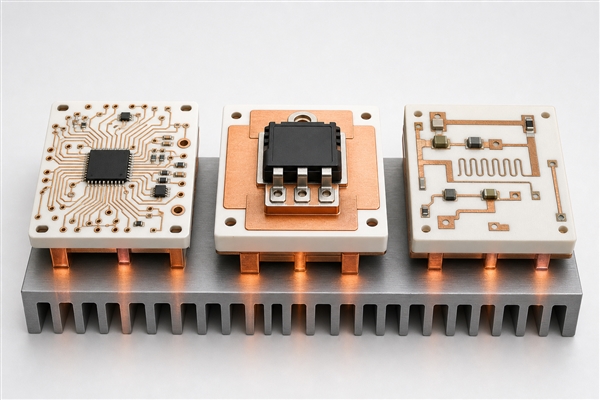
A DPC Al2O3 ceramic substrate circuit board for a cooler is relevant when fine features and a localized heat source must share a compact substrate. For high-current devices, a DBC ceramic substrate PCB for IGBT semiconductors uses thicker copper to improve current capacity and lateral heat spreading. A 96% Al2O3 thick-film ceramic substrate is more suitable when fired conductors or functional resistor layers are part of the circuit.
When Is Alumina Not Conductive Enough?
Alumina becomes a weak choice when the ceramic layer dominates the thermal resistance and the temperature margin cannot be recovered through geometry, copper spreading, interface improvement, or a larger heat-transfer area. This often occurs with compact high-power laser diodes, dense GaN or SiC devices, very small die footprints, and modules with strict junction-temperature or temperature-uniformity limits.
Use a first-pass resistance check, R = t / (k x A), where t is ceramic thickness, k is thermal conductivity, and A is the effective heat-transfer area. The calculation is only a screen because real heat spreads in three dimensions, but it reveals whether changing from 25 W/m.K alumina to a much higher-conductivity material can materially reduce the bottleneck.
AlN is the usual next comparison when conductivity is the limiting factor. Si3N4 may be the better alternative when fracture toughness and repeated thermal or mechanical cycling matter more than achieving the highest possible conductivity.
What Should Be Specified for an Alumina Ceramic PCB Quote?
An actionable drawing and prototype specification should identify:
- alumina grade or approved material family, nominal purity, and minimum thermal conductivity;
- conductivity test temperature or required conductivity curve;
- substrate length, width, thickness, dimensional tolerances, flatness, and warpage;
- DPC, DBC/DCB, thick-film, or thin-film construction;
- copper or conductor thickness, circuit pattern, minimum line/space, and edge clearance;
- holes, slots, laser features, metallized vias, and singulation method;
- surface finish, solderability, wire-bonding, or die-attach requirements;
- device power, heat-source footprint, operating temperature, assembly peak temperature, and cooling boundary;
- inspection, adhesion, dielectric, thermal-cycle, and traceability requirements;
- prototype and production quantities.
BSTCeramicPCB can use this information to review whether the requested conductivity grade, thickness, metallization, and tolerances are technically aligned before prototype release. A bare request for "high-conductivity alumina PCB" is not enough to select a controlled material or quote the correct process.
What Selection Mistakes Increase Cost or Thermal Risk?
- Treating the conductivity of ideal Al2O3 as the guaranteed value of a fired commercial substrate.
- Specifying only "96% alumina" without a grade, conductivity requirement, or temperature condition.
- Paying for high-purity alumina when 96% material already meets the thermal and electrical limits.
- Comparing substrate conductivity while ignoring ceramic thickness and heat-transfer area.
- Assuming thick copper automatically solves cooling without checking the attach layer, TIM, heat sink, and copper balance.
- Using room-temperature data for a board that operates continuously at elevated temperature.
- Substituting AlN without reviewing cost, machining, metallization, moisture handling, and mechanical requirements.
FAQ
Is alumina a good conductor of heat?
Alumina is a moderate thermal conductor and a strong electrical insulator. Common electronic grades conduct heat far better than FR4, but much less effectively than AlN.
What is the thermal conductivity of 96% alumina?
PCB-grade 96% alumina is commonly listed around 24-26 W/m.K at room temperature. Use the selected supplier grade's data sheet as the controlled value.
Is Al2O3 electrically conductive?
No. Dense alumina used for electronic substrates is electrically insulating. Its ability to conduct heat while blocking electrical current is a principal reason it is used in ceramic PCBs.
Does alumina thickness change thermal conductivity?
Thickness does not change the material's thermal conductivity, but it changes thermal resistance. A thinner ceramic layer creates a shorter heat path when grade and effective area remain the same.
Is high-purity alumina always better for a PCB?
No. It is better only when its verified thermal, dielectric, surface, or mechanical properties solve a defined requirement. Higher purity may increase material and processing cost without improving the finished assembly enough to matter.
What is the difference between alumina and aluminum heat conductivity?
Alumina is an electrically insulating ceramic; aluminum is an electrically conductive metal. Their thermal conductivities, mechanical behavior, and PCB functions are very different, so aluminum heat conductivity data should not be used for an alumina substrate.
Is alumina heat capacity the same as heat conductivity?
No. Heat capacity describes stored thermal energy per degree of temperature change. Heat conductivity describes the rate at which heat moves through the material.
When should AlN replace alumina?
Consider AlN when a thermal model shows that the alumina layer is a major temperature bottleneck and the design cannot gain enough margin from reduced thickness, larger area, better interfaces, or improved cooling.
Conclusion
Alumina heat conductivity is commonly in the 20-30 W/m.K range for PCB-grade material, with 96% alumina often near 24-26 W/m.K. Select the grade from the complete heat path and operating conditions, then verify conductivity, thickness, metallization, interfaces, and cooling during prototyping.
For an alumina ceramic PCB material or thermal-path review, contact BSTCeramicPCB at sales@bstceramicpcb.com with the drawing, stackup, device power, temperature range, and test requirements.
 Products
 About us
 Contact us