









 HOME


-

Ceramic PCB for Humanoid Robot joint actuators
2026 04,07 -
LTCC PCB Surprises: What Most People Miss
2025 12,09 -
Step-by-Step Guide to DPC PCB Design for Sensor Systems
2025 12,03 -
Ceramic PCBs Essential Benefits and Applications
2025 12,01 -
How Al2O3 DPC Ceramic Substrate PCB Enhances Heat Dissipation in Modern Electronics?
2025 11,28 -
How to Choose Between Ceramic, FR4, and Metal Core PCBs
2025 11,27 -
DPC Ceramic PCB Materials: Surprising Science Inside
2025 11,26 -
Wire bondable 2-layer Alumina substrates PCB | Bstceramic PCB
2025 09,22 -
Silicon Nitride Substrate, Silicon Nitride Ceramic Substrate Formula
2025 05,08 -
What is thick film ceramic PCB?
2023 08,02
Ceramic PCB solutions for Hydrogen Fuel Cell Sensors
Published:
Market Outlook: Why Germany Leads Europe’s Hydrogen Sensor Boom
Germany is accelerating its transition toward a hydrogen economy at an unprecedented pace. In early 2026, the German government announced a new €220 million funding initiative to support hydrogen refueling stations and fuel cell trucks, aiming to establish a core heavy-duty transport refueling network (AFIR compliance). Additionally, Berlin has committed €3 billion in public funds to support green technologies including hydrogen production and fuel cell infrastructure. The federal state of Baden-Württemberg has separately launched a €50 million funding call focused specifically on deepening local hydrogen supply chains.
Germany‘s hydrogen fuel cell market is experiencing significant growth, driven by national decarbonization targets and the transition to renewable energy sources. Within this macro trend, sensors serve as the “neural endpoints” of hydrogen safety and performance management, playing a critical role in leak detection, concentration monitoring, and system diagnostics. The global automotive hydrogen sensor market alone is projected to grow from $131.4 million in 2025 to $422.9 million by 2035, representing a CAGR of 12.4%. Hydrogen concentration sensors for fuel cells are expected to expand at a CAGR of approximately 9.8–10.0% through 2032.
Read more: Hydrogen fuel cell sensor applications →

Technical Deep Dive: Why Ceramic PCB Is the Inevitable Choice for H₂ Sensor Applications
German engineering is renowned for its uncompromising standards, and hydrogen fuel cell sensors represent one of the most demanding PCB application scenarios in existence. Traditional FR4 or metal-core PCBs face severe challenges when deployed in hydrogen environments, including corrosion, hydrogen diffusion, and long-term reliability degradation.
The technical superiority of ceramic PCB solutions for hydrogen sensors is well-documented by leading German research institutions. Fraunhofer IKTS has validated that ceramics are hydrogen-tight, chemically inert, and temperature-resistant—properties that directly counteract the failure mechanisms observed in metallic sensor components. In contrast, gold-coated metallic or silicon pressure membranes are susceptible to hydrogen corrosion and diffusion, which limits their service life and reliability in continuous operation.
Key Performance Advantages of Ceramic PCB for H₂ Sensors:
| Criteria | Ceramic PCB (Al₂O₃ / AlN / LTCC) | Standard FR4 / Metal-core PCB |
|---|---|---|
| Hydrogen permeation resistance | Excellent – inherently hydrogen-tight | Poor – susceptible to diffusion |
| Thermal conductivity (W/mK) | 24–180 (Al₂O₃ / AlN) | 0.2–0.3 |
| Operating temperature | Up to 350°C+ | 130–150°C max |
| Chemical inertness | High – inert to H₂ / acids / alkalis | Moderate – can degrade |
| Dimensional stability | Excellent (CTE 4–7 ppm/°C), zero water absorption | Moderate (CTE 14–17 ppm/°C), absorbs humidity |
| High-frequency signal integrity | Superior for sensor readout accuracy | Signal loss at higher frequencies |
| Hermetic packaging capability | LTCC enables fully sealed sensor modules | Limited |
Learn more: Ceramic PCB vs. FR4: Thermal & electrical comparison →
The growing adoption of LTCC (Low-Temperature Co-fired Ceramics) in hydrogen sensor packaging further reinforces ceramic PCB‘s dominance. Latest research demonstrates that LTCC-based solid-state electrochemical hydrogen sensor modules exhibit remarkable reproducibility—sensitivity deviation remains within 4.3% across repeated tests, maintaining less than 1.2% deviation even after 52 days. This translates directly into sensor reliability and reduced calibration cycles—parameters that German engineers prioritize above nearly all others.
Aside from LTCC, thick film ceramic substrates with screen-printed conductive pastes and sputtered thin-film sensor layers are also widely deployed, each offering distinct trade-offs in sensitivity versus cost. BST Ceramic PCB provides all three variants (LTCC, thick-film, and thin-film ready substrates) to match diverse design architectures.
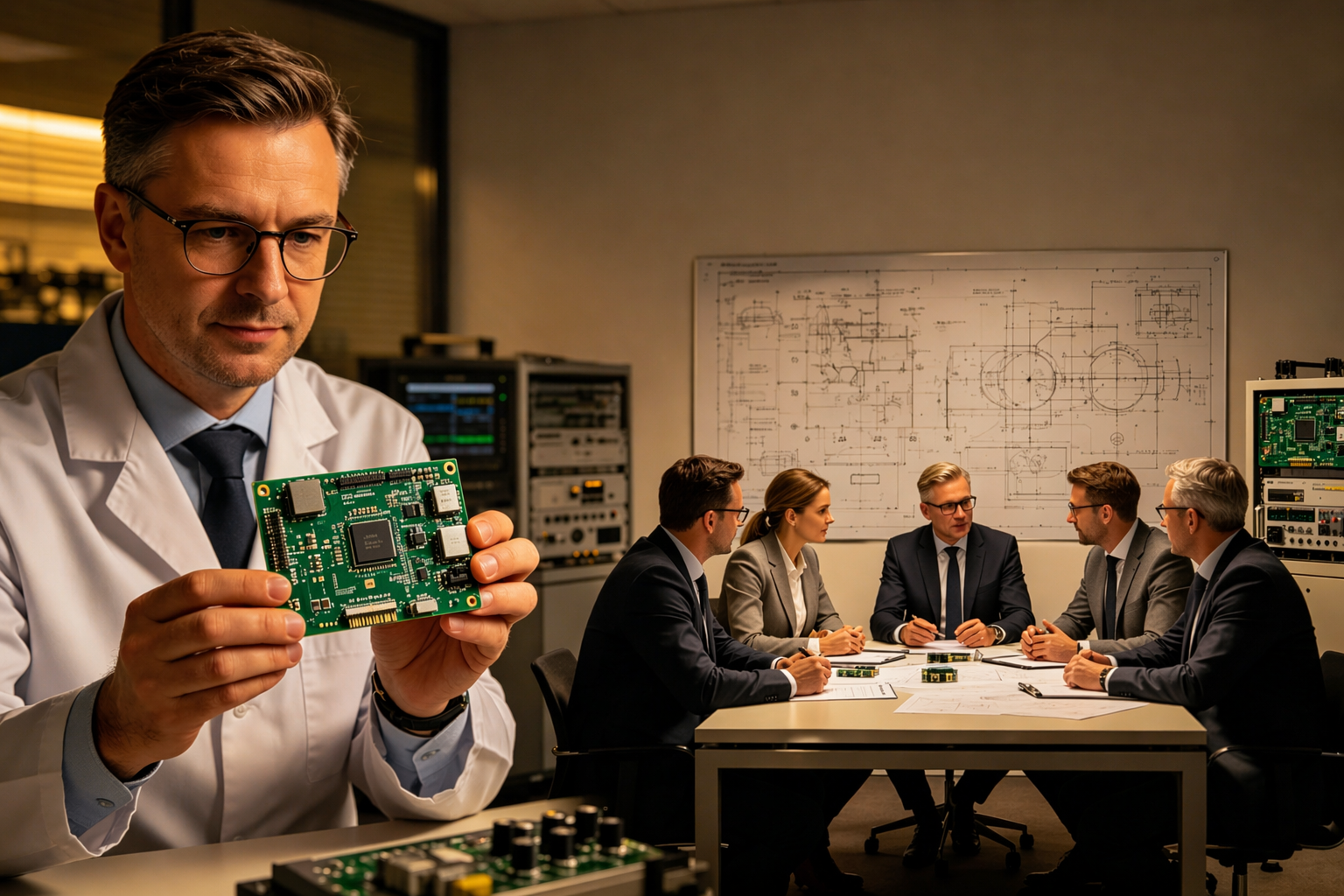
Decision Matrix: How German Engineers & Procurement Select PCB Suppliers for Hydrogen Sensor Applications
German buyers in the hydrogen fuel cell supply chain do not make PCB sourcing decisions lightly. Their evaluation framework is methodical, data-driven, and risk-averse. Understanding these decision factors is essential for any supplier aiming to enter the German market.
Certifications & Compliance Standards
German procurement teams mandate internationally recognized certifications as a non-negotiable entry requirement. Key credentials include ISO 9001:2015 for quality management, IATF 16949 for automotive-grade production consistency (critical for fuel cell applications), and full REACH/RoHS compliance for EU market entry. Additionally, DIN EN standards specific to PCB procurement (such as DIN EN 16602-70-11 for space and mission-critical applications) are increasingly referenced in hydrogen infrastructure contracts. BST Ceramic PCB maintains all of the above, with full documentation available for audit.
Hydrogen-Specific Material Compatibility & Reliability
German engineers prioritize material verification over cost when safety is at stake. The core concern is hydrogen embrittlement and hydrogen diffusion—phenomena where hydrogen molecules permeate conventional PCB materials, causing signal drift, electrical degradation, or catastrophic failure. In ZeMA‘s H2-DruckSens project, researchers confirmed that standard austenitic steels with gold diffusion barriers still experience drift, particularly at elevated temperatures. By contrast, ceramic deformation bodies demonstrate extremely low hydrogen permeation rates, delivering reliable, fail-safe sensor performance. BST Ceramic PCB utilizes high-purity Al₂O₃ (96%/99.6%), AlN, and LTCC compositions that are inherently resistant to hydrogen permeation, addressing this critical engineering pain point directly.
Supplier’s Hydrogen Industry Track Record
German buyers will scrutinize a supplier‘s existing references within the hydrogen and fuel cell ecosystem. They prefer suppliers who have already navigated the unique manufacturing challenges of ceramic substrate processing for sensing applications—including laser drilling for micro-vias, controlled impedance for signal fidelity, and surface finish compatibility with wire-bonding or die-attach processes. BST has successfully delivered ceramic PCBs to hydrogen sensor developers worldwide, with documented performance data.
Supply Chain Transparency & EU Market Accessibility
Post-pandemic supply chain resilience remains a top procurement priority. German buyers evaluate lead times, capacity scalability, and logistical reliability. Suppliers offering full BOM traceability, counterfeit-prevention policies, and CE-marking documentation are strongly favored. BST Ceramic PCB operates with transparent supply chain protocols and provides full REACH/RoHS compliance declarations, enabling German customers to fulfill their EU regulatory obligations seamlessly.
Engineering Support & Customization Capability
German engineers do not simply “order off-the-shelf” PCBs—they require close technical collaboration during the design phase. Suppliers who provide DFM (Design for Manufacturing) feedback, impedance modeling, and material selection consultation gain significant competitive advantage. BST offers turnkey engineering support from prototype through mass production, with typical lead times of 5–10 days for ceramic PCB prototypes and 15–25 days for volume orders.
Submit your spec: Custom ceramic PCB for H₂ sensors →
Why BST Ceramic PCB Stands Out for German H₂ Sensor Manufacturers
Germany‘s ceramic PCB landscape includes domestic players such as Ceramany GmbH (Menden, turnover €3.6M, 120 employees), KERAFOL® (Eschenbach, specializing in ceramic tapes and substrates), CeramTec GmbH (global high-performance ceramic leader), and Micro-Hybrid Electronic GmbH (ceramic substrates for sensor control). While these suppliers offer high-quality products, B2B buyers increasingly recognize that globally integrated suppliers like BST provide comparable or superior technical capabilities at 30–40% cost savings, with faster prototyping turnarounds.
BST‘s Distinctive Advantages for the German Market:
- Full ceramic PCB portfolio: Al₂O₃ (96%/99.6%), AlN, LTCC, thick-film printed substrates, thin-film ready surfaces. Single-vendor solution for all sensor PCB needs.
- Proven hydrogen industry compatibility: BST‘s ceramic PCBs exhibit hydrogen-tight properties per Fraunhofer-grade material standards; all products are RoHS/REACH certified and CE-marking ready.
- Custom engineering support: Dedicated DFM review, impedance-controlled designs (±10% tolerance on controlled impedance), laser micro-via drilling for sensor interconnect needs.
- Scalable production capacity: Prototype quantities (5–50 pcs) through medium-volume runs (100–10,000 pcs/month) to mass production (50,000+ pcs/month). Flexible MOQ structure tailored to German SME and OEM requirements.
- Transparent quality system: ISO 9001:2015 certified, IPC-A-600 Class 2/3 compliant, full lot traceability (spent logs, AOI results, first-article inspection reports available per shipment).
- Logistics optimized for Germany: Direct DHL/FedEx Express shipping from BST‘s manufacturing hub to German destinations (Berlin, Munich, Stuttgart, Frankfurt, Hamburg) typically within 3–5 business days.
Compare: BST vs. European ceramic PCB suppliers →
Real-World Validation: Ceramic Substrate Solutions for Extreme H₂ Environments
German research leadership in ceramic hydrogen sensor technology is beyond question. The country hosts multiple flagship projects that directly inform BST‘s capabilities:
- Fraunhofer IKTS ceramic pressure sensor platform (FKZ 03EN5025A-F): Developing hydrogen-tight ceramic sensors with gas-tight laser beam soldering using special glass solders, eliminating condensation and freezing issues that plague metallic sensors.
- ZeMA H2-DruckSens project (BMWi): Hydrogen-compatible pressure sensors using ceramic sensor bodies with highly sensitive thin-film strain gauges (∼100 nm thickness), solving hydrogen diffusion and embrittlement challenges.
- IFW Jena Ceramic-H₂-Sensor: Developing LTCC-based technology platforms for hydrogen pressure sensors in electrochemical hydrogen production and fuel cell processing.
BST Ceramic PCB is fully aligned with these technical trajectories. Our ceramic substrates are manufactured to support both thick-film screen-printed sensor circuits and thin-film sputtered sensing layers, providing the material foundation that German hydrogen sensor developers require to commercialize their innovations.
Frequently Asked Questions About Ceramic PCB for Hydrogen Sensors
Search more questions
What do German engineers ask about ceramic PCB?
Q1: Is ceramic PCB suitable for hydrogen fuel cell sensor applications?
A: Yes — ceramic PCB (Al₂O₃, AlN, LTCC) is highly suitable. Unlike standard FR4, ceramics are hydrogen-tight, chemically inert, and thermally stable. German research institutions (Fraunhofer IKTS, ZeMA, IFW Jena) have validated ceramic‘s superiority over metallic materials for hydrogen sensor bodies.
Q2: What‘s the difference between Al₂O₃ (96% vs. 99.6%) for hydrogen sensors?
A: 96% Al₂O₃ offers a cost-performance balance for general sensor PCBs (thermal conductivity ≈24 W/mK). 99.6% Al₂O₃ delivers higher purity, better electrical insulation (>10¹⁴ Ω·cm), and superior mechanical strength for mission-critical applications like fuel cell stack monitoring. BST offers both grades for German customers.
Q3: Can ceramic PCB handle high operating temperatures in fuel cell environments?
A: Yes. Ceramic PCBs maintain mechanical and electrical integrity from -55°C to 350°C+ (specific grade dependent). AlN (aluminum nitride) provides even higher thermal conductivity (140–180 W/mK) for heat-dissipation-intensive sensor designs.
Q4: What certifications should I look for when sourcing ceramic PCB for the German market?
A: ISO 9001 (quality management), IATF 16949 (automotive-grade—critical for fuel cell applications), RoHS and REACH compliance for EU import. Some hydrogen infrastructure contracts also require IPC-A-600 Class 3 or DIN EN 16602-70-11 certification.
Q5: What‘s a typical lead time for custom ceramic PCB prototypes?
A: 5–10 business days for non-recurring engineering (NRE) and prototype tooling, followed by 3–5 days for air freight to Germany. Total lead time from specification to delivery typically 8–12 business days for quantities under 100 pcs.
Q6: How does BST compare to German ceramic PCB manufacturers (CeramTec, KERAFOL)?
A: BST offers comparable technical specifications (Al₂O₃, AlN, LTCC) at 30–40% lower unit cost, with faster prototyping turnaround (5–10 days vs. 15–25 days typical of domestic suppliers), while maintaining full RoHS/REACH compliance and CE-ready documentation.
Q7: What surface finishes are available for wire-bonding in sensor assembly?
A: BST provides ENIG (Electroless Nickel Immersion Gold — 0.05–0.1 µm Au thickness), silver-based thick-film pastes, and sputtered thin-film metal layers (Pt, Ag, Au for electrode contacts).
Q8: Do you support LTCC packaging for solid-state hydrogen sensors?
A: Yes. BST manufactures LTCC ceramic packages with embedded cavities, micro-vias, and integrated Ag/Pt electrodes—matching the architecture validated in published solid-state hydrogen sensor research.
Q9: How do I request a quote for a custom ceramic PCB for my hydrogen sensor project?
A: Submit your design files (Gerber, DXF, or PDF), material preference (Al₂O₃/AlN/LTCC), layer count (2–12 layers), dimensions, and annual quantity to BST‘s engineering team. Typical quotation turnaround: 24–48 business hours.
Q10: Can BST supply ceramic PCBs for EU-funded hydrogen research projects?
A: Yes — BST has supplied ceramic PCB prototypes to academic and commercial entities worldwide. All materials are fully RoHS/REACH compliant, with documentation suitable for EU grant reporting.
Need more answers? Chat with BST engineering →
Get in Touch With BST‘s Engineering Team
German engineers and procurement professionals requiring ceramic PCB solutions for hydrogen fuel cell sensors are invited to submit inquiries directly.
E-mail: sales@bstceramicpcb.com
Website: www.bstceramicpcb.com
Standard offering: Quote within 48 business hours | DFM review included | Full 3D Gerber evaluation | Free material consult for H₂ sensor applications
BST supplies premium ceramic PCB (Al₂O₃, AlN, LTCC, thick film, thin film ready, multilayer hybrid) to customers worldwide. Full ISO 9001:2015, IATF 16949 compliance (audit ready), RoHS/REACH 100%.
 Products
 About us
 Contact us