













































 HOME
HOME


-

Ceramic PCB for Humanoid Robot joint actuators
2026 04,07 -
LTCC PCB Surprises: What Most People Miss
2025 12,09 -
Step-by-Step Guide to DPC PCB Design for Sensor Systems
2025 12,03 -
Ceramic PCBs Essential Benefits and Applications
2025 12,01 -
How Al2O3 DPC Ceramic Substrate PCB Enhances Heat Dissipation in Modern Electronics?
2025 11,28 -
How to Choose Between Ceramic, FR4, and Metal Core PCBs
2025 11,27 -
DPC Ceramic PCB Materials: Surprising Science Inside
2025 11,26 -
Wire bondable 2-layer Alumina substrates PCB | Bstceramic PCB
2025 09,22 -
Silicon Nitride Substrate, Silicon Nitride Ceramic Substrate Formula
2025 05,08 -
What is thick film ceramic PCB?
2023 08,02
Ceramic PCB Substrate Material Selection: Al2O3, AlN, Si3N4 and BeO
Published:
Ceramic PCB substrate material selection should start with the heat load, insulation requirement, coefficient of thermal expansion, copper thickness and production process. Alumina is often the economical starting point, aluminum nitride is used when heat removal is the bottleneck, silicon nitride is valuable when thermal cycling and mechanical strength matter, and BeO requires strict safety control because of dust risk during machining.
What Is the Best Starting Point for Ceramic PCB Substrate Material Selection?
The best starting point is not the highest thermal conductivity number; it is the weakest constraint in the assembly. For many LED, sensor and moderate-power modules, a well-designed alumina board can be more practical than an expensive high-conductivity substrate. For dense power modules, laser drivers, high-current converters or compact thermal paths, the substrate choice should be checked against junction temperature, copper area, dielectric thickness, thermal cycling and package attachment method.
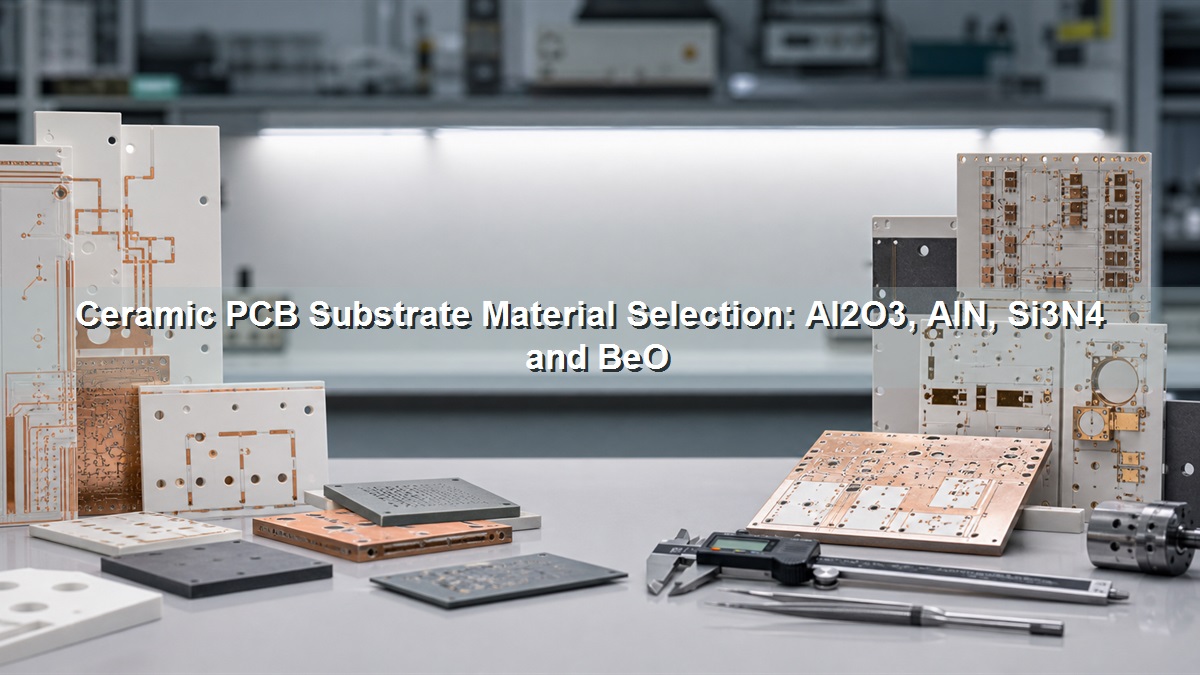
A useful decision path is to define the thermal target first, then screen materials by CTE compatibility, mechanical risk and cost. This prevents a common sourcing problem: asking every supplier for the most expensive ceramic material before confirming whether the design actually needs it.
| Material | Typical Use | Strength | Limitation | Buyer Note |
| Al2O3 alumina | LED modules, sensors, control boards, cost-sensitive ceramic PCBs | Stable, widely available, lower cost | Lower thermal conductivity than AlN or BeO | Good first option when heat flux is moderate and budget matters. |
| AlN aluminum nitride | Power modules, laser drivers, high-power LEDs, compact heat paths | High thermal conductivity with electrical insulation | Higher material and processing cost | Specify grade, thickness and copper design instead of requesting "AlN" only. |
| Si3N4 silicon nitride | Automotive power modules, cycling loads, mechanically stressed substrates | Better fracture toughness and thermal cycling resistance | Not always the highest thermal conductivity option | Useful when reliability under cycling is more important than headline conductivity. |
| BeO beryllium oxide | Special high-thermal applications with controlled handling | Very strong heat dissipation potential | Safety risk if dust is inhaled during machining | Use only with qualified suppliers and clear handling controls. |
How Do Al2O3, AlN, Si3N4 and BeO Compare?
The practical comparison should combine thermal performance, mechanical behavior, CTE, process fit and sourcing risk. Public power-substrate references commonly describe alumina as economical but lower in thermal conductivity, AlN as much higher in thermal performance, Si3N4 as useful for reliability, and BeO as thermally strong but safety-sensitive.
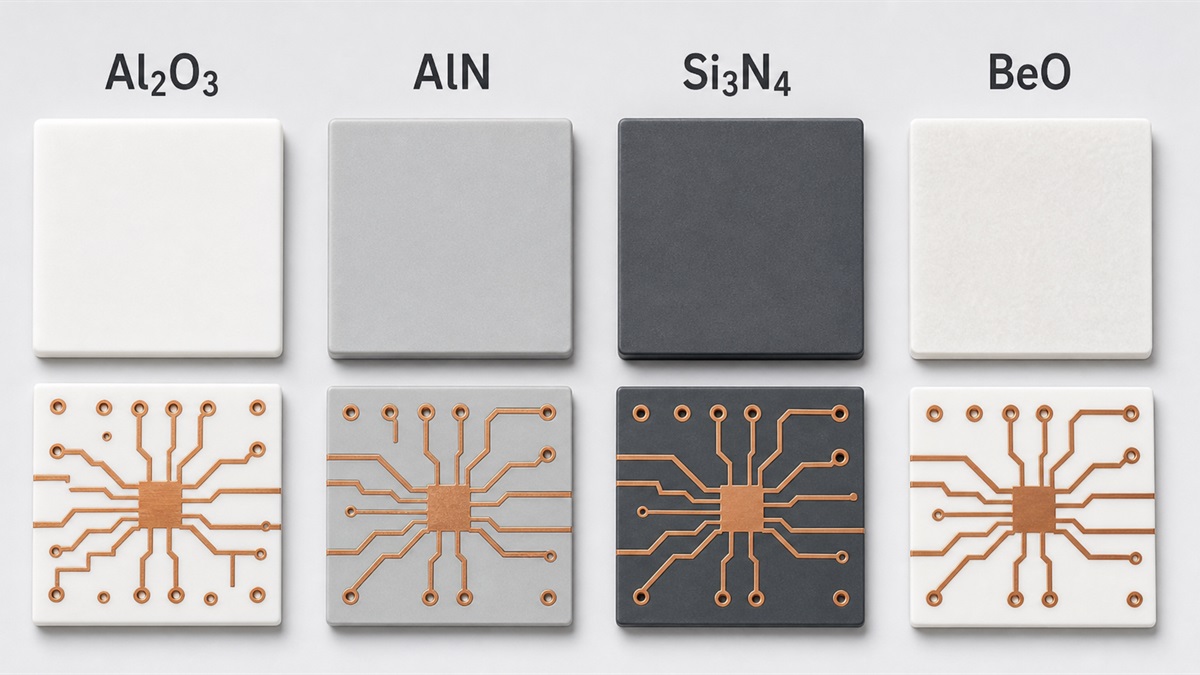
| Selection Factor | Al2O3 | AlN | Si3N4 | BeO |
| Thermal performance | Moderate | High | Medium to high by grade | Very high |
| Relative cost | Lower | Higher | Higher | Special handling cost |
| Thermal cycling strength | Acceptable for many designs | Good when designed correctly | Strong advantage | Application-specific |
| Typical process fit | DPC, thick film, DBC options | DPC, DBC and high-power structures | AMB and demanding power modules | Special thick film or custom builds |
| Best procurement use | Balanced performance and cost | Heat-limited assemblies | Reliability-limited assemblies | Special high-thermal programs with safety review |
When Should You Choose Alumina Ceramic Substrate?
Choose alumina when the application needs ceramic insulation, dimensional stability and better heat spreading than FR-4, but does not justify the cost of AlN or Si3N4. Alumina is often suitable for LED lighting modules, sensors, ignition-related electronics, heating control circuits and compact boards where the heat source is distributed instead of concentrated into a small die attach area.
For quotation, buyers should define alumina purity or grade if it affects the design, substrate thickness, copper thickness, minimum trace and space, via requirement, surface finish and working temperature. A vague request for "ceramic board" can result in mismatched quotes because suppliers may assume different alumina grades or different metallization processes.
When Is Aluminum Nitride the Better Choice?
AlN is the better choice when the design is limited by heat transfer through the substrate rather than by copper area or external heat-sink design. It is commonly considered for power LEDs, laser diode modules, high-current converters, RF power packaging, compact power electronics and assemblies where the component junction temperature needs a shorter thermal path.
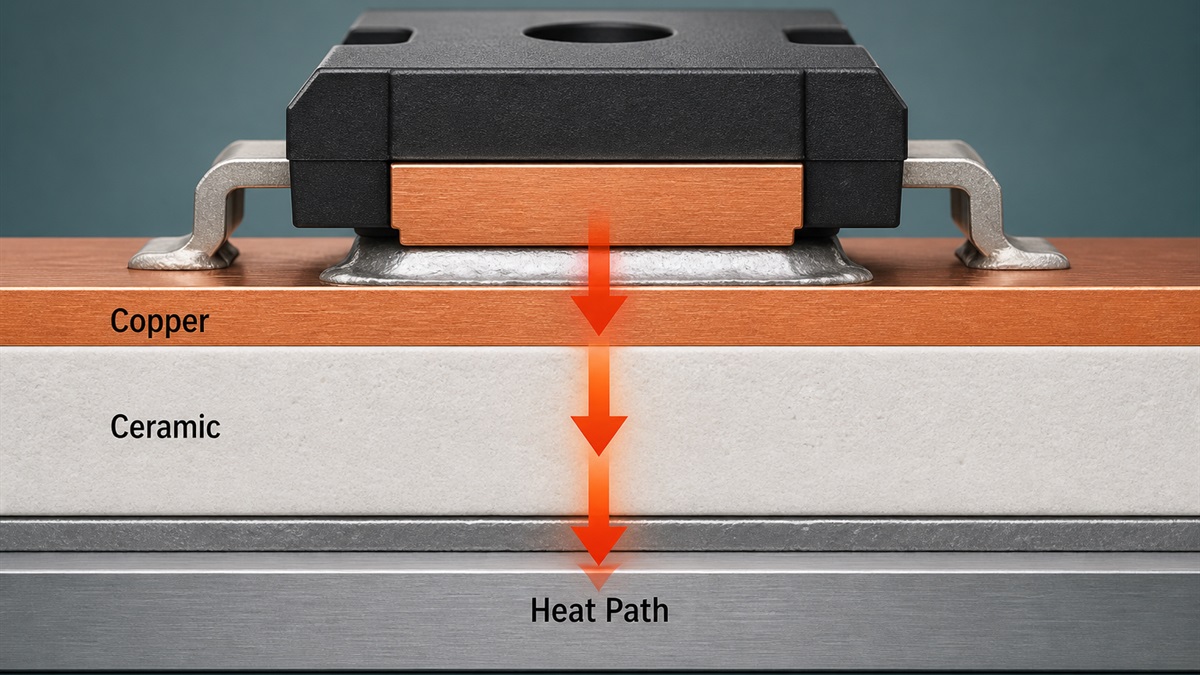
AlN should be specified carefully because performance depends on the material grade and final structure. In an RFQ, include the target thermal resistance or operating heat load, board outline, copper thickness, copper coverage, dielectric thickness, surface finish, soldering process and expected volume. This helps a supplier judge whether a ceramic PCB should use DPC, DBC or another process route.
When Does Silicon Nitride Make Sense?
Si3N4 makes sense when the assembly faces thermal cycling, mechanical stress, vibration or high reliability requirements. In automotive and power module work, the substrate is not only a heat spreader; it also has to survive copper expansion, solder fatigue risk and repeated temperature swings. This is where stronger fracture toughness can matter more than a simple thermal conductivity comparison.
Buyers should consider Si3N4 when failures are expected to come from cracking, cycling fatigue or attachment stress. It can be relevant for AMB ceramic PCB structures, automotive power modules and compact high-current assemblies where reliability evidence is part of supplier qualification.
Why Is BeO a Special Case?
BeO is a special case because it can offer strong thermal performance, but machining dust can create a serious health hazard if not controlled. The finished fired ceramic is commonly discussed in electronics thermal applications, but any drilling, grinding, lapping or rework process must be handled by qualified suppliers with proper safety controls.
For most new projects, buyers should compare AlN and Si3N4 first unless the thermal model clearly supports BeO and the supply chain can document safe handling. If BeO is required, the RFQ should identify finished dimensions, any post-fired machining, inspection requirements and packaging expectations so the supplier can evaluate risk before accepting the program.
How Does the Ceramic Substrate Manufacturing Process Affect Material Choice?
The ceramic substrate manufacturing process affects copper thickness, feature size, adhesion, current capacity and cost. DPC supports fine patterns and thin metallization, DBC supports thicker copper and power substrates, AMB is often considered for high-reliability power modules, and thick film supports printed conductors, resistive layers and hybrid circuit needs.
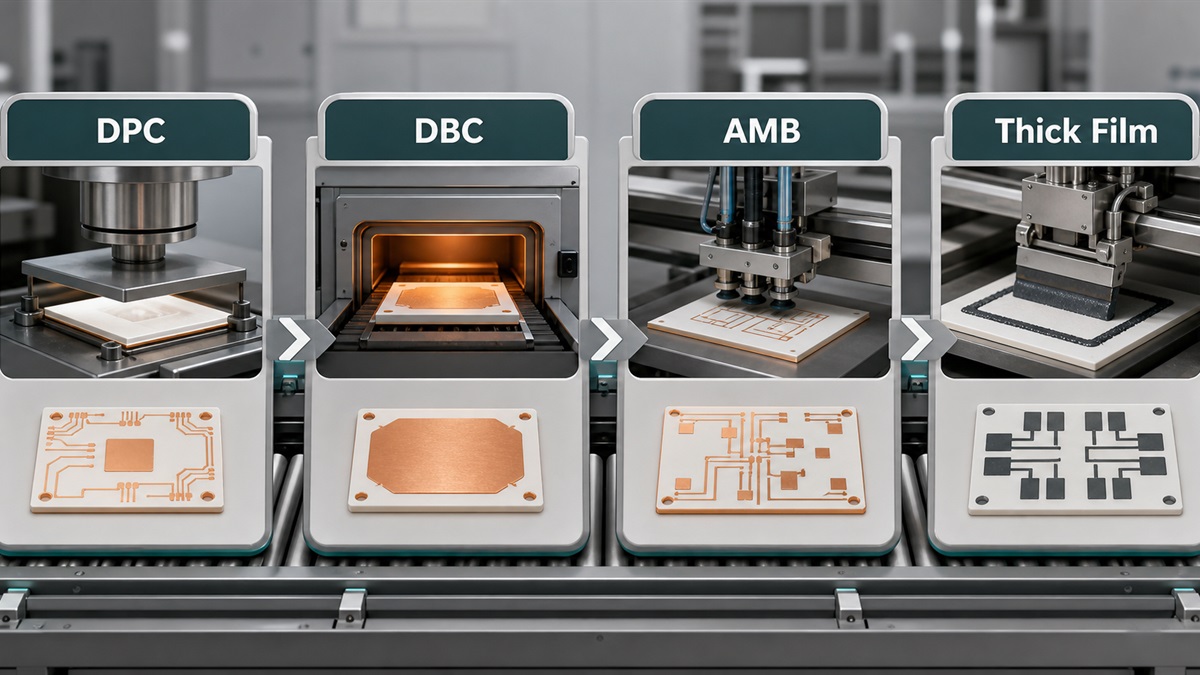
| Process | Best Fit | Material Link | Inspection Point |
| DPC | Fine lines, thin copper, compact ceramic circuit boards | Often used with alumina or AlN | Check plating thickness, adhesion and via quality. |
| DBC | Power substrates with thicker copper | Often paired with alumina or AlN | Check copper bond quality, voids and warpage. |
| AMB | High-reliability power modules and demanding cycling loads | Often considered with Si3N4 or AlN | Check active metal bond, peel strength and thermal cycling evidence. |
| Thick film | Hybrid circuits, printed resistors, sensors and special layouts | Common on alumina, also used on other ceramics | Check paste compatibility, firing profile and resistor trimming needs. |
If the drawing requires very fine spacing, the material choice alone will not solve manufacturability. The buyer should match material, copper thickness, line width, spacing, via design and surface finish to the chosen process before comparing prices.
What Should Buyers Send Before Requesting a Quote?
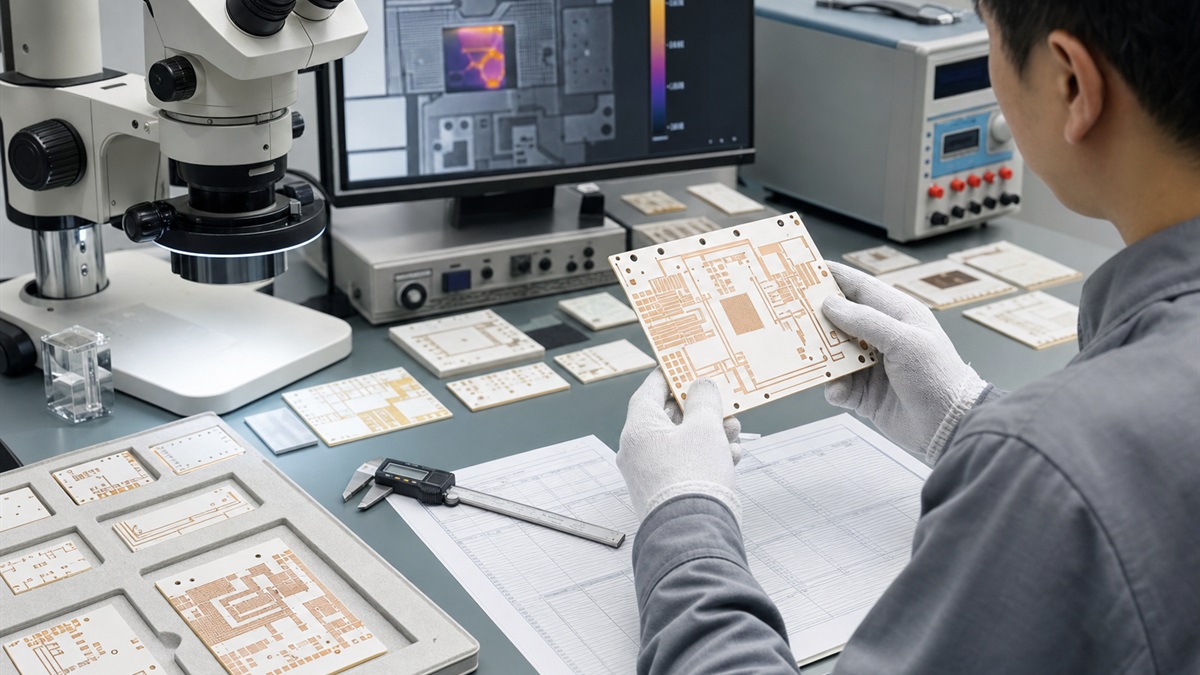
A complete RFQ should give the supplier enough information to judge material, process and inspection needs. Missing thermal data or copper requirements can cause large price differences between quotes even when every supplier appears to be pricing the same ceramic substrate PCB.
- Gerber files, CAD data, PDF drawing and board outline.
- Target substrate material or performance requirement if the material is not fixed.
- Substrate thickness, copper thickness, line width, spacing, holes and vias.
- Surface finish, soldering process, assembly temperature and cleanliness needs.
- Operating temperature, estimated heat load, voltage isolation and thermal cycling expectation.
- Prototype quantity, annual forecast, inspection standard and packaging requirement.
When the material is still open, send the use case and constraints instead of forcing one option. BSTCeramicPCB can review prototype drawings and help compare alumina DPC ceramic substrate PCB, AlN, Si3N4 and related process routes before quotation.
How Should You Choose a Ceramic PCB Supplier?
Choose a supplier that can discuss material choice, process limits and inspection evidence before quoting. A strong ceramic PCB supplier should not only ask for Gerbers; it should ask why the material is being selected, what thermal target the board must meet, and whether the process choice matches copper thickness, feature size and reliability requirements.
For sourcing teams, the most useful supplier questions are specific: Can the supplier support the required material grade? What copper thickness range is realistic? Which process is recommended for this drawing? What inspection report can be provided? How will the supplier handle prototype review before mass production? These answers are more useful than a low unit price with unclear material and process assumptions.
BSTCeramicPCB supports ceramic PCB sourcing discussions for prototypes, custom engineering review and production planning. For projects where ceramic PCB substrate material selection is still open, the quotation should start with application constraints rather than only a target price.
FAQ
What is the best ceramic PCB substrate material?
There is no single best material. Alumina is usually the cost-effective starting point, AlN is preferred when heat transfer is the main limit, Si3N4 is valuable for thermal cycling and mechanical reliability, and BeO is reserved for special thermal applications with safety controls.
Is AlN always better than alumina?
No. AlN usually provides better thermal conductivity, but it costs more and may not improve the final assembly if heat is limited by copper area, solder layer, thermal interface material or the external heat sink. Alumina can be the better commercial choice for moderate heat loads.
Why does CTE matter in ceramic PCB design?
CTE matters because copper, ceramic, solder and semiconductor packages expand at different rates. Poor CTE matching can increase stress during temperature cycling, leading to cracks, solder fatigue or bond degradation. This is why reliability projects may evaluate Si3N4 or AMB structures.
When should I choose DPC ceramic PCB?
DPC is useful when the design needs fine features, thin metallization, compact routing or precise patterns on a ceramic substrate. It is often considered for alumina and AlN boards where circuit density and surface quality are important.
When should I choose DBC ceramic substrate?
DBC is often used when thicker copper, higher current handling and stronger heat spreading are needed. It is common in power electronics, but the design must account for copper thickness, bond quality, warpage and thermal cycling behavior.
When is AMB ceramic substrate useful?
AMB is useful for demanding power modules where bond reliability and thermal cycling performance are important. It is often evaluated with Si3N4 or AlN substrates in automotive, IGBT, inverter and other high-reliability applications.
Is BeO safe for ceramic PCB production?
Finished BeO ceramic can be used in specialized electronics applications, but dust from machining or grinding is hazardous if inhaled. BeO projects should only be handled by qualified suppliers with clear safety controls, documentation and controlled processing.
What information is needed for a ceramic PCB quote?
Send Gerber files, drawing, substrate material or performance target, substrate thickness, copper thickness, minimum line and spacing, holes, vias, surface finish, operating temperature, thermal target, quantity and inspection requirements.
Can I prototype first before choosing the final ceramic material?
Yes. A prototype can help validate assembly behavior, soldering, fit, heat path and inspection requirements. If the final material is uncertain, prototype discussions should include the thermal target and production volume so the supplier does not optimize only for sample cost.
How does substrate thickness affect material choice?
Thicker substrates can improve mechanical strength and voltage spacing, but they may increase thermal resistance through the ceramic. Thin substrates improve heat transfer but can be more fragile. The best thickness depends on heat load, isolation, handling and assembly stress.
Should the article keyword be linked to the final page?
Yes, for this published page the exact phrase "ceramic PCB substrate material selection" is linked to the final article URL in the body so readers and crawlers can clearly identify the current topic page.
Conclusion
Material choice for ceramic PCBs should be based on heat load, CTE, reliability risk, manufacturing process and sourcing cost. Alumina is often the practical baseline, AlN is chosen for heat-limited designs, Si3N4 supports demanding cycling and mechanical reliability, and BeO should be treated as a special controlled-handling option.
If you are evaluating a ceramic PCB prototype or production project, send your drawings, thermal target, material preference, copper thickness, operating conditions and forecast to BSTCeramicPCB. Our team can review the material and process route and provide quotation guidance at sales@bstceramicpcb.com or through contact BSTCeramicPCB.
 Products
 About us
 Contact us