

















































 HOME
HOME

-

Ceramic PCB for Humanoid Robot joint actuators
2026 04,07 -
LTCC PCB Surprises: What Most People Miss
2025 12,09 -
Step-by-Step Guide to DPC PCB Design for Sensor Systems
2025 12,03 -
Ceramic PCBs Essential Benefits and Applications
2025 12,01 -
How Al2O3 DPC Ceramic Substrate PCB Enhances Heat Dissipation in Modern Electronics?
2025 11,28 -
How to Choose Between Ceramic, FR4, and Metal Core PCBs
2025 11,27 -
DPC Ceramic PCB Materials: Surprising Science Inside
2025 11,26 -
Wire bondable 2-layer Alumina substrates PCB | Bstceramic PCB
2025 09,22 -
Silicon Nitride Substrate, Silicon Nitride Ceramic Substrate Formula
2025 05,08 -
What is thick film ceramic PCB?
2023 08,02
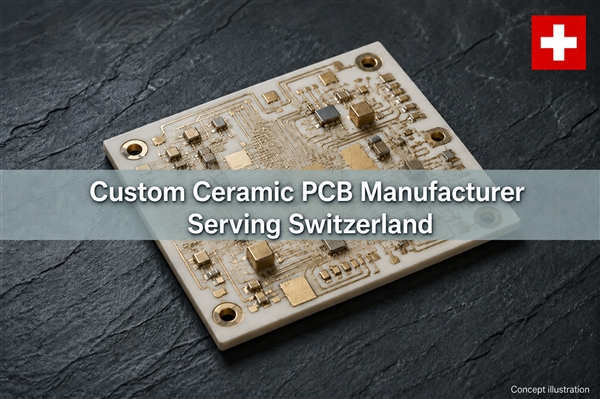
Custom Ceramic PCB Manufacturer Serving Switzerland
At BSTCeramicPCB, we are a custom ceramic PCB manufacturer serving Switzerland, manufacturing ceramic circuits in China for Swiss engineering teams. Ceramic PCBs for Switzerland medical instrumentation should support stable measurement and repeatable assembly. Our thin-film, thick-film and plated-copper options sit alongside other ceramic technologies. We provide manufacturing review, prototypes and agreed assembly support, and can coordinate FPC or rigid-flex requirements for connections to the instrument electronics.
A Ceramic Circuit Built Around the Instrument Function
We focus on the circuit that benefits from ceramic: a precision sensing element, a compact hybrid circuit or a thermally demanding subassembly. The entire instrument does not need to use ceramic to gain value from one carefully designed ceramic circuit.
For Swiss medical-instrument developers, identifying that boundary helps keep the design and manufacturing scope clear. We supply the ceramic circuit or agreed electronic assembly, not an automatically qualified finished medical instrument. Sensor, semiconductor and control-electronics requirements should be separated before their manufacturing details are combined.
Choose the Metal System Before Freezing the Layout
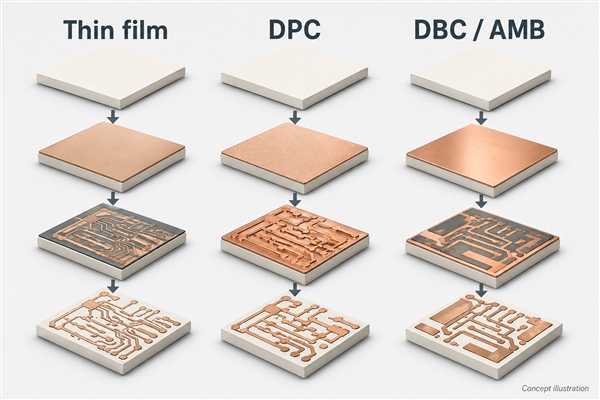
Our thin-film ceramic circuits for medical equipment support fine patterned metallization, while thick-film ceramic substrates for medical devices provide a printed-and-fired route for suitable hybrid circuits. Our DPC ceramic PCB for sensors are relevant where plated copper circuitry fits the electrical and attachment requirements.
| Need in the instrument | Ceramic route to evaluate |
|---|---|
| Small patterned metal features | Thin film, with geometry tied to the film stack. |
| Printed functional elements | Thick film, with material system and stability requirements defined. |
| Plated copper conductors | DPC, with copper thickness and spacing assessed together. |
| Separate high-current stage | DBC or AMB, with a suitable ceramic and thermal design. |
Selecting the metal system first prevents a layout from depending on geometry that belongs to a different process.
Specify Critical Features Without Over-Constraining the Board
Tolerances should protect the measurement or assembly function. The pad-to-datum relationship may be more important than making every outline dimension equally tight. Define how the ceramic is located in its housing and how the sensing element references that position.
Our published thin-film capability includes 20 um minimum line width for film thickness below 3 um. This is not a universal limit across all ceramic processes. We review the complete metal structure and substrate choice before confirming feasibility, including the attachment area and distance from fragile edges.
Manage Thermal Drift at the Assembly Level
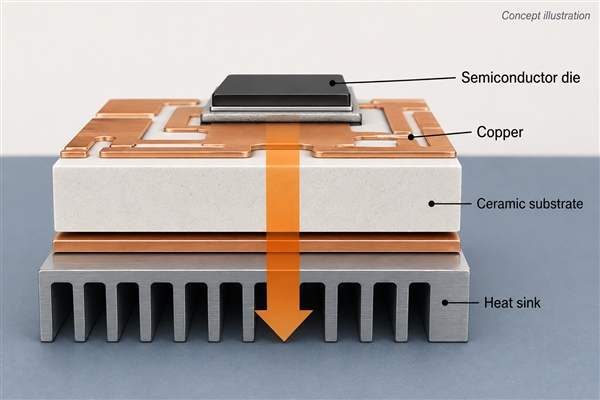
A material with higher thermal conductivity can help distribute heat, but stable measurement requires control of the whole temperature field. A nearby power device, an uneven attachment layer or a changing housing interface can introduce gradients around the sensing circuit.
Evaluate alumina and aluminum nitride against the actual heat load and mechanical design. Test the assembled circuit in its intended mounting arrangement so the result includes attachment and cooling interfaces. Do not infer instrument accuracy, biocompatibility or sterilization resistance from the ceramic material alone.
Agree What Fabrication and Assembly Inspection Must Prove
A clear inspection plan separates bare-circuit acceptance from assembly acceptance. Conductor continuity and dimensions verify one part of the build; placement, attachment and the instrument-level response verify other parts.
We discuss the inspection scope alongside ceramic fabrication and assembly services. For a sensing circuit, the plan may need attention to the repeatability of the mounting and attachment features. For a semiconductor power section, heat-path performance may require an assembled test. Not every test is included automatically, so the required evidence should be agreed before the build.
Use FPC and Rigid-Flex for the Instrument Interconnect
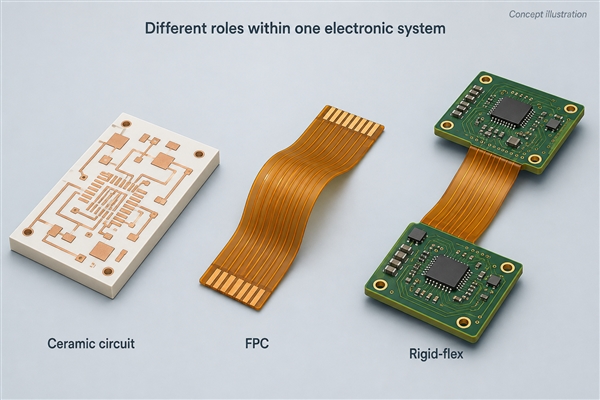
FPC can connect a ceramic sensing circuit through a narrow enclosure space, while rigid-flex can integrate rigid component regions with flexible routing. These technologies complement ceramic; they are not variants of a flexible ceramic substrate.
We can coordinate their requirements within the wider circuit project. Give the ceramic interface adequate support and keep flex motion away from the attachment. Also consider assembly access, connector orientation and whether the bend occurs only during installation or repeatedly during use. Those details determine the practical interconnect construction.
Keep Certification Scope Separate from Device Qualification
When a medical project requires ISO 13485 documentation, the certificate must be current and cover the relevant entity and activity. A certificate covering sales is not evidence that every manufacturing operation is covered. Likewise, a quality-management certificate does not certify the performance of the finished instrument.
Discuss current ISO 9001 or medical-sector quality-system evidence with our team as part of the project requirements. The supplied circuit still needs the agreed inspection evidence, and the finished medical device requires its own applicable qualification work.
Plan Prototype and Production Delivery as Separate Stages
The prototype schedule should include ceramic processing, inspection, any component sourcing and assembly, and the validation step needed before release. Production planning then follows the approved configuration and the required quantity.
We confirm the manufacturing schedule for the actual design and distinguish it from transport to Switzerland. Special materials, finishes or inspection arrangements may affect timing. Avoid treating the quickest published sample example as a promise for every ceramic technology or assembled instrument circuit.
Control Changes That Could Affect Measurement Repeatability
A recurring build should preserve the approved substrate, metal system, finish and attachment requirements. A change in one of those elements can affect the measurement baseline even when the circuit remains electrically continuous.
We work with the project team to connect the approved prototype with fabrication and assembly requirements for later builds. Define which substitutions require review and which changes need renewed testing. This creates a more useful basis for repeat supply than an undocumented expectation that every future batch will behave like the first sample.
If you need a ceramic PCB manufacturer serving Switzerland, contact our team at sales@bstceramicpcb.com to discuss your ceramic circuit, prototype build, assembly scope and related FPC or rigid-flex requirements.
 Products
 About us
 Contact us