

















































 HOME
HOME


-

Ceramic PCB for Humanoid Robot joint actuators
2026 04,07 -
LTCC PCB Surprises: What Most People Miss
2025 12,09 -
Step-by-Step Guide to DPC PCB Design for Sensor Systems
2025 12,03 -
Ceramic PCBs Essential Benefits and Applications
2025 12,01 -
How Al2O3 DPC Ceramic Substrate PCB Enhances Heat Dissipation in Modern Electronics?
2025 11,28 -
How to Choose Between Ceramic, FR4, and Metal Core PCBs
2025 11,27 -
DPC Ceramic PCB Materials: Surprising Science Inside
2025 11,26 -
Wire bondable 2-layer Alumina substrates PCB | Bstceramic PCB
2025 09,22 -
Silicon Nitride Substrate, Silicon Nitride Ceramic Substrate Formula
2025 05,08 -
What is thick film ceramic PCB?
2023 08,02
Factors to Consider When Choosing Ceramic Substrates
Published:
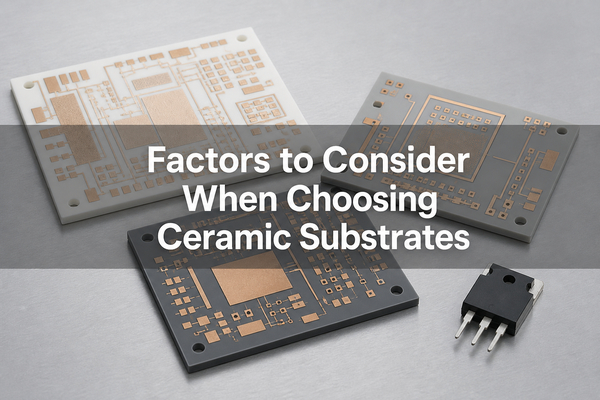
The factors to consider when choosing ceramic substrates are not limited to thermal conductivity. The correct substrate must carry the circuit, isolate voltage, transfer heat, match the expansion of attached materials and survive fabrication, assembly and field cycling. Alumina may be the right economical baseline, AlN may reduce thermal resistance in a compact heat path, and Si3N4 may provide the mechanical reliability required by a power module. The decision should be made against the complete construction rather than one material value.
What Does Choosing a Ceramic Substrate Actually Mean?
A ceramic substrate is an electrically insulating ceramic plate that supports conductors, pads, vias, resistors or bare semiconductor dies. In a ceramic PCB or power module, the substrate is only one part of a stack that may also include copper metallization, a die-attach layer, wire bonds, solder, a baseplate, thermal interface material and a heat sink.
Choosing the substrate therefore means fixing four linked decisions:
- the ceramic material and grade;
- the ceramic thickness and finished geometry;
- the metallization process and conductor thickness;
- the test limits for the finished substrate and assembly.
A material can look strong on a datasheet and still be wrong for the circuit. For example, high-conductivity AlN cannot correct a voided die-attach layer, while a mechanically robust ceramic can still crack if heavy copper is unbalanced or mounting pressure is concentrated at one point.
Which Application Requirements Should Be Defined First?
Start with measurable operating limits. A description such as "high-power ceramic PCB" is not enough to select a material or process.
| Application input | Minimum information | Why it changes the substrate choice |
|---|---|---|
| Heat source | Loss per die or component, source area, duty cycle and maximum junction temperature | Determines heat flux and the allowable thermal resistance through the stack |
| Electrical stress | Working voltage, transient voltage, frequency, creepage, clearance and test voltage | Sets insulation, edge-spacing and dielectric requirements |
| Mechanical load | Board size, mounting method, clamp force, shock and vibration | Changes the need for flexural strength, fracture toughness and flatness control |
| Temperature history | Minimum and maximum temperature, ramp rate and cycle count | Drives CTE mismatch, copper fatigue and ceramic crack risk |
| Assembly | Soldering, silver sintering, brazing, wire bonding or adhesive attachment | Determines pad finish, surface condition, coplanarity and process compatibility |
| Environment | Humidity, corrosive media, vacuum, pressure or contamination limits | Affects ceramic grade, metallization, finish and qualification tests |
The most damaging condition may not be maximum steady power. An automotive inverter can experience rapid junction-temperature swings, while an industrial heater controller may run at a high but stable temperature. These loads favor different constructions even when their average power is similar.
How Should Thermal Performance Be Evaluated?
Bulk thermal conductivity, expressed as k, is useful for comparing materials, but the design quantity is thermal resistance. For a simple one-dimensional ceramic layer, the first estimate is Rth = t / (k x A), where t is thickness and A is the effective heat-transfer area. This shows why thickness, heat-source footprint and spreading are inseparable from conductivity.
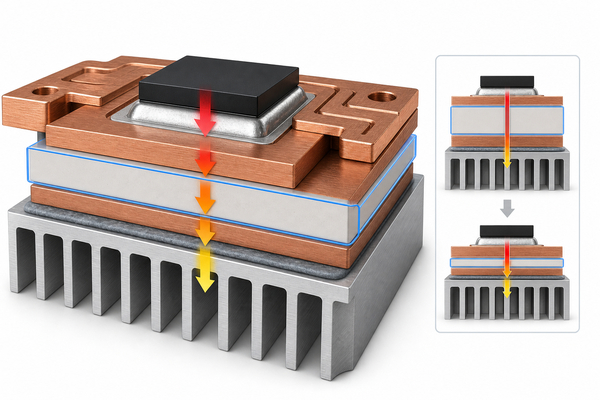
The estimate must then be expanded to include each interface. A practical junction-to-cooler path can contain die attach, top copper, ceramic, bottom copper, substrate attachment, thermal interface material and heat sink. Contact resistance, solder voids, surface flatness and mounting pressure may dominate after the ceramic is upgraded.
Use these checks before paying for a higher-conductivity material:
- calculate the thermal-resistance contribution of the ceramic at its actual thickness and heated area;
- compare that contribution with package, joint, TIM and cooler resistance;
- model transient duty if the heat pulse is shorter than the time needed to reach steady state;
- verify the delivered material grade because nominal AlN or Si3N4 does not define one guaranteed conductivity;
- confirm thermal performance on a representative assembly rather than an unpopulated coupon alone.
If changing alumina to AlN reduces only a small fraction of total junction-to-ambient resistance, improving the die attach, copper spreading area or cooling interface may provide more value.
How Do Alumina, AlN and Si3N4 Compare?
Material selection should balance heat flow, mechanical reliability, CTE and cost. The ranges below are representative of electronic-substrate grades; they are not purchase specifications. Supplier grade, purity, additives, temperature and test method can change the result.
| Material | Representative thermal conductivity | Typical selection strength | Main trade-off |
|---|---|---|---|
| 96% alumina (Al2O3) | About 20-30 W/mK | Established, electrically insulating and economical for moderate heat flux | Higher substrate thermal resistance and lower fracture toughness than advanced power ceramics |
| Aluminum nitride (AlN) | Commonly about 140-180 W/mK for substrate grades | High heat transfer with CTE close to silicon | Higher material cost; grade, handling history and metallization quality require control |
| Silicon nitride (Si3N4) | Commonly about 50-90 W/mK for power-substrate grades | High strength and fracture toughness for severe cycling | Lower conductivity than AlN and normally paired with a higher-cost AMB construction |
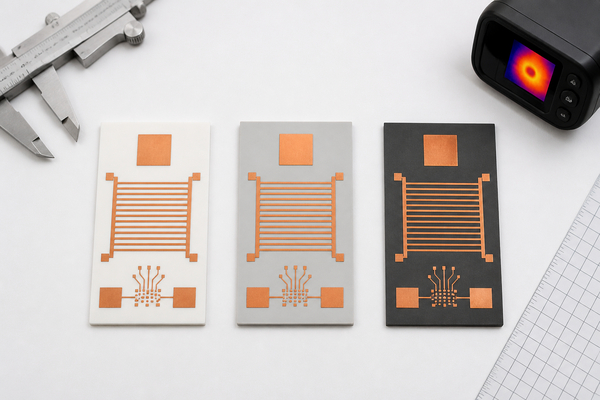
Choose alumina when the thermal model has margin and cost, availability and process maturity matter most. An alumina DPC ceramic substrate is a practical example for LED or compact electronics that need precise metallization without the thermal premium of AlN.
Choose AlN when the ceramic layer is a meaningful thermal bottleneck, especially under a small die, laser, LED array or compact power device. An AlN DPC ceramic substrate combines a high-conductivity ceramic with plated conductor features, but the actual conductivity grade and copper construction still need to be specified.
Choose Si3N4 when cracking resistance, vibration or repeated power cycling dominates the lifetime target. Its conductivity can be lower than AlN, yet its strength allows thinner constructions in some power-module designs. The resulting assembly can provide competitive thermal resistance with greater mechanical margin.
How Do Electrical Requirements Affect Selection?
All three ceramics can provide electrical insulation, but insulation performance is a property of the finished geometry, surface and test condition. A bulk dielectric-strength value does not replace layout rules.
For high-voltage designs, define working voltage, peak transient, test voltage, test duration, temperature, humidity and acceptable leakage current. Then review copper-to-edge distance, conductor spacing, ceramic thickness, surface contamination, metallization edges and the electric field at the conductor-ceramic-encapsulant triple point. Partial-discharge requirements should state the applied waveform and inception or extinction criterion.
RF and microwave circuits require additional data. Dielectric constant, dissipation factor, conductor roughness, metallization thickness and substrate thickness affect impedance and loss. A thermal material should not be selected for RF use until its electrical grade and frequency-dependent data are confirmed.
Why Do CTE, Strength and Fracture Toughness Matter?
Coefficient of thermal expansion, or CTE, describes dimensional change with temperature. Representative power-substrate data places alumina near 6.8 ppm/K, AlN near 4.7 ppm/K and Si3N4 roughly in the 2.5-3.5 ppm/K range, depending on grade and temperature interval. Copper expands much more, so every heating cycle loads the copper-to-ceramic interface and attached joints.
Three mechanical properties answer different questions:
- Flexural strength indicates resistance to bending failure under a defined test.
- Fracture toughness indicates resistance to crack growth from a defect or stressed edge.
- Elastic modulus affects how stress is transferred through the stack.
Large ceramic panels, thick copper, sharp conductor corners and asymmetric layouts increase stress. Rounded copper corners, balanced copper coverage, controlled mounting support and a realistic singulation method can reduce failure risk. For severe power cycling, the best material is often the one that delivers adequate heat flow with the highest lifetime margin, not the one with the highest conductivity.
Which Metallization Process Fits the Substrate?
The ceramic and conductor process must be selected together. Metallization determines conductor thickness, feature resolution, via options, bond structure and surface finish.
| Process | Best starting point | Important limit to confirm |
|---|---|---|
| DPC | Fine pads, thinner plated copper, LED arrays, sensors and compact power circuits | Achievable copper thickness, via construction, adhesion and plated geometry |
| DBC/DCB | Thick copper, high current and established alumina or AlN power modules | Line/space grows with copper thickness; copper balance affects stress and bow |
| AMB | Si3N4 power substrates and demanding automotive or power-cycling duty | Braze system, copper thickness, ceramic grade and interface quality must be qualified together |
| Thick film | Printed conductors, resistors, heaters and hybrid circuits | Paste resistivity, fired thickness, minimum geometry and resistor trimming |
| Thin film | Fine geometry, RF, sensors and precision circuits | Film stack, adhesion, conductor loss and production area |
An AMB ceramic PCB for IGBT modules is relevant when Si3N4 strength and copper-to-ceramic reliability support a demanding lifetime target. DBC on alumina or AlN is often sufficient for industrial power modules. DPC is preferable when conductor definition and plated features matter more than very heavy copper.
The existing guide on how to select ceramic PCB metallization covers the process comparison in more depth. The key boundary is that a material decision made without the copper process is incomplete.
Which Thickness, Flatness and Tolerance Limits Matter?
Reducing ceramic thickness lowers through-thickness thermal resistance, but it also reduces mechanical margin and can make handling, copper stress and assembly flatness more difficult. Increasing thickness improves stiffness and insulation distance but increases thermal resistance. The correct value follows from the full stack, not a standard PCB thickness habit.
Define tolerances by function:
| Dimension or condition | Why it matters | What to specify |
|---|---|---|
| Ceramic thickness | Thermal resistance, insulation and stiffness | Nominal thickness, tolerance and measurement points |
| Overall size | Fit, clamp loading and panel utilization | Finished dimensions and datum system |
| Flatness or bow | Die attach, TIM contact and mounting stress | Measurement method, support condition and limit |
| Copper thickness | Current capacity, heat spreading and stress | Finished thickness by side and allowed variation |
| Line and spacing | Voltage, current density and manufacturing yield | Minimum values tied to the chosen metallization process |
| Copper-to-edge distance | Electric field and edge cracking | Minimum distance including routing or singulation tolerance |
| Hole and cavity position | Alignment, mounting and isolation | Diameter, location tolerance and edge condition |
| Pad coplanarity and roughness | Soldering, sintering and wire bonding | Functional pads, test area and acceptance method |
Avoid applying one tight tolerance to every dimension. Identify which pads, edges and holes control assembly. Over-specifying cosmetic or nonfunctional features raises cost and can reduce yield without improving reliability.
What Reliability and Environmental Risks Should Be Tested?
Reliability tests should reproduce the dominant field load and measure degradation, not only visible damage.
| Risk | Likely cause | Useful verification |
|---|---|---|
| Ceramic crack or edge chip | Impact, clamp force, unbalanced copper, sharp corners or rapid temperature change | Visual inspection, acoustic inspection, thermal shock and fixture review |
| Copper or metallization separation | Interface defect, copper stress or incompatible cycling | Peel or adhesion test before and after cycling |
| Excess thermal resistance | Wrong grade, poor contact, joint voids or substrate bow | Thermal transient measurement and cross-section correlation |
| Solder or sinter fatigue | CTE mismatch and junction-temperature swing | Thermal cycling or power cycling with electrical and thermal monitoring |
| Insulation degradation | Contamination, inadequate edge spacing, moisture or high field concentration | Hipot, insulation resistance and partial-discharge testing under stated conditions |
| Wire-bond failure | Pad finish, contamination, intermetallic growth or cycling | Bond pull or shear testing before and after aging |
Moisture control is especially important for AlN processing because exposed AlN can react with water under unfavorable conditions. Finished boards should be cleaned, dried, packaged and stored according to the validated material and metallization process. Do not apply a generic moisture rule without confirming the actual finished surface and storage life.
When Is a Higher-Cost Ceramic Unnecessary?
A higher-cost ceramic is unnecessary when the system already meets its temperature, voltage and lifetime limits with a lower-cost construction. Alumina can be the correct choice for moderate heat flux, large heat-spreading area and stable industrial operation. An aluminum MCPCB may be sufficient for an LED assembly when the polymer dielectric and heat sink keep junction temperature within margin. FR4 remains appropriate for control, sensing and low-power sections that do not need a ceramic heat path.
Do not choose AlN only because its conductivity is higher. First calculate how much of total thermal resistance belongs to the ceramic. Do not choose Si3N4 only because it is tougher. First define the cycling, vibration and crack-risk requirement. Premium materials should remove a measured design constraint.
What Should Be Confirmed Before Prototyping?
A useful prototype must preserve the risks of the intended production construction. Before release, confirm:
- ceramic material, grade, thickness and any guaranteed thermal-conductivity requirement;
- metallization process, conductor thickness, copper balance and via construction;
- final artwork, line/space, conductor-to-edge distance, holes, cavities and singulation method;
- surface finish and whether pads will be soldered, sintered, brazed or wire bonded;
- working voltage, test voltage, partial-discharge criteria and insulation test conditions;
- heat-source map, maximum temperatures, cooling interface and mounting force;
- flatness, bow, dimensional tolerances and critical pad coplanarity;
- prototype quantity and the thermal, electrical and mechanical tests that will also control production.
BSTCeramicPCB can review these inputs against alumina, AlN, DPC, DBC and AMB process options before the prototype is released. The purpose of the review is to expose conflicting limits, such as fine geometry with very thick copper or low thermal resistance with excessive ceramic thickness, while changes are still inexpensive.
FAQ
1. What is a ceramic substrate for PCB?
It is an electrically insulating ceramic base carrying patterned conductors and pads. Depending on the process, it can also contain plated vias, printed resistors or surfaces for bare-die attachment and wire bonding.
2. Which ceramic substrate has the highest thermal conductivity?
Among common electrically insulating electronic substrates, AlN normally has the highest thermal conductivity. The exact value depends on grade and temperature, and the finished assembly still includes interface and joint resistance.
3. Is AlN always better than alumina?
No. Alumina costs less and is adequate for many moderate-power applications. AlN is justified when lowering ceramic thermal resistance produces a meaningful reduction in device temperature or package size.
4. Why is Si3N4 used in power modules?
Si3N4 combines useful thermal conductivity with high strength and fracture toughness. It is commonly considered for AMB substrates exposed to vibration, rapid cycling and demanding automotive or SiC power-module lifetime targets.
5. How should ceramic substrate thickness be selected?
Balance thermal resistance, insulation, stiffness, handling and copper stress. A thinner substrate transfers heat more easily but may require stronger material, better support and tighter process control.
6. What is the difference between DBC and DPC ceramic substrates?
DBC bonds relatively thick copper to alumina or AlN and is common in power modules. DPC builds plated conductors and supports finer features and vias. The achievable geometry and copper thickness must be confirmed with the fabricator.
7. Is AMB better than DBC?
AMB is not universally better. It is often selected with Si3N4 for severe thermal-mechanical cycling. DBC remains effective for many alumina and AlN power substrates where its established construction meets the lifetime target.
8. What causes ceramic substrates to crack?
Frequent causes include edge damage, point loading, unbalanced copper, sharp conductor corners, excessive panel size, poor support, rapid thermal change and CTE mismatch in the assembly.
9. Which data should be guaranteed on a ceramic substrate drawing?
Guarantee only functional limits: material grade, thickness, critical dimensions, conductor thickness, line/space, flatness, insulation tests, adhesion, surface finish and any thermal-conductivity requirement tied to a defined test method.
10. Can a ceramic substrate replace FR4 or an MCPCB?
Yes, when the application needs a shorter insulated heat path, high-temperature stability, bare-die assembly or demanding electrical isolation. Replacement is unnecessary when FR4 or MCPCB already meets the thermal and reliability limits.
Conclusion
The factors to consider when choosing ceramic substrates should be evaluated in sequence: define the application load, calculate the complete thermal path, select the ceramic and metallization together, set functional tolerances, then verify the representative assembly. Alumina, AlN and Si3N4 each solve a different balance of cost, heat transfer and mechanical reliability. For a construction review based on your drawings and operating limits, contact BSTCeramicPCB at sales@bstceramicpcb.com.
 Products
 About us
 Contact us