
















 HOME
HOME


-

Ceramic PCB for Humanoid Robot joint actuators
2026 04,07 -
LTCC PCB Surprises: What Most People Miss
2025 12,09 -
Step-by-Step Guide to DPC PCB Design for Sensor Systems
2025 12,03 -
Ceramic PCBs Essential Benefits and Applications
2025 12,01 -
How Al2O3 DPC Ceramic Substrate PCB Enhances Heat Dissipation in Modern Electronics?
2025 11,28 -
How to Choose Between Ceramic, FR4, and Metal Core PCBs
2025 11,27 -
DPC Ceramic PCB Materials: Surprising Science Inside
2025 11,26 -
Wire bondable 2-layer Alumina substrates PCB | Bstceramic PCB
2025 09,22 -
Silicon Nitride Substrate, Silicon Nitride Ceramic Substrate Formula
2025 05,08 -
What is thick film ceramic PCB?
2023 08,02
Low Temperature Co Fired Ceramics Market: Growth Drivers, Applications, and Future Outlook
Published:
The low temperature co-fired ceramics market is growing as advanced electronics move toward smaller size, higher frequency, better signal stability, and stronger long-term reliability. LTCC is no longer used only in specialized ceramic packaging. It is becoming more relevant in 5G communication, RF modules, automotive radar, aerospace electronics, medical devices, sensors, and compact high-reliability electronic systems.
This market is not driven by one single factor. It is shaped by several engineering needs at the same time: multilayer integration, low transmission loss, dimensional stability, thermal reliability, and compatibility with conductive metals such as silver and copper. For customers, LTCC is not simply a ceramic material. It is a packaging and substrate solution for applications where ordinary organic boards or traditional ceramic substrates may not provide enough performance margin.
What Is Low Temperature Co-Fired Ceramic Technology?
Low temperature co-fired ceramic, usually called LTCC, is a multilayer ceramic technology. Ceramic green tapes are punched, filled, printed with conductive paste, stacked, laminated, and fired together at a relatively low temperature. During firing, the ceramic layers and internal metal conductors become one integrated structure.
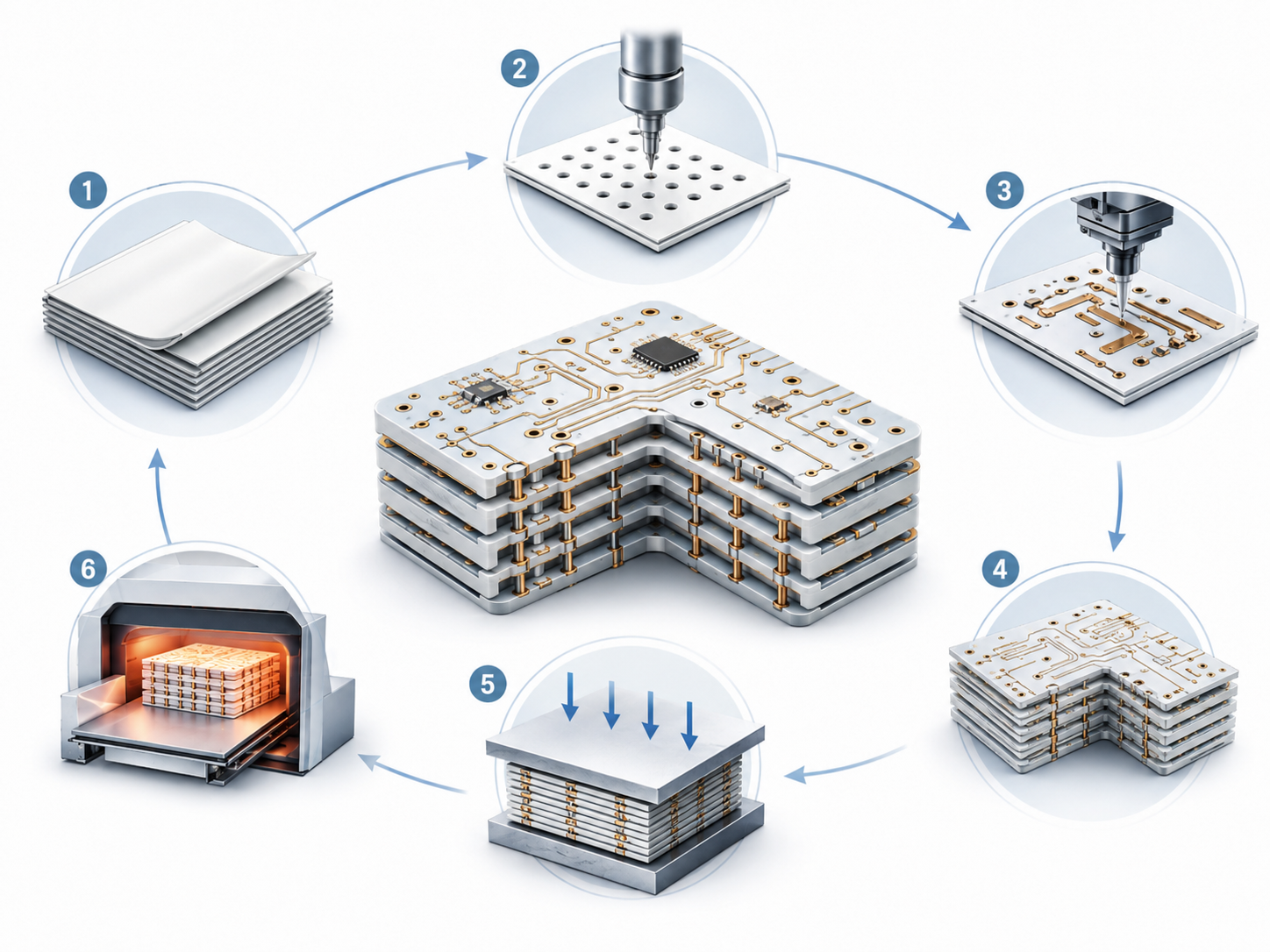
The word “low temperature” is important. Compared with high-temperature ceramic processes, LTCC can be fired at lower temperatures because glass materials are mixed into the ceramic system. This lower firing temperature allows the use of low-resistance conductor materials, including copper or silver, depending on the system design and manufacturing process. Kyocera notes that LTCC can use low electrical resistance metals such as copper and can offer lower transmission loss than conventional alumina ceramics, which makes it suitable for cutting-edge semiconductor packages and high-frequency devices.
From a market perspective, this means LTCC is attractive when a product needs both ceramic reliability and electrical performance. It can support multilayer routing, embedded passive structures, compact RF layouts, and stable performance in demanding environments.
How Large Is the Low Temperature Co-Fired Ceramics Market?
Public market reports show that LTCC-related markets are growing, but the reported market size varies significantly. This is normal because different reports use different statistical boundaries. Some reports count LTCC materials. Some count LTCC ceramic substrates. Some include LTCC components, modules, or even LTCC and HTCC together.
For example, Market Research Future estimates that the low temperature co-fired ceramic market will grow from USD 3.29 billion in 2024 to USD 6.35 billion by 2035, with a projected CAGR of 6.16%. The same report highlights consumer electronics and automotive electronics as important application segments.
Other reports use a different market scope. Knowledge Sourcing estimates the global low temperature co-fired ceramic substrate market at USD 9.5 billion in 2025 and projects it to reach USD 15.8 billion by 2030, with a CAGR of 10.73%. Intel Market Research, using a narrower LTCC ceramic substrate scope, estimates the market at USD 404 million in 2024 and projects it to reach USD 631 million by 2032, with a CAGR of 6.9%.
The practical conclusion is clear: LTCC is a growing market, but buyers should check the scope before comparing numbers. A report about “LTCC market,” “LTCC ceramic substrate market,” and “LTCC and HTCC market” may describe different product categories.
What Is Driving Growth in the LTCC Market?
The LTCC market is growing because several electronics sectors are facing the same design pressure: more functions, higher frequency, smaller space, and higher reliability.
5G and high-frequency communication
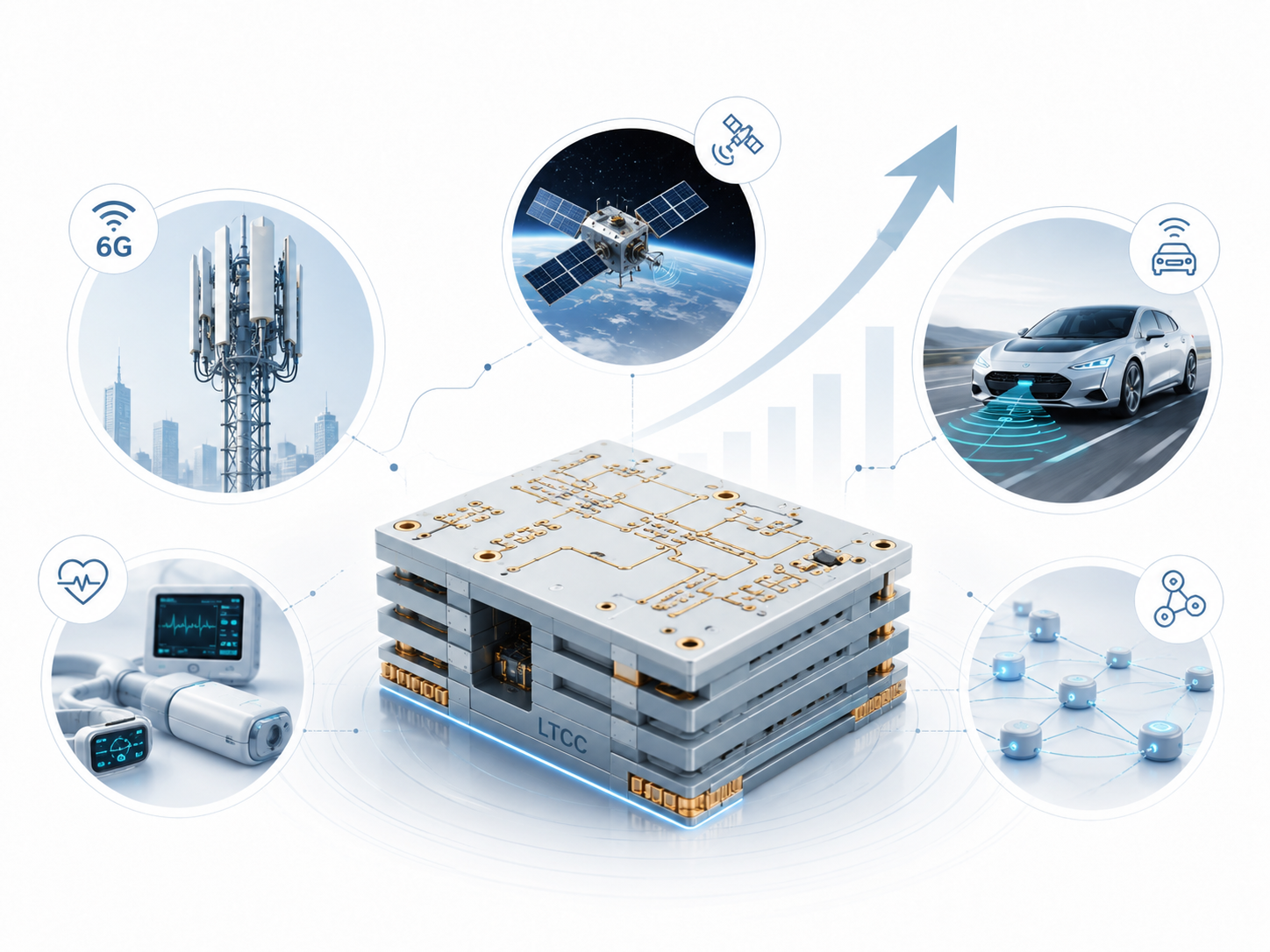
5G communication, Wi-Fi modules, Bluetooth modules, satellite communication, and RF front-end designs all require stable dielectric behavior and compact multilayer structures. LTCC is well suited for filters, diplexers, couplers, baluns, antennas, and RF modules. Murata describes multilayer LC filter products as structures made by stacking ceramic sheets that incorporate inductors and capacitors, supporting products such as filters, diplexers, couplers, and baluns for evolving communication standards.
Automotive electronics
Automotive radar, ADAS sensors, vehicle communication modules, powertrain control, and harsh-environment electronics all require high reliability. In automotive systems, stable electrical performance and mechanical durability are often more important than the lowest possible substrate cost. LTCC fits applications where compact design, environmental stability, and long operating life are required.
Miniaturization of electronic devices
As electronic products become smaller, designers need substrates that can integrate multiple layers, signal paths, passive functions, and package structures in limited space. LTCC can help reduce module size by embedding or integrating part of the circuit structure into the ceramic body.
Aerospace, defense, and medical electronics
These applications usually have strict requirements for reliability, frequency stability, hermeticity, and material performance. LTCC is often selected for high-value systems where stable operation matters more than basic material cost.
Which Applications Are Creating the Strongest Demand for LTCC?
LTCC demand is concentrated in applications where high-frequency performance, multilayer integration, and stable reliability are needed at the same time.
| Application Area | Why LTCC Is Used | Typical Products |
|---|---|---|
| 5G and RF communication | Low-loss multilayer design and compact RF integration | Filters, antennas, couplers, baluns, RF modules |
| Automotive electronics | Stable performance under heat, vibration, and long service cycles | Radar modules, sensors, ADAS electronics |
| Semiconductor packaging | Fine multilayer routing and lower transmission loss | RF packages, high-frequency packages, sensor packages |
| Aerospace and defense | High reliability, dimensional stability, and environmental resistance | Microwave modules, radar electronics, hermetic packages |
| Medical electronics | Miniaturized structure and stable long-term performance | Implantable electronics, diagnostic modules, sensor systems |
| IoT and compact devices | Smaller module size and integrated passive functions | Wireless modules, compact sensors, smart device modules |
Among these areas, RF communication and automotive electronics are especially important because both markets continue to demand smaller, faster, and more reliable electronic modules. Market Research Future also identifies consumer electronics and automotive electronics as major application segments in the LTCC market.
LTCC Market by Product Type: Materials, Substrates, and Modules
To understand the LTCC market correctly, it is useful to divide it into three layers: materials, substrates, and modules.
LTCC materials include ceramic powder systems, glass ceramic materials, conductive pastes, dielectric materials, and compatible metallization systems. These materials determine firing behavior, shrinkage control, dielectric constant, dielectric loss, mechanical strength, and conductor compatibility.
LTCC ceramic substrates are multilayer ceramic circuit structures used for interconnection, packaging, and signal transmission. They may include internal vias, filled vias, conductor traces, embedded passive elements, and surface metallization.
LTCC components and modules include filters, antennas, sensors, RF modules, microwave packages, couplers, and integrated ceramic packages. These products usually carry higher added value because they combine substrate manufacturing, electrical design, and functional integration.
This distinction matters for market analysis. A substrate-only market report may show a smaller value than a report that includes complete RF modules. A material report may focus on raw material demand, while a module report may reflect downstream electronics value.
LTCC vs HTCC vs Traditional Ceramic Substrates: Where Is the Market Difference?
LTCC, HTCC, and traditional ceramic substrates are not direct replacements in every project. They serve different engineering needs.
| Item | LTCC | HTCC | Traditional Alumina Ceramic Substrate |
| Firing temperature | Lower firing temperature | Higher firing temperature | Depends on process |
| Conductor compatibility | Can use low-resistance metals such as silver or copper | Often uses refractory metals such as tungsten or molybdenum | Usually uses thick film, thin film, DPC, or DBC processes |
| Main strength | High-frequency performance and multilayer integration | High-temperature reliability and hermetic packaging | Cost-effective insulation and thermal stability |
| Typical applications | RF modules, sensors, antennas, high-frequency packages | Hermetic packages, power packages, military electronics | LED, power electronics, industrial ceramic PCB |
| Market position | High-value integration platform | High-reliability ceramic packaging | Broad ceramic substrate solution |
LTCC is usually selected when the project requires compact multilayer routing, lower transmission loss, and integration of passive or RF functions. HTCC is often used when higher-temperature processing and strong hermetic packaging are required. Traditional alumina ceramic substrates remain important when customers need insulation, heat resistance, and cost-effective ceramic performance.
Which Regions Are Leading the LTCC Market?
The LTCC market is closely related to the global electronics supply chain. Demand is stronger in regions with advanced electronics manufacturing, semiconductor packaging, RF component production, automotive electronics, aerospace, and medical device development.
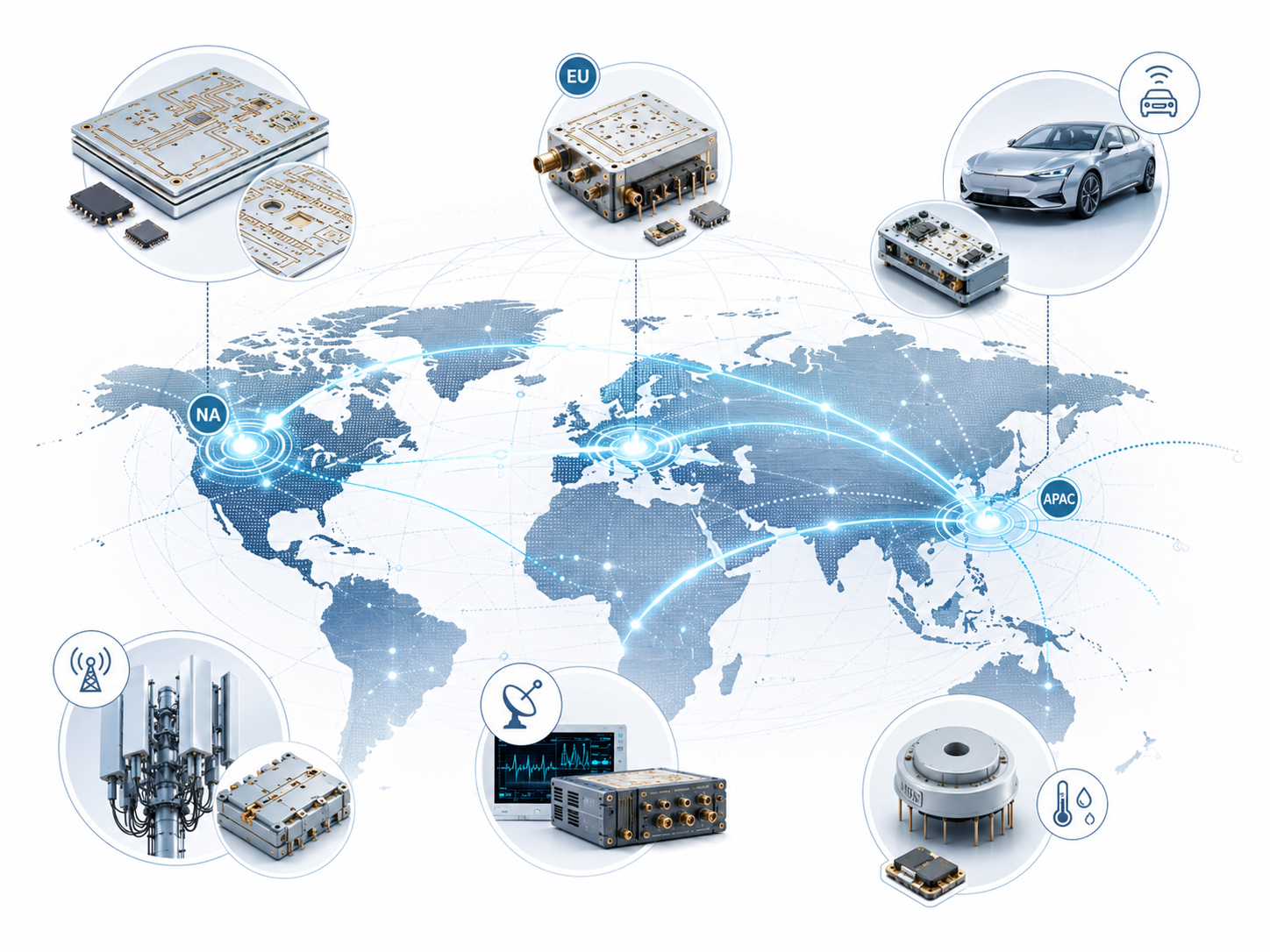
Asia-Pacific has strong demand because of its large electronics manufacturing base, communication device production, semiconductor packaging activity, and automotive electronics supply chain. Japan, China, South Korea, and Taiwan are important players in ceramic electronic components and high-frequency module manufacturing.
North America is important for aerospace, defense, medical electronics, advanced semiconductor packaging, and high-end communication systems. These sectors often value reliability, material qualification, and long-term performance.
Europe has strong demand from automotive electronics, industrial control, medical technology, and sensor applications. Automotive radar, ADAS, and industrial sensing are especially relevant for LTCC-related products.
A broader ceramic substrate market report from Mordor Intelligence states that LTCC accounted for 36.86% of ceramic substrate revenue by manufacturing process in 2025, which indicates that LTCC is a meaningful segment within the larger ceramic substrate market.
Who Are the Key Companies in the LTCC Market?
The LTCC market includes material suppliers, ceramic substrate manufacturers, electronic component companies, and module producers. Representative companies often mentioned in public market discussions include Kyocera, Murata, DuPont, TDK, KOA, Yokowo, Nikko, and NEO Tech.
Market Research Future lists DuPont, Kyocera Corporation, and Murata Manufacturing as key players in the low temperature co-fired ceramic market. These companies are connected to different parts of the value chain, including materials, ceramic packages, components, and integrated modules.
For buyers, the company list is less important than capability matching. A good LTCC supplier should understand ceramic material behavior, multilayer structure design, conductor compatibility, shrinkage control, surface metallization, and electrical testing. In high-frequency projects, the supplier also needs experience with dielectric properties, signal transmission, and layout-related manufacturing limits.
What Challenges Could Affect LTCC Market Growth?
LTCC has strong technical value, but it is not the best choice for every electronic product. Buyers need to understand its practical limitations before starting a project.
Cost is higher than ordinary PCB solutions.
LTCC materials, tooling, process control, and firing management increase manufacturing cost. It is usually selected for high-value applications rather than low-cost general electronics.
Design rules must be considered early.
LTCC is not just a board material that can be changed late in the project. Layer count, via structure, conductor paste, shrinkage rate, metallization, dielectric properties, and package requirements should be considered during the design stage.
Process control is demanding.
Because ceramic layers and conductors are co-fired, dimensional shrinkage and layer alignment must be tightly controlled. Poor control can affect circuit accuracy, electrical performance, and package reliability.
Qualification cycles can be long.
Automotive, aerospace, defense, and medical projects often require long validation cycles. Customers should prepare enough time for prototype verification, reliability testing, and production approval.
These challenges do not weaken the market potential of LTCC. They simply show that LTCC is a technical solution for demanding applications, not a universal replacement for FR4, aluminum substrate, alumina PCB, or standard ceramic PCB.
How Should Buyers Evaluate LTCC Ceramic Substrate Suppliers?
Choosing an LTCC supplier should not be based only on price. A low quotation may not help if the supplier cannot control the material system, firing process, or high-frequency performance.
Buyers should evaluate suppliers from these practical points:
| Evaluation Point | Why It Matters |
| Material system experience | Determines dielectric behavior, shrinkage, thermal performance, and conductor compatibility |
| Multilayer design capability | Affects routing density, internal vias, embedded functions, and module size |
| Co-firing process control | Influences dimensional accuracy, layer bonding, and long-term reliability |
| Metallization options | Supports different electrical, soldering, bonding, and packaging requirements |
| Testing capability | Helps verify electrical performance, insulation, reliability, and dimensional quality |
| Prototype support | Reduces risk before mass production |
| Application experience | Helps the supplier identify design risks earlier |
For RF and high-frequency products, customers should also ask about dielectric constant, dielectric loss, conductor roughness, via structure, surface finish, and impedance-related design support. For automotive or medical projects, reliability testing and documentation control are also important.
What Is the Future Outlook for the LTCC Market?
The future of the LTCC market will be shaped by high-frequency communication, compact packaging, automotive sensing, advanced medical electronics, aerospace systems, and semiconductor-related applications. As products become smaller and operating frequencies increase, LTCC will remain attractive for applications where organic substrates have limited performance margin.
The market is unlikely to grow because LTCC replaces every standard PCB. Its growth will come from targeted applications where customers need stronger signal integrity, better stability, higher integration, and ceramic-level reliability. That is why LTCC is more accurately described as a high-value integration platform than a simple ceramic substrate.
In the next few years, demand is expected to remain strongest in RF modules, 5G/6G-related communication devices, automotive radar, sensor packages, microwave electronics, and compact high-reliability modules. Public reports generally support continued growth, although their market size estimates vary because of different statistical scopes.
Conclusion
The low temperature co-fired ceramics market is expanding because modern electronics need smaller structures, higher-frequency performance, stable multilayer integration, and stronger long-term reliability. LTCC is especially valuable in applications where signal loss, space limitation, temperature stability, and packaging reliability directly affect product performance.
For customers, the key question is not simply whether LTCC is advanced. The real question is whether the application requires the specific advantages LTCC can provide. RF modules, automotive radar, medical electronics, aerospace systems, sensors, and high-frequency packages are among the most suitable areas.
If you are developing LTCC ceramic substrates, high-frequency ceramic packages, RF modules, sensor substrates, or ceramic-based electronic modules, BSTCeramicPCB can help evaluate material selection, structure design, prototype requirements, manufacturing feasibility, and production planning. Share your drawings, electrical requirements, working environment, and expected quantity with our team, and we will help you review the best ceramic substrate solution for your project.
 Products
 About us
 Contact us