































 HOME
HOME


-

Ceramic PCB for Humanoid Robot joint actuators
2026 04,07 -
LTCC PCB Surprises: What Most People Miss
2025 12,09 -
Step-by-Step Guide to DPC PCB Design for Sensor Systems
2025 12,03 -
Ceramic PCBs Essential Benefits and Applications
2025 12,01 -
How Al2O3 DPC Ceramic Substrate PCB Enhances Heat Dissipation in Modern Electronics?
2025 11,28 -
How to Choose Between Ceramic, FR4, and Metal Core PCBs
2025 11,27 -
DPC Ceramic PCB Materials: Surprising Science Inside
2025 11,26 -
Wire bondable 2-layer Alumina substrates PCB | Bstceramic PCB
2025 09,22 -
Silicon Nitride Substrate, Silicon Nitride Ceramic Substrate Formula
2025 05,08 -
What is thick film ceramic PCB?
2023 08,02
REACH and RoHS 3 Compliance for Ceramic PCB Exporters
Published:
Table of Contents
- 1. Market Outlook: Brazil‘s Electronics Industry & the Rising Bar for PCB Compliance
- 2. Regulatory Deep Dive: What “Brazil REACH” & “Brazil RoHS” Really Mean for Ceramic PCBs
- 3. Decision Matrix: How Brazilian Engineers & Procurement Professionals Select PCB Suppliers with REACH/RoHS Compliance
- 4. Why BST Ceramic PCB Is the Strategic Compliance Partner for Your Brazil Market Entry
- 5. Real-World Validation: BST‘s RoHS/REACH-Ready Ceramic PCB Portfolio for Brazilian OEMs
- 6. Frequently Asked Questions About REACH & RoHS Compliance for Ceramic PCB Import into Brazil
-
7. Get in Touch with BST’s Export Compliance Team
Internal navigation: click a heading to jump directly to that section

Market Outlook: Brazil’s Electronics Industry & the Rising Bar for PCB Compliance
Brazil is the heartbeat of South American electronics, characterized by its “China + 1” potential and a robust internal market. In 2026, the Brazilian electronics industry is entering a transformative phase. Following a 4% revenue increase in 2025, the sector forecasts BRL 289 billion in revenue for 2026, representing 3% real growth, with employment reaching approximately 292,000 and investment projected to grow 7% to BRL 500 million. The PCB market in Brazil is experiencing steady growth driven by increasing demand for electronic devices across automotive, telecommunications, and consumer electronics sectors.
However, this growth brings mounting regulatory complexity. Starting in 2025, Brazil began rolling out two major environmental compliance frameworks modeled closely on European standards:
- Brazil REACH (Law 15,022/2024) — a comprehensive chemical management system regulating the registration, risk assessment, and management of chemical substances;
- Brazil RoHS (draft published in August 2025) — a restriction of hazardous substances regulation that largely mirrors EU RoHS 2.0/3 standards, limiting 10 substances in electrical and electronic equipment sold in Brazil.
For ceramic PCB exporters targeting the Brazilian market, these regulations are not optional. Non-compliance carries severe penalties — up to 2 million BRL in fines, product registration denial, potential product recalls and suspension of sales, as well as mandatory public disclosure of corrective measures.
Read more: Ceramic PCB for industrial electronics applications →
Regulatory Deep Dive: What “Brazil REACH” & “Brazil RoHS” Really Mean for Ceramic PCBs
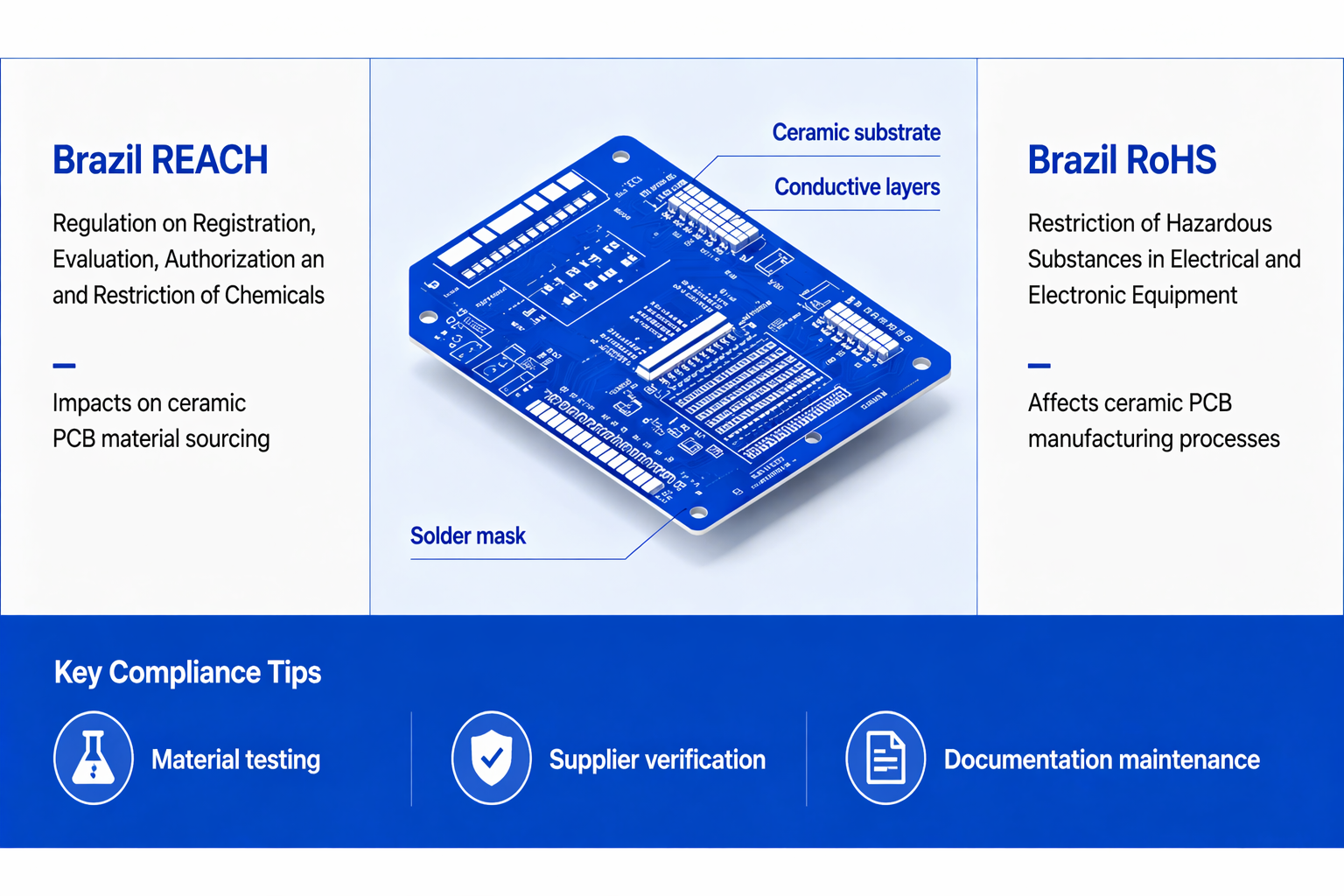
Brazil has established a chemical management framework similar to EU REACH. For ceramic PCB exporters, two separate but overlapping compliance tracks are converging in 2026.
Brazil REACH (Law 15,022/2024) was enacted in November 2024 and modeled explicitly on EU REACH. The implementing regulation draft was published in May 2025 for public consultation. Key features include:
- Registration threshold: Chemical substances manufactured or imported at ≥1 ton/year (3-year rolling average) must be registered in Brazil‘s National Chemical Substance Inventory.
- Obligated entities: Manufacturers, importers, and offshore manufacturers’ “Only Representative” (OR) are all subject to registration.
- Tiered fee structure: Registration fees range from R$ 50 (for micro/small enterprises in lower tonnage bands) up to R$ 5,000 (for larger entities in higher tonnage bands); risk assessment fees range from R$ 50 to R$ 7,500 depending on submission type.
- Effective timeline: The regulation is expected to take effect in Q4 2025, with an 18-month transition period for existing substances.
Brazil RoHS is moving through its final legislative stages in 2026. On August 8, 2025, Brazil‘s National Environment Council (CONAMA) launched a public consultation on a draft RoHS-style regulation proposing to restrict 10 hazardous substances in electrical and electronic equipment sold in Brazil. The restricted substances and limits are identical to EU RoHS:
| Substance | Limit (homogeneous material) | Effective Timeline |
|---|---|---|
| PBB, PBDE | 0.1% | Immediately upon enactment |
| Mercury (Hg) | 0.1% | 180 days after enactment |
| Lead (Pb), Cr-VI | 0.1% | 3 years after enactment |
| Cadmium (Cd) | 0.01% | 3 years after enactment |
| Four phthalates (DEHP, BBP, DBP, DIBP) | 0.1% | 4 years after enactment |
The Brazil RoHS draft questionnaire period closed on September 24, 2025. The technical committee voted to approve the revised draft in early 2026. The proposal is now under legal review, with final passage expected by late 2026. Critically, Brazil RoHS introduces mandatory pre-market registration in a national database and a Declaration of Conformity (DoC) that complies with Brazil-specific requirements — not merely EU DoC equivalents.
Learn more: BST Ceramic PCB manufacturing certifications →
Decision Matrix: How Brazilian Engineers & Procurement Professionals Select PCB Suppliers with REACH/RoHS Compliance
Brazilian buyers operate with a distinct decision-making logic. Unlike their European or North American counterparts, Brazilian importers must navigate excessive taxation structures, complex logistics, decentralized regulatory enforcement, and heavy reliance on in-country representatives or local BRHs (Brazilian Registration Holders). Ceramic PCB suppliers must understand these layers to win contracts.
Compliance Verification & Documentation
Before price discussions, Brazilian procurement teams want to see evidence of compliance. Key documentation includes documented third-party verification of REACH and RoHS conformance through accredited laboratories, a seller‘s Declaration of Conformity (DoC) that follows the upcoming Brazilian standard, compliance certification for EU REACH and RoHS 3, as well as Portuguese-language technical files and safety data sheets for chemical substances that fall under Brazil REACH (substances ≥1 ton/year).
Brazil’s 2025–2026 tax reform pilot merges traditional taxes into the new CBS and IBS systems, and new regulations require full transparency in RoHS/REACH compliance. Suppliers who cannot produce verifiable compliance records are eliminated early.
Supply Chain Due Diligence & Contamination Risk
For ceramic PCB manufacturers, the greatest risk lies not in raw ceramic itself, but in secondary materials — conductive silver pastes, nickel/gold plating solutions, solder masks, and via-filling materials. These often contain lead, cadmium, or phthalates at levels that exceed upcoming Brazilian limits. Brazilian engineers know that a PCB is only as compliant as its weakest material. BST maintains full material traceability and prohibits restricted substances at all processing stages.
Supply Chain Resilience in the Brazilian Context
Brazil‘s electronics industry operates with significant “Custo Brasil” (Brazil Cost) logistics overhead. Local PCB fabrication often lacks advanced HDI and multilayer ceramic capabilities. Brazilian sourcing professionals evaluate suppliers for consistent lead times, understanding of import duty structures, and the ability to register products through a local entity or OR. BST offers flexible logistics support and compliance documentation to help Brazilian importers register PCB products in Brazil’s national databases.
The Critical Role of an In-Country Representative (BRH)
Brazil mandates that imported products have a legally responsible entity within Brazil to sign off on regulatory filings, accept legal service, and manage product recall obligations. Few international PCB suppliers offer this capability. BST works with qualified legal partners to assist Brazilian clients in meeting registration and legal liaison requirements — reducing risk and administrative friction substantially.
Lifecycle Compliance & Product Stewardship
Brazil‘s National Solid Waste Policy (PNRS) and directives published in early 2026 regarding reverse logistics for electronics impose extended producer responsibility on component manufacturers. Portaria GM/MMA No. 1,560 set recycling targets at 17% of the total weight of household electronics sold domestically. Suppliers who can demonstrate responsible material sourcing and assist in compliance with reverse logistics obligations are valued partners. BST’s REACH/RoHS-ready materials reduce downstream compliance burdens for Brazilian OEMs.
Submit your compliance requirements: Request BST compliance documentation for Brazil →
Why BST Ceramic PCB Is the Strategic Compliance Partner for Your Brazil Market Entry
BST Ceramic PCB supports Brazilian importers with full REACH and RoHS 3 compliance readiness. Every ceramic PCB we produce — whether Al₂O₃, AlN, LTCC, thick-film, or thin-film ready — is manufactured using materials and processes that meet the EU and (by extension) Brazil RoHS draft thresholds.
BST’s compliance credentials for the Brazilian market include:
- RoHS 3 (EU 2015/863) compliance: All BST products fully comply with the restriction of 10 hazardous substances;
- REACH compliance: Full documentation of SVHC (Substances of Very High Concern) compliance available on request;
- Third-party test reports: Every batch can be accompanied by accredited laboratory test reports verifying compliance down to parts-per-million levels;
- Portuguese compliance documentation: BST can supply DoC templates and technical data in a format easily adapted for Brazilian registration;
- Direct support for Brazilian registration: BST assists clients in preparing the technical documentation needed for Brazil‘s national registration database.
Why Brazilian OEMs and EMS providers choose BST:
- Cost advantage: 30–40% lower unit cost than domestic Brazilian ceramic PCB production or European imports;
- Flexible MOQ: Prototype to mass production (5–10,000 pcs/month, scalable higher);
- Short lead times: 5–10 days for prototypes; 15–20 days for production; 3–5 days express shipping to São Paulo, Manaus, Curitiba, Porto Alegre;
- Full material range: Al₂O₃ (96%/99.6%), AlN (thermal conductivity 170–230 W/mK), LTCC multilayer, thick-film printed, thin-film ready;
- IATF 16949 & ISO 9001:2015 certified — automotive-grade quality for critical sensor applications.
Compare: BST vs. other ceramic PCB suppliers on compliance →
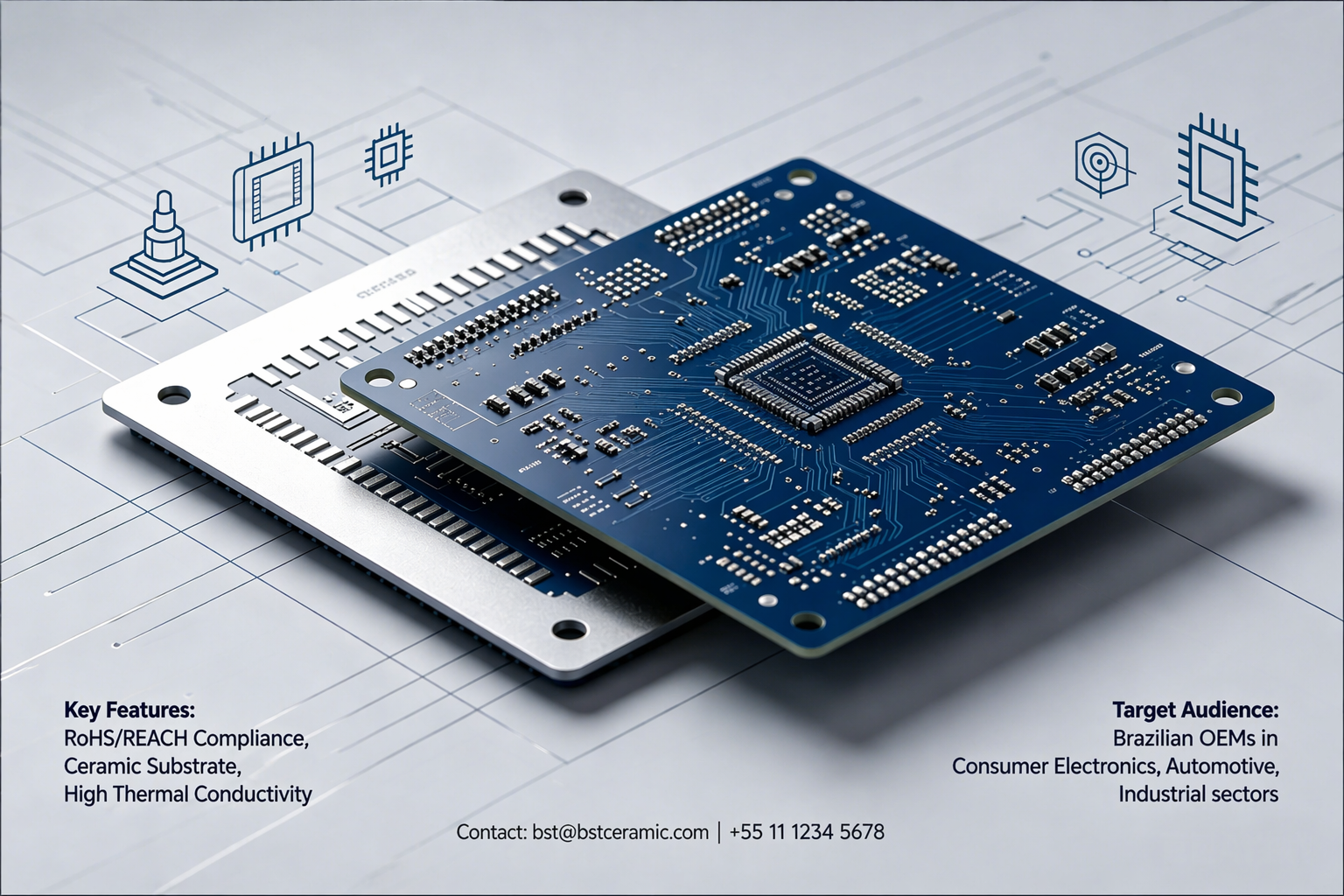
Real-World Validation: BST‘s RoHS/REACH-Ready Ceramic PCB Portfolio for Brazilian OEMs
Brazilian electronics production is concentrated in three strategic hubs:
-
Manaus Free Trade Zone (ZFM / PIM) — “tax haven” for high-volume PCB assembly for smartphones, TVs, and motorcycles;
-
São Paulo & Campinas — “Silicon Valley of Brazil,” home to R&D and aerospace giants like Embraer, requiring advanced multilayer PCBs;
-
Southern Brazil (Curitiba/Porto Alegre) — automotive and industrial automation hub.
In 2026, Brazilian engineers are prioritizing automotive digitalization (heavy copper PCBs for battery management systems), IoT and smart cities (multilayer PCBs with RF capabilities), and sustainability (full RoHS/REACH transparency). BST delivers across all three sector needs.
Furthermore, Brazil‘s reverse logistics directives and hazardous substance restrictions serve as powerful drivers for component-level compliance. BST provides documented material origin, restricted substance testing, and auditable quality records — enabling Brazilian OEMs to meet their own ESG and regulatory reporting requirements.
Explore BST’s full ceramic PCB range: Materials and capabilities →
Frequently Asked Questions About REACH & RoHS Compliance for Ceramic PCB Import into Brazil
Q1: Is ceramic PCB subject to Brazil REACH?
A: Yes — ceramic PCBs contain chemical substances in pastes, platings, and laminating materials. If any single substance is imported at ≥1 ton/year across all products, registration under Brazil REACH (Law 15.022/2024) is required. BST can supply substance volume data to assist registration.
Q2: What is the difference between EU RoHS 3 and Brazil RoHS draft?
A: The substance restriction list is identical (10 substances). The major differences are Brazil‘s mandatory pre-market registration in a national database and a Brazil-specific Declaration of Conformity (DoC) not interchangeable with EU DoC.
Q3: What is the lead time for Brazil RoHS final enforcement?
A: The draft completed public consultation in September 2025. Legislative approval is expected in H2 2026, with phased effective dates for different restricted substances. Early compliance is strongly advised.
Q4: Does BST provide third-party test reports for RoHS compliance?
A: Yes — BST can supply test reports from accredited laboratories verifying restricted substance limits down to ppm levels, ready for submission to Brazilian authorities.
Q5: What if my PCB uses an exempted application under Brazil RoHS?
A: Exemptions exist for defense/aerospace, large industrial equipment, vehicles, R&D, and certain medical devices. BST can help assess potential exemption applicability.
Q6: Does BST offer ceramic PCBs with RoHS-compliant surface finishes?
A: Yes — ENIG (Electroless Nickel Immersion Gold) is fully RoHS-compliant and ideal for wire-bonding. Silver and gold thick-film pastes are also RoHS 3 certified.
Q7: What is the typical cost difference between BST and domestic Brazilian PCB suppliers?
A: BST typically offers 30–40% lower unit cost than domestic Brazilian production while meeting the same or stricter compliance standards due to scale advantages in ceramic substrate manufacturing.
Q8: Can BST support product registration in Brazil‘s national database?
A: BST provides technical documentation, material composition data, and DoC templates — but a local Brazilian representative (BRH) is legally required to perform the actual registration. BST can connect clients with qualified BRH partners.
Q9: What happens if my products fail Brazil RoHS inspection?
A: Non-compliant products may be denied market access, recalled, or subject to fines up to 2 million BRL, with corrective measures published in media. Prevention through supplier verification is essential.
Q10: How do I request BST compliance documentation for Brazilian customs?
A: Simply submit your inquiry via the RFQ form or directly at sales@bstceramicpcb.com. Include your target annual import volume (helps assess Brazil REACH threshold) and preferred ceramic substrate specifications.
More FAQs: Contact BST compliance team →
Get in Touch with BST‘s Export Compliance Team
Brazilian engineers, procurement professionals, and EMS partners — when you need a ceramic PCB partner who truly understands REACH and RoHS 3 compliance for hassle-free importation into the Brazilian market, BST is ready to support you.
E-mail: sales@bstceramicpcb.com
Website: www.bstceramicpcb.com
Standard offering: Quote within 48 business hours | DFM review | Full compliance documentation | RoHS 3 test reports | REACH SVHC declaration
 Products
 About us
 Contact us