







































 HOME
HOME

-

Ceramic PCB for Humanoid Robot joint actuators
2026 04,07 -
LTCC PCB Surprises: What Most People Miss
2025 12,09 -
Step-by-Step Guide to DPC PCB Design for Sensor Systems
2025 12,03 -
Ceramic PCBs Essential Benefits and Applications
2025 12,01 -
How Al2O3 DPC Ceramic Substrate PCB Enhances Heat Dissipation in Modern Electronics?
2025 11,28 -
How to Choose Between Ceramic, FR4, and Metal Core PCBs
2025 11,27 -
DPC Ceramic PCB Materials: Surprising Science Inside
2025 11,26 -
Wire bondable 2-layer Alumina substrates PCB | Bstceramic PCB
2025 09,22 -
Silicon Nitride Substrate, Silicon Nitride Ceramic Substrate Formula
2025 05,08 -
What is thick film ceramic PCB?
2023 08,02
Active Metal Brazed Ceramic Substrate Market: Growth, Applications, and Future Trends
The power electronics industry is undergoing a structural transformation driven by electrification, energy efficiency requirements, and the rapid adoption of wide bandgap semiconductors such as SiC and GaN. Applications including electric vehicles (EVs), renewable energy systems, industrial automation, and energy storage are pushing power modules toward higher voltage, higher current, and significantly higher power density. Under these conditions, traditional substrate technologies are increasingly challenged in terms of thermal management, insulation reliability, and mechanical durability.
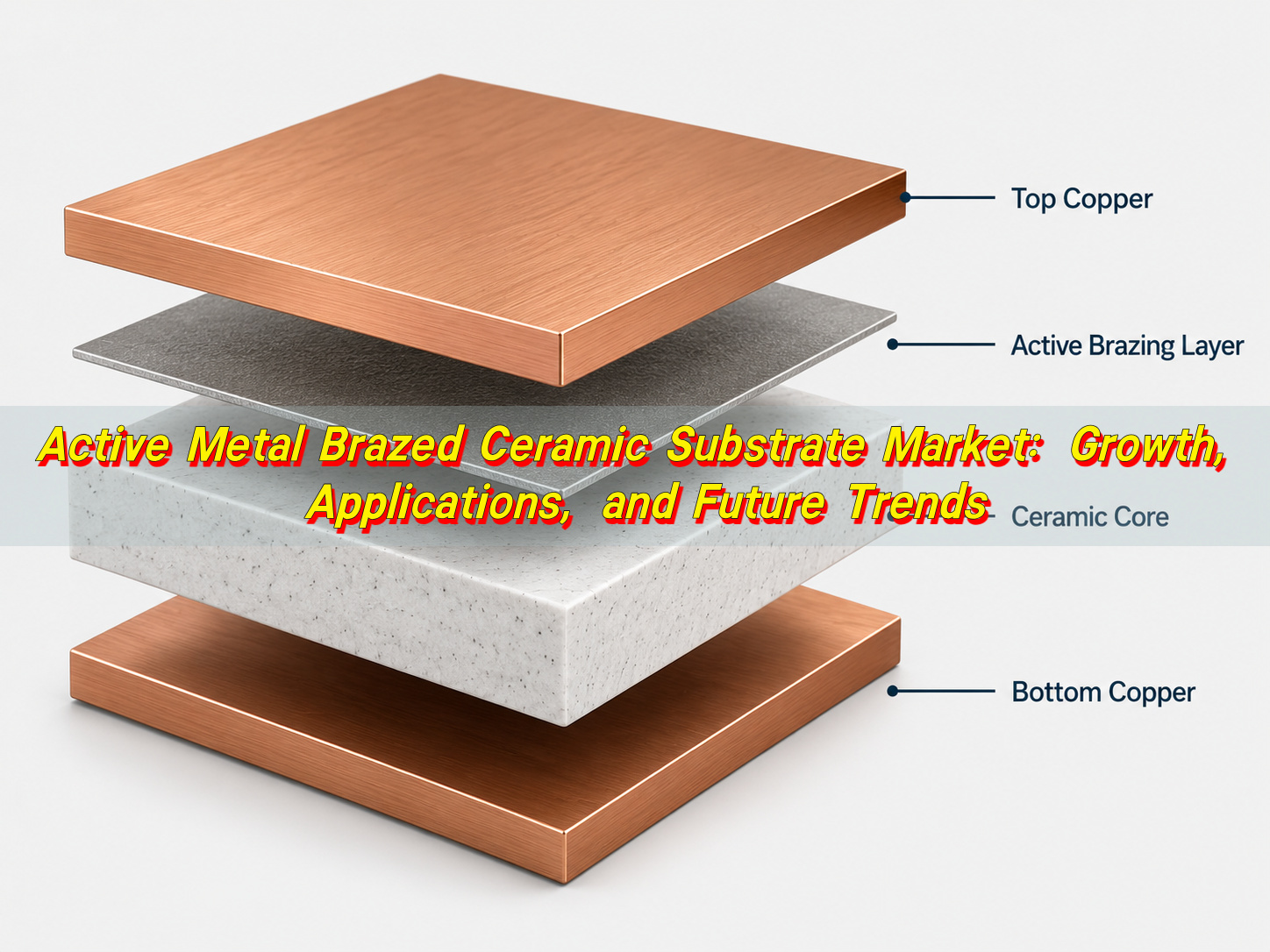
As a result, active metal brazed (AMB) ceramic substrates are gaining attention as a critical enabling technology. Unlike conventional substrates that primarily serve as circuit carriers, AMB substrates play a central role in heat dissipation, electrical insulation, and structural integrity within power modules. Their ability to combine thick copper layers with high-performance ceramic materials makes them particularly suitable for demanding environments where thermal cycling and electrical stress are severe.
What Is an Active Metal Brazed Ceramic Substrate?
An active metal brazed ceramic substrate is a metallized ceramic structure formed by bonding copper layers to ceramic materials using an active metal brazing process. This process involves a brazing alloy that contains reactive elements such as titanium or zirconium, which chemically interact with the ceramic surface to create a strong metallurgical bond.
The resulting structure typically consists of a top copper layer for circuit formation, a ceramic core for insulation and thermal conduction, and a bottom copper layer for heat spreading and mechanical balance. Compared with traditional bonding methods, active metal brazing provides superior adhesion strength and improved reliability under thermal cycling conditions.
Common ceramic materials used in AMB substrates include aluminum nitride (AlN), known for its high thermal conductivity, and silicon nitride (Si₃N₄), valued for its mechanical strength and fracture toughness. These material combinations allow AMB substrates to meet the stringent requirements of modern power modules, where both thermal performance and long-term reliability are critical.
How Large Is the Active Metal Brazed Ceramic Substrate Market?
The global active metal brazed ceramic substrate market is experiencing steady growth, although exact figures vary depending on how the market is defined. According to multiple industry reports and market research analyses, the AMB substrate market is estimated to have reached approximately USD 800 million to USD 1.2 billion in 2023. Forecasts suggest that the market could grow to between USD 2.5 billion and USD 3.5 billion by 2030, representing a compound annual growth rate (CAGR) of around 12% to 18%.
When viewed within the broader context of metallized ceramic substrates, which include DBC, AMB, DPC, and thick-film technologies, the total market size exceeds USD 5 billion and is expected to surpass USD 10 billion by the end of the decade. Within this broader category, AMB is one of the fastest-growing segments due to its suitability for high-reliability and high-power applications.
The growth of the AMB market is closely tied to the expansion of electric vehicles and SiC-based power electronics. For example, the global EV market surpassed 14 million units in 2023 and is projected to exceed 30 million units annually by 2030. Each EV typically contains multiple power modules, many of which are transitioning toward advanced substrate technologies such as AMB to meet performance and reliability requirements.
| Market Segment | Estimated Size (2023) | CAGR (2023–2030) | Key Insight |
|---|---|---|---|
| AMB ceramic substrate market | $0.8B–$1.2B | 12%–18% | Rapid growth driven by EV and SiC adoption |
| DBC + AMB substrate market | $2B–$3B | 8%–12% | Mature base with gradual shift toward AMB |
| Metallized ceramic substrate total | $5B+ | 10%–15% | Strong demand across power electronics sectors |
These figures indicate that while AMB is still a smaller segment compared to DBC, its growth rate is significantly higher, reflecting its increasing importance in next-generation power module design.
Why Is the AMB Ceramic Substrate Market Growing?
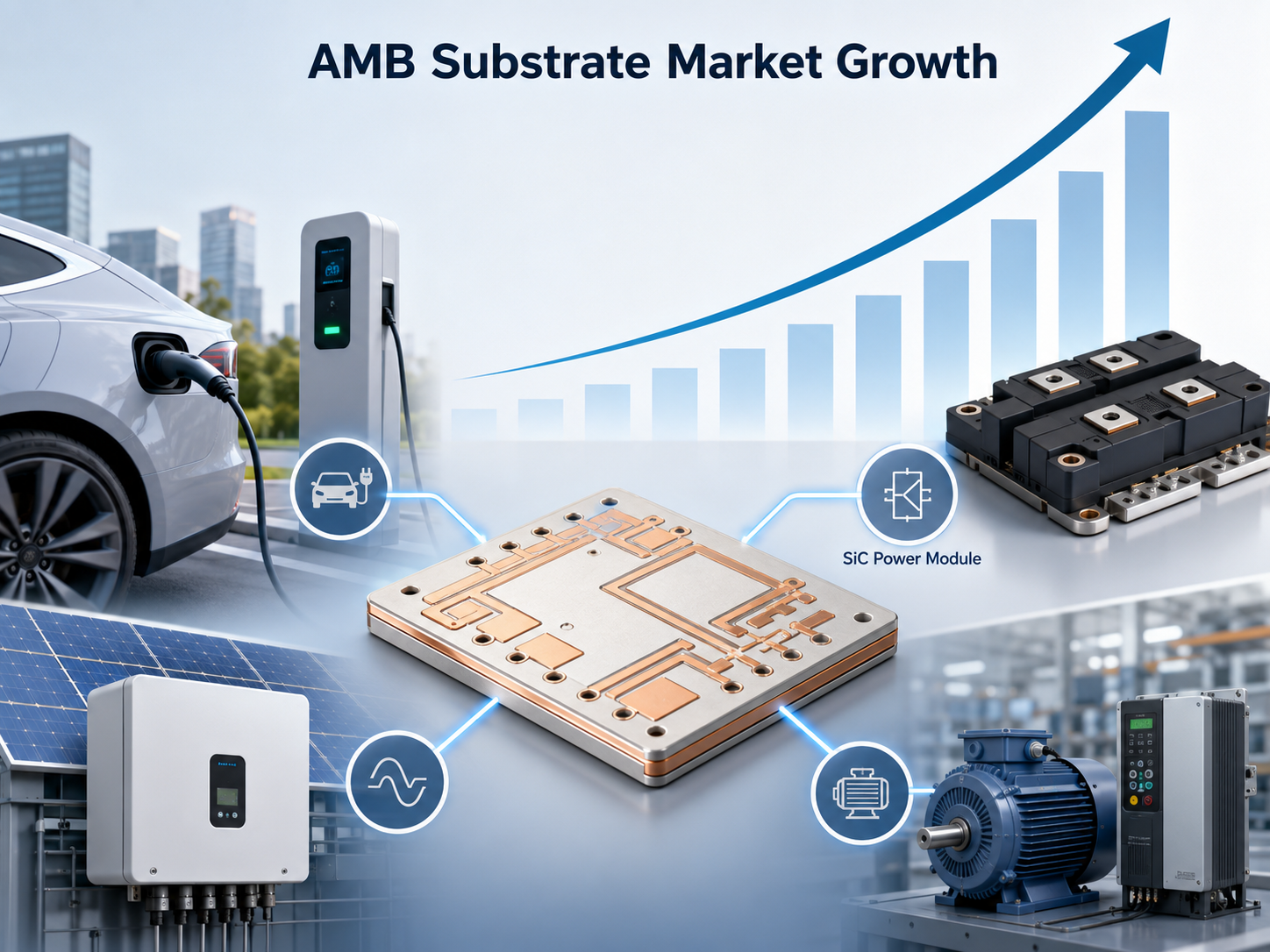
The AMB ceramic substrate market is growing because power modules are becoming smaller, more efficient, and more thermally demanding. These changes increase pressure on substrate materials and bonding structures.
Electric Vehicles Increase Power Module Demand
Electric vehicles use power modules in traction inverters, onboard chargers, DC-DC converters, battery systems, and charging equipment. These modules operate under high voltage, high current, vibration, and repeated temperature changes.
AMB ceramic substrates support these requirements by combining copper conductivity with ceramic insulation. They are especially relevant for EV inverter modules and high-reliability automotive power electronics.
SiC Devices Require Better Thermal Management
Silicon carbide devices can operate at higher temperature and switching frequency than many traditional silicon devices. This improves system efficiency but increases packaging and thermal management requirements.
SiC power modules often generate concentrated heat in compact layouts. AMB substrates based on AlN or Si₃N₄ help transfer heat while maintaining electrical isolation and mechanical stability.
Higher Power Density Requires Stronger Substrates
EV inverters, solar inverters, industrial drives, and energy storage converters are designed with higher output in smaller packages. This requires substrates with better current-carrying capability and heat spreading. Thick copper AMB substrates can support high current paths and efficient thermal transfer. The ceramic layer provides insulation for high-voltage operation.
Reliability Requirements Are Increasing
Power modules used in vehicles, rail systems, renewable energy, and industrial equipment must perform for long service periods. Thermal cycling, insulation resistance, bonding strength, and copper adhesion are critical.
Active metal brazing provides strong copper-to-ceramic bonding. Si₃N₄ AMB substrates further improve resistance to mechanical stress and thermal fatigue, making them suitable for demanding environments.
Which Applications Are Driving AMB Ceramic Substrate Demand?
AMB ceramic substrates are used where heat, current, insulation, and reliability are all important. The strongest demand comes from power electronics.
EV Traction Inverters
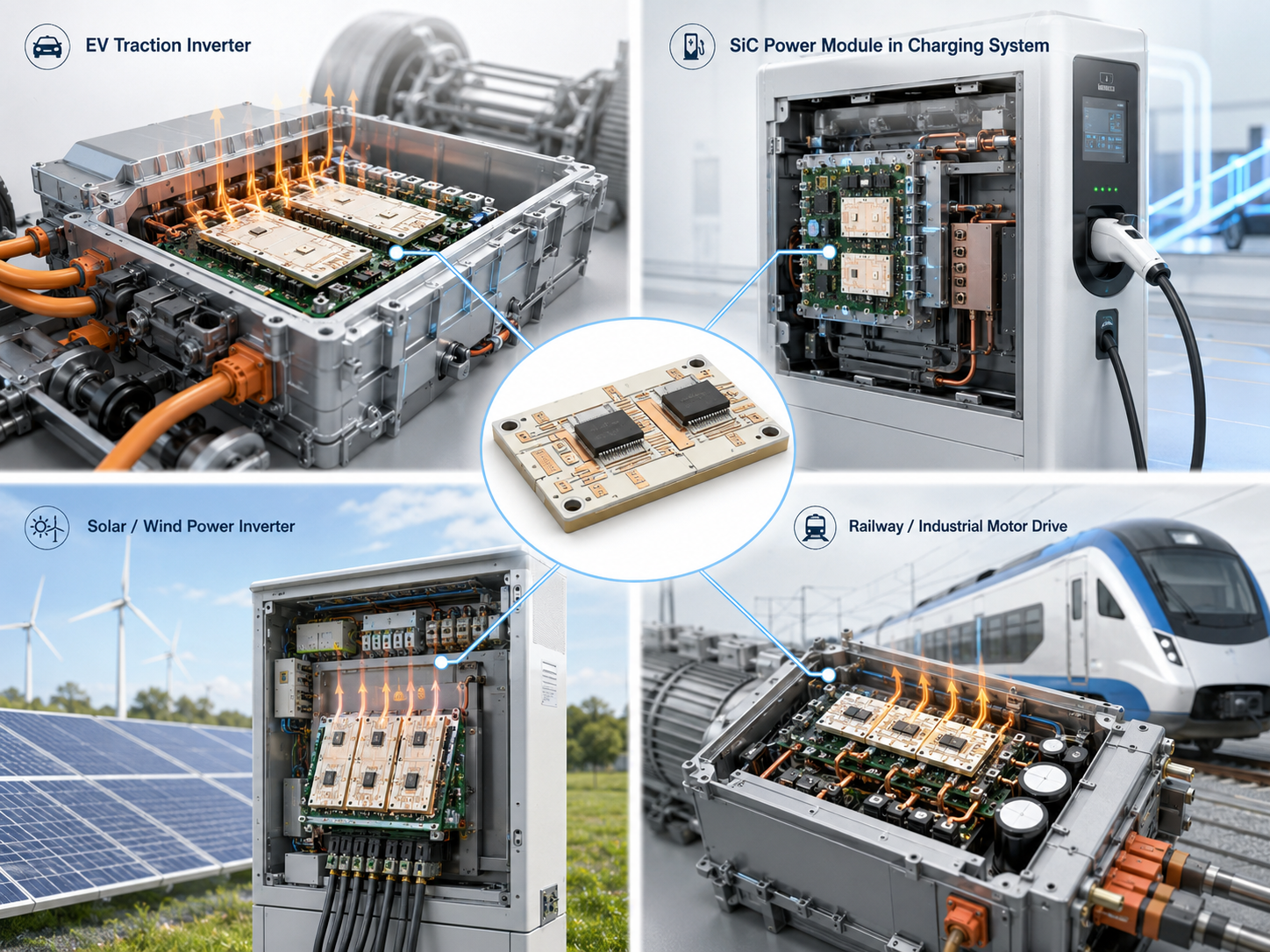
Traction inverters convert DC power from the battery into AC power for the motor. They operate under high current, high voltage, and frequent load changes. An active metal brazed AMB substrate helps manage heat and maintain insulation in compact inverter power modules.
SiC Power Modules
SiC modules are used in EVs, charging stations, renewable energy systems, industrial drives, and high-efficiency converters. These modules require substrates that support high thermal load and stable electrical insulation. AMB substrates are suitable for SiC modules because they allow copper circuit layers to be bonded to AlN or Si₃N₄ ceramic cores.
IGBT Modules
IGBT modules remain widely used in motor control, welding equipment, railway traction, renewable energy systems, and industrial power electronics. AMB ceramic substrates can improve reliability in high-power IGBT modules, especially where thermal cycling and mechanical stress are major design concerns.
Solar and Wind Power Inverters
Solar inverters and wind power converters need reliable power conversion in long-term operating environments. Thermal management and insulation stability are essential. AMB ceramic substrates help improve the durability of power modules used in renewable energy systems.
Railway and Industrial Power Systems
Railway traction systems, industrial motor drives, UPS systems, and heavy-duty power supplies require robust power modules. These systems often operate under repeated thermal and electrical stress. AMB substrates support these applications with strong bonding, high insulation, and effective heat spreading.
Why Are Si₃N₄ AMB Substrates Important in the Market?
Si₃N₄ AMB substrates are becoming a key segment in the active metal brazed ceramic substrate market because many power modules need both thermal performance and mechanical reliability.
Aluminum nitride provides high thermal conductivity. Silicon nitride provides high mechanical strength and better resistance to thermal cycling. For EV power modules, railway traction, and SiC modules, thermal cycling performance is often more important than thermal conductivity alone.
During operation, a power module repeatedly heats and cools. This creates stress between copper and ceramic because the two materials expand at different rates. Si₃N₄ helps reduce reliability risks caused by mechanical fatigue.
For this reason, Si₃N₄ AMB substrates are often used in EV traction inverters, automotive power modules, railway systems, and high-reliability industrial power modules.
AMB vs DBC Ceramic Substrate: Which One Fits High-Power Modules Better?
DBC and AMB are both ceramic substrate technologies used in power electronics. Their difference lies mainly in the bonding method, material compatibility, and reliability performance.
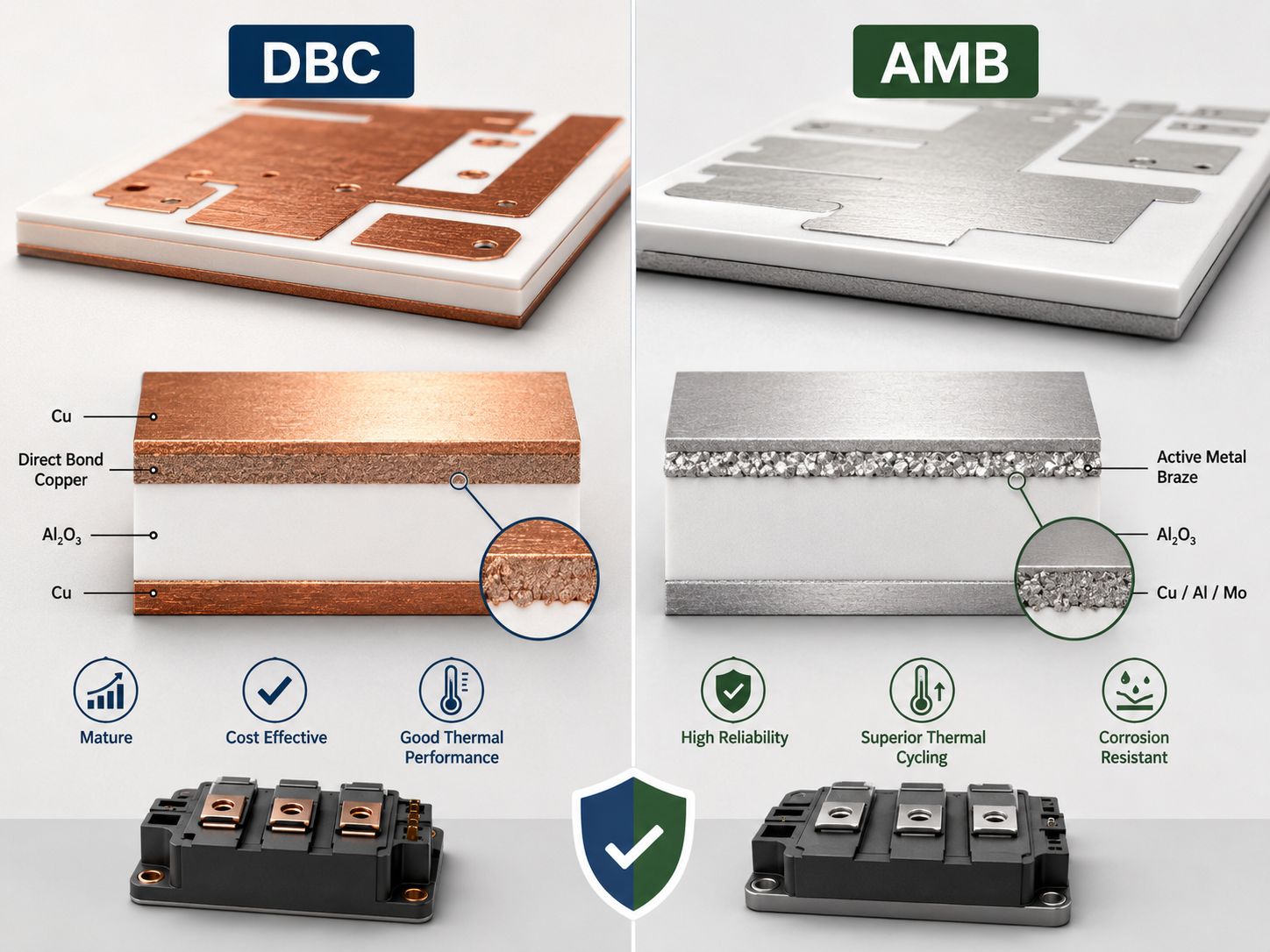
DBC means Direct Bond Copper. It bonds copper directly to ceramic, commonly alumina or aluminum nitride. DBC is mature and widely used in standard power modules.
AMB means Active Metal Brazing. It uses active brazing alloy to bond copper to ceramic. AMB is often selected for AlN and Si₃N₄ substrates that require stronger bonding and better thermal cycling performance.
| Item | DBC Ceramic Substrate | AMB Ceramic Substrate |
| Bonding method | Direct copper bonding | Active metal brazing |
| Common ceramics | Al₂O₃, AlN | AlN, Si₃N₄ |
| Cost level | Usually lower | Usually higher |
| Reliability | Suitable for many standard modules | Stronger under demanding thermal cycling |
| Copper thickness | Suitable for common power modules | Suitable for thick copper structures |
| Typical applications | Industrial modules, power supplies, general inverters | EV, SiC, traction, high-reliability power modules |
DBC remains suitable for many applications. AMB is preferred when the design requires higher reliability, stronger bonding, thicker copper, or better resistance to thermal fatigue.
The final choice depends on voltage, current, chip type, ceramic material, copper thickness, cooling structure, cost target, and lifetime requirement.
What Materials Are Used in Active Metal Brazed Substrates?
Material selection directly affects thermal performance, mechanical strength, insulation, and production cost.
Aluminum Nitride AMB
Aluminum nitride is selected for high thermal conductivity. It is suitable for high-power modules, laser systems, and thermal management applications where heat transfer is the main design priority.
Silicon Nitride AMB
Silicon nitride is selected for mechanical strength and thermal cycling reliability. It is suitable for EV power modules, railway traction, industrial drives, and high-reliability SiC modules.
Copper Layer
Copper provides electrical conduction and heat spreading. Copper thickness depends on current requirement, thermal load, circuit pattern, and mechanical stress. Thicker copper can carry more current, but it also increases thermal stress, so it must be matched with the ceramic material and reliability requirement.
Active Brazing Alloy
The active brazing alloy forms the bonding layer between copper and ceramic. Its quality affects peel strength, thermal cycling performance, and long-term reliability. Stable active metal brazing process control is therefore essential in AMB substrate manufacturing.
What Are the Main Challenges in the AMB Ceramic Substrate Market?
AMB substrates offer strong performance, but the manufacturing and qualification process is demanding.
Cost Control
AMB substrates usually cost more than standard DBC substrates. The cost is affected by ceramic material, copper thickness, active brazing alloy, process control, yield, and testing.
For high-power modules, buyers should evaluate substrate cost together with module reliability and system lifetime.
Material Consistency
High-quality AlN and Si₃N₄ ceramics require stable thickness, surface quality, mechanical strength, and thermal performance. Consistent material supply is important for automotive, railway, and industrial programs.
Process Stability
Active metal brazing requires accurate control of temperature, atmosphere, surface preparation, and bonding conditions. Process variation can affect interface strength and void control.
Pattern Design
Copper pattern design affects current flow, heat spreading, and mechanical stress. Sharp corners, unbalanced copper areas, and unsuitable copper thickness may increase thermal cycling risk.
A reliable design should consider copper symmetry, ceramic thickness, isolation distance, creepage distance, current path, and heat distribution.
Testing Requirements
Power module customers may require insulation resistance, dielectric withstand voltage, peel strength, thermal cycling, visual inspection, and dimensional control. Automotive projects often require stricter qualification.
Which Regions Have Strong Demand for AMB Ceramic Substrates?
Demand for AMB ceramic substrates is linked to electric vehicles, power semiconductor production, industrial automation, and renewable energy infrastructure.
Asia-Pacific
Asia-Pacific has strong demand due to its EV supply chain, power module manufacturing base, and electronics production capacity. China, Japan, and South Korea are active markets for EVs, charging systems, industrial power electronics, and energy storage.
Europe
Europe has demand from automotive electrification, railway systems, industrial drives, renewable energy, and high-efficiency power electronics. Reliability, traceability, and long-term product performance are major purchasing concerns.
North America
North America shows growing demand in SiC devices, EV infrastructure, energy storage, aerospace, data centers, and advanced power electronics. Customers in this region often require detailed engineering support and quality documentation.
How Should Buyers Choose an AMB Ceramic Substrate Supplier?
Choosing an AMB ceramic substrate supplier requires more than comparing unit price. Buyers should evaluate material capability, process control, testing support, and engineering communication.
A qualified supplier should be able to review voltage, current, thermal load, cooling method, ceramic material, copper thickness, surface finish, and assembly method before production.
| Question | Why It Matters |
| Can the supplier support AlN and Si₃N₄ AMB? | Different applications require different ceramic properties |
| What copper thickness can be produced? | Copper thickness affects current capacity and heat spreading |
| Can custom circuit patterns be made? | Power modules often require customized layouts |
| What surface finishes are available? | Surface finish affects soldering, sintering, and wire bonding |
| Can the supplier support prototypes and low-volume production? | Early-stage projects need flexible engineering support |
| What tests can be provided? | Testing verifies insulation, bonding, and reliability |
| Does the supplier understand power module applications? | Application knowledge helps reduce design risk |
For accurate quotation, buyers should provide substrate drawing, ceramic material, copper thickness, surface finish, tolerance, voltage requirement, test requirement, and estimated quantity.
What Is the Future Outlook for the Active Metal Brazed Ceramic Substrate Market?
The active metal brazed ceramic substrate market will continue to grow with the development of power electronics. Several trends are clear. Si₃N₄ AMB substrates will gain more attention in automotive and traction applications because of their strength and thermal cycling performance.
SiC power modules will continue to support AMB adoption. These modules require substrates with strong thermal transfer, high insulation, and stable bonding. Cost optimization will become more important as AMB moves into larger-volume applications. Suppliers with stable processes and reliable material sourcing will have stronger competitiveness.
Customized AMB substrates will become more common. Power module designs are becoming more application-specific, so layout, copper thickness, ceramic selection, and surface treatment require closer cooperation between buyers and manufacturers.
AMB will not replace every ceramic substrate technology. DBC, DPC, thick film, and thin film substrates will continue to serve different markets. AMB will grow fastest in applications that require high power density, high reliability, and strong thermal cycling performance.
Practical Buying Tips for AMB Ceramic Substrate Projects
For a new AMB substrate project, buyers should start from application requirements rather than material names.
An EV traction inverter may require Si₃N₄ AMB because thermal cycling reliability is critical. A high-power laser module may prefer AlN AMB because heat dissipation is the priority. A standard industrial power supply may still use DBC if cost and performance requirements are suitable.
Before requesting a quotation, prepare the following information:
| Item | Details to Provide |
| Ceramic material | AlN or Si₃N₄ |
| Ceramic thickness | Based on insulation and mechanical requirements |
| Copper thickness | Top and bottom copper thickness |
| Circuit data | Drawing, Gerber file, or layout requirement |
| Surface finish | Ni, Au, Ag, or other finish |
| Electrical requirement | Voltage, current, insulation distance |
| Working condition | Temperature range and thermal load |
| Reliability requirement | Thermal cycling, peel strength, dielectric test |
| Assembly method | Soldering, sintering, wire bonding, or other process |
| Quantity | Prototype, low-volume, or mass production |
Complete information helps the supplier review manufacturability, cost, and reliability before production.
FAQs About AMB Ceramic Substrate Market
Q1: Why is AMB ceramic substrate used in SiC power modules?
A1: SiC power modules operate under high temperature, high voltage, and high power density. AMB ceramic substrates provide heat transfer, insulation, and strong copper-ceramic bonding.
Q2: Is AMB better than DBC for automotive power modules?
A2: AMB is often preferred for high-reliability automotive modules, especially with Si₃N₄ ceramic. DBC remains suitable for standard power modules with moderate thermal cycling requirements.
Q3: What is the difference between AlN AMB and Si₃N₄ AMB?
A3: AlN AMB focuses on high thermal conductivity. Si₃N₄ AMB focuses on mechanical strength and thermal cycling reliability.
Q4: Why is an active metal brazed substrate more expensive?
A4: The cost comes from ceramic material, copper thickness, active brazing alloy, process control, yield, and reliability testing.
Q5: Can AMB ceramic substrates support thick copper?
A5: Yes. AMB substrates can support thick copper structures for high current and heat spreading. The suitable thickness depends on ceramic type, circuit pattern, and reliability requirement.
Q6: What industries use active metal brazed AMB substrate products?
A6: Main industries include electric vehicles, rail transportation, renewable energy, energy storage, industrial motor drives, high-power charging, aerospace power electronics, and SiC module manufacturing.
Q7: What information is needed for an AMB substrate quotation?
A7: Buyers should provide ceramic material, copper thickness, substrate size, circuit drawing, surface finish, tolerance, voltage requirement, test requirement, and expected quantity.
Q8: Is the AMB ceramic substrate market mainly driven by EVs?
A8: EVs are a major driver, but SiC power modules, solar inverters, energy storage systems, industrial power supplies, and railway traction systems also support market growth.
Conclusion
The active metal brazed ceramic substrate market is growing because power electronics require better heat dissipation, stronger insulation, and higher reliability. EV inverters, SiC power modules, renewable energy converters, railway traction, and industrial power systems are the main demand drivers.
BSTCeramicPCB supports advanced ceramic PCB and metallized ceramic substrate solutions for high-power electronic applications. For AMB ceramic substrate projects or other ceramic PCB requirements, please contact BSTCeramicPCB at sales@bstceramicpcb.com. Our team will help evaluate your design and provide a suitable quotation based on your technical requirements.
 Products
 About us
 Contact us