

















































 HOME
HOME


-

Ceramic PCB for Humanoid Robot joint actuators
2026 04,07 -
LTCC PCB Surprises: What Most People Miss
2025 12,09 -
Step-by-Step Guide to DPC PCB Design for Sensor Systems
2025 12,03 -
Ceramic PCBs Essential Benefits and Applications
2025 12,01 -
How Al2O3 DPC Ceramic Substrate PCB Enhances Heat Dissipation in Modern Electronics?
2025 11,28 -
How to Choose Between Ceramic, FR4, and Metal Core PCBs
2025 11,27 -
DPC Ceramic PCB Materials: Surprising Science Inside
2025 11,26 -
Wire bondable 2-layer Alumina substrates PCB | Bstceramic PCB
2025 09,22 -
Silicon Nitride Substrate, Silicon Nitride Ceramic Substrate Formula
2025 05,08 -
What is thick film ceramic PCB?
2023 08,02
Al Nitride Guide: Formula, Properties and Substrate Uses
Published:
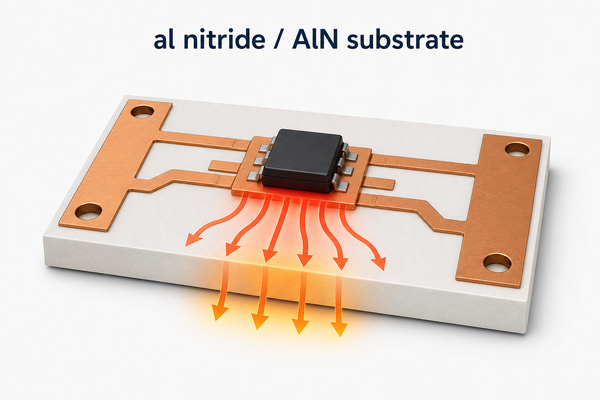
Al nitride usually refers to aluminum nitride, or AlN, a ceramic material used when an electronic assembly needs high thermal conductivity and electrical insulation in the same substrate. A practical evaluation should check the formula, basic properties, electrical behavior, disadvantages, safety notes, and substrate use conditions before selecting it for a circuit design. For ceramic PCB design, AlN becomes relevant when FR4 or alumina cannot provide enough thermal margin.
What Is Al Nitride?
Al nitride is a shortened search phrase that normally means aluminum nitride, abbreviated as AlN. It is a non-oxide technical ceramic made from aluminum and nitrogen, not metallic aluminum and not alumina.
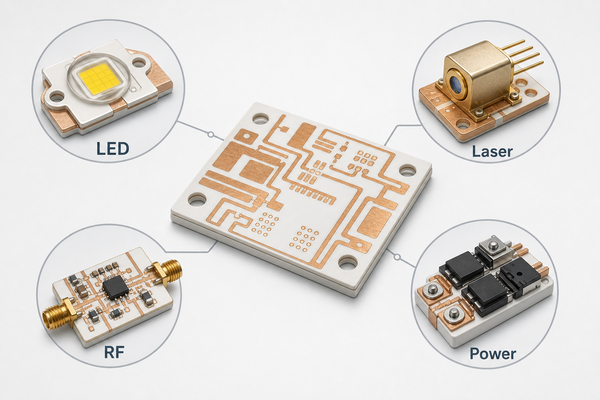
In electronics, AlN is valued because it can move heat while remaining electrically insulating. This combination is why it appears in ceramic PCB substrates, chip carriers, heat spreaders, LED packages, laser diode submounts, RF devices, and power electronics modules.
What Is the Al Nitride Formula and Structure?
The chemical formula of aluminum nitride is AlN. One aluminum atom and one nitrogen atom form the compound, so related searches such as "al nitride formula," "aluminum nitride chemical formula," and "aluminum nitride Al and N" all point to the same answer.
AlN commonly has a wurtzite crystal structure. For most ceramic PCB users, the important takeaway is not the crystal diagram itself, but the resulting property set: high thermal conductivity, strong electrical insulation, low thermal expansion compared with many organic materials, and useful stability in high-temperature electronic environments.
Why Does Al Nitride Matter for Ceramic PCB Substrates?
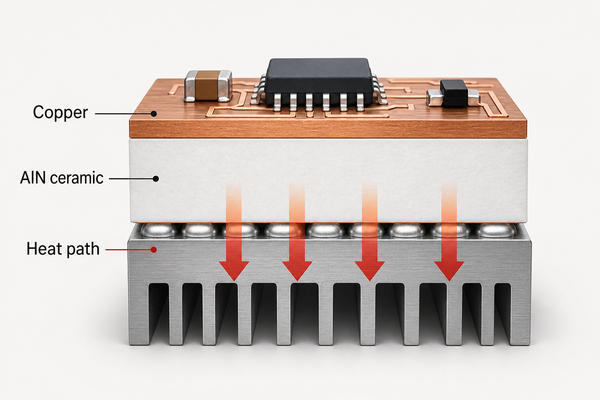
AlN matters when heat must pass through an insulating substrate instead of only spreading across copper. In a high-power LED, laser diode, RF power amplifier, SiC device, or GaN power stage, the heat source may sit directly above the ceramic. If the substrate blocks heat, the junction temperature rises even when the external heat sink is large.
An AlN ceramic PCB substrate can lower thermal resistance through the board, maintain isolation between copper and the heat sink, and reduce thermal expansion mismatch near semiconductor devices. It is most useful where the design has high heat density, limited board area, and repeated thermal cycling.
Key Al Nitride Properties for Electronics
The exact values depend on grade and supplier data, but the properties below are the ones that usually decide whether AlN is worth using in a ceramic PCB substrate.
| Property | Typical Meaning for Electronics | Design Note |
|---|---|---|
| Thermal conductivity | Common commercial AlN ceramic is often around 140-200 W/mK | System temperature also depends on solder, interface material, copper area, and heat sink contact |
| Electrical conductivity | Dense AlN ceramic is normally electrically insulating | Do not treat AlN as a conductor just because it conducts heat well |
| Dielectric behavior | Useful for isolated thermal paths and some RF power circuits | Frequency, surface finish, copper geometry, and dielectric data need review |
| CTE | Lower than many organic laminates and closer to semiconductor materials | Helps reduce stress in chip attach and thermal cycling conditions |
| Density | Often around 3.2-3.3 g/cm3 depending on grade | Relevant for package weight and mechanical design |
| Mechanical behavior | Hard, rigid, and brittle | Avoid sharp corners, thin bridges, and concentrated mounting force |
| Moisture sensitivity | AlN can hydrolyze under unfavorable moisture and temperature exposure | Storage, surface protection, and operating environment should be checked |
How Does Al Nitride Compare With Alumina, Silicon Nitride and FR4?
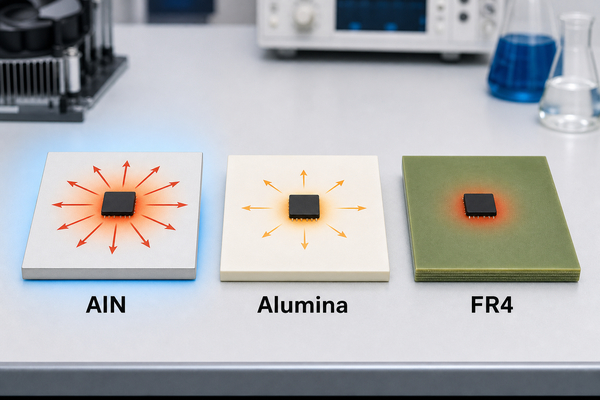
The material choice should start from the failure mode: excess temperature, poor isolation, mechanical cracking, dielectric loss, or unnecessary cost. AlN is strong in thermal performance, but it is not automatically the best answer for every board.
| Material | Thermal Conductivity | Electrical Insulation | Mechanical Strength | Best Use |
|---|---|---|---|---|
| AlN | High for a ceramic substrate | Excellent | Good but brittle | High heat flux with electrical isolation |
| Alumina | Moderate for ceramic | Excellent | Good | Cost-sensitive ceramic circuits and stable insulation |
| Silicon nitride | Medium to high depending on grade | Excellent | Very strong | Power modules needing stronger fracture resistance |
| FR4 | Low | Good | Flexible compared with ceramics | Standard electronics without high heat flux through the board |
Choose AlN when thermal resistance through the insulating layer is a real constraint. Choose alumina or FR4 when the heat load is lower and the extra AlN cost does not improve the finished assembly.
Where Is Al Nitride Used in Electronics?
AlN is used where heat spreading, insulation, and dimensional stability must work together. Common electronic uses include:
- High-power LED modules where heat must leave the LED die quickly
- Laser diode submounts requiring stable alignment and fast heat spreading
- RF and microwave power circuits where dielectric behavior and heat control both matter
- IGBT, MOSFET, SiC, and GaN power devices in compact modules
- Semiconductor package bases, chip carriers, and heat-spreading insulating plates
- Industrial, automotive, medical, and energy electronics exposed to repeated thermal cycling
Which Copper Metallization Options Work With Al Nitride Substrates?
AlN becomes a circuit substrate only after the conductor system is selected. The ceramic grade and copper process should be reviewed together because line width, copper thickness, adhesion, current capacity, surface finish, and thermal cycling behavior are linked.
| Process | Where It Fits | Main Check |
|---|---|---|
| Thick film | Printed conductors, resistor patterns, simple ceramic circuits | Paste system, fired thickness, line definition |
| Thin film | Fine features and controlled surface layers | Conductor thickness and surface finish |
| DPC | Fine copper patterns, plated copper, compact circuits | Line/space, via design, copper balance |
| DBC | Thicker copper and higher-current layouts | Copper thickness, etch geometry, stress at copper edges |
| AMB | Power modules needing strong copper-to-ceramic bonding | Thermal cycle range and copper symmetry |
What Are the Main Disadvantages of Al Nitride?
The main disadvantages of AlN are cost, brittleness, machining difficulty, and sensitivity to poor interface design. The material itself can move heat well, but a bad solder layer, voided attach material, uneven heat sink contact, or weak copper balance can still create high operating temperature.
AlN also needs careful mechanical design. Sharp internal corners, very small holes, narrow webs between slots, thin unsupported edges, and aggressive mounting pressure can increase crack risk. If the design needs holes, slots, edge plating, or tight outline tolerances, those features should be checked before the stack is fixed.
When Should You Choose an Al Nitride Substrate?
Choose an AlN substrate when the design has a concentrated heat source, needs electrical isolation through the substrate, and cannot meet temperature targets with FR4, metal core PCB, or alumina. It is especially suitable when the heat source is small, the power density is high, and the assembly must survive thermal cycling.
Avoid overusing AlN when the temperature rise is already acceptable with alumina or a conventional PCB solution. A better decision starts from power loss, heat source size, allowable junction temperature, voltage isolation, copper thickness, ceramic thickness, surface flatness, and the cooling boundary.
FAQ
1. Is al nitride the same as aluminum nitride?
In most electronics searches, yes. Al nitride usually means aluminum nitride, abbreviated as AlN. The standard chemical formula is AlN.
2. What is aluminum nitride used for?
Aluminum nitride is used for heat spreaders, ceramic PCB substrates, chip carriers, LED packages, laser diode submounts, RF power circuits, semiconductor fixtures, and power module substrates.
3. Is aluminum nitride toxic?
A finished AlN ceramic substrate is normally handled as a solid technical ceramic, but machining dust and powder exposure should be controlled with proper industrial safety measures. It should not be treated like beryllium oxide, but dust inhalation and processing exposure still require care.
4. Why is aluminum nitride so expensive?
AlN costs more because powder purity, sintering, density control, diamond grinding, laser processing, inspection, and copper metallization are more demanding than many standard PCB or alumina processes.
5. Is AlN electrically conductive?
No. Dense AlN ceramic is normally an electrical insulator, although it conducts heat well. That combination is the reason it is useful in isolated thermal paths.
6. What is the thermal conductivity of aluminum nitride?
Many commercial AlN ceramics are commonly around 140-200 W/mK, while reported values vary by grade, density, oxygen content, test method, and temperature.
7. Is AlN better than alumina?
AlN is better when thermal conductivity is the limiting factor. Alumina is often better when cost, availability, and general insulation matter more than maximum heat spreading.
8. Can AlN replace FR4?
AlN can replace FR4 only in specific high-heat or high-isolation designs. It is not a drop-in replacement because ceramic substrates use different fabrication rules, assembly conditions, and mechanical handling limits.
9. Is AlN suitable for RF circuits?
Yes, AlN can be suitable for RF power circuits when its dielectric properties, surface finish, copper process, and layout geometry are matched to the operating frequency.
10. What is an aluminum nitride sheet?
An aluminum nitride sheet is a flat AlN ceramic plate or substrate. It may be used bare as an insulating heat spreader or processed with metallization to become a ceramic circuit substrate.
Conclusion
Al nitride is best understood as AlN, an aluminum nitride ceramic with the formula AlN, high thermal conductivity, and strong electrical insulation. A reliable material decision should consider properties, disadvantages, safety notes, and ceramic substrate use cases together instead of judging AlN by thermal conductivity alone. BSTCeramicPCB can review AlN ceramic PCB substrate requirements and help match the material, copper process, and thermal path to the intended application. For project discussion, contact sales@bstceramicpcb.com.
 Products
 About us
 Contact us