













































 HOME
HOME


-

Ceramic PCB for Humanoid Robot joint actuators
2026 04,07 -
LTCC PCB Surprises: What Most People Miss
2025 12,09 -
Step-by-Step Guide to DPC PCB Design for Sensor Systems
2025 12,03 -
Ceramic PCBs Essential Benefits and Applications
2025 12,01 -
How Al2O3 DPC Ceramic Substrate PCB Enhances Heat Dissipation in Modern Electronics?
2025 11,28 -
How to Choose Between Ceramic, FR4, and Metal Core PCBs
2025 11,27 -
DPC Ceramic PCB Materials: Surprising Science Inside
2025 11,26 -
Wire bondable 2-layer Alumina substrates PCB | Bstceramic PCB
2025 09,22 -
Silicon Nitride Substrate, Silicon Nitride Ceramic Substrate Formula
2025 05,08 -
What is thick film ceramic PCB?
2023 08,02
Al2O3 Ceramic: Properties, Purity Grades, Manufacturing and PCB Uses
Published:
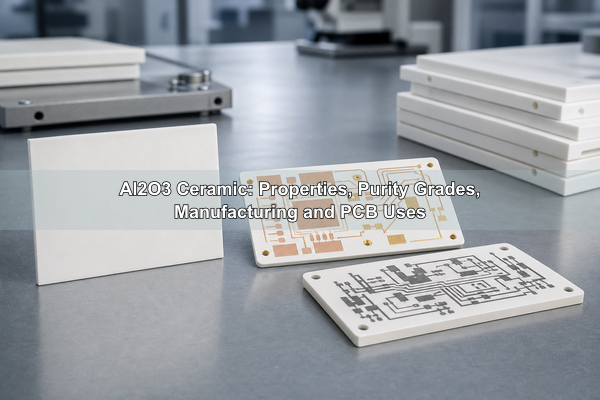
Al2O3 ceramic is a dense, sintered aluminum oxide material used where electrical insulation, wear resistance, dimensional stability and moderate heat transfer must work together. In electronic substrates, it supports thick-film conductors, plated copper, thin-film circuits and direct-bonded copper structures while remaining electrically insulating. Its performance is controlled by purity, density, grain structure, thickness, surface condition and the selected metallization process, not by the chemical formula alone.
What Is Al2O3 Ceramic?
Al2O3 is the chemical formula for aluminum oxide. Alumina is the common engineering name for this oxide, while Al2O3 ceramic normally means a shaped and sintered polycrystalline body made primarily from alumina powder. The powder is mixed with controlled additives and binders, formed into a green body, fired at high temperature and, when necessary, ground or laser processed to final dimensions.
This definition separates dense technical ceramic from several materials that share similar names. Aluminum metal is electrically and thermally conductive. Loose aluminum oxide powder may be used as an abrasive or ceramic feedstock. Sapphire is single-crystal Al2O3. A commercial alumina substrate is polycrystalline and may contain a small controlled glass phase or sintering additives. Those differences change machinability, dielectric behavior, surface finish and cost.
Is Al2O3 Ceramic the Same as Alumina and Aluminum Oxide?
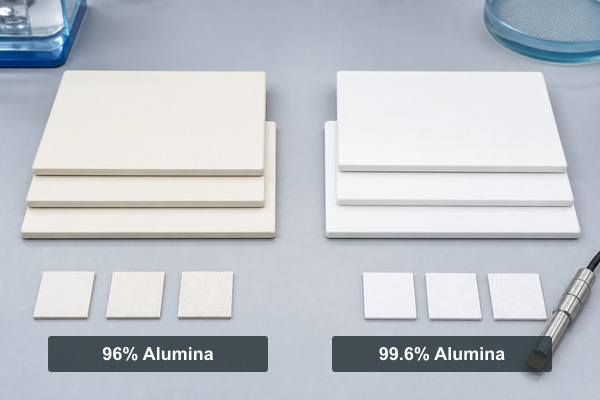
In most technical ceramic specifications, Al2O3 ceramic, alumina ceramic and aluminum oxide ceramic describe the same material family. The names are not complete purchasing specifications, however. A drawing should identify the purity grade, fired thickness, dimensions, flatness, surface roughness and any metallization or plating requirements. A 96% Al2O3 thick-film substrate and a 99.6% polished thin-film substrate are both Al2O3 ceramics, but they are not interchangeable.
"Aluminium oxide" is the British spelling and "aluminum oxide" is the American spelling. Both refer to Al2O3. For international drawings, the clearest notation is the material name plus purity, such as "96% Al2O3 ceramic substrate."
Which Properties Define Al2O3 Ceramic?
The useful property set is a balance rather than one maximum value. Published numbers vary with purity, porosity, grain size, additives, test temperature and measurement method, so the selected grade's datasheet should control the design.
| Property | Typical dense alumina behavior | Engineering significance |
|---|---|---|
| Density | About 3.6-3.95 g/cm3 | Reflects purity and densification; residual porosity can affect strength and insulation |
| Thermal conductivity | Commonly about 18-35 W/m-K at room temperature | Higher than FR4 but much lower than high-conductivity AlN |
| Coefficient of thermal expansion | Approximately 6.5-8.5 ppm/K over common engineering ranges | Affects stress at copper, solder and attached component interfaces |
| Dielectric constant | Often around 9-10, depending on grade and frequency | Influences capacitance, impedance and electric-field distribution |
| Volume resistivity | Typically very high at room temperature | Supports electrical isolation and high-voltage structures |
| Flexural strength | Often about 300-500 MPa | Useful for rigid substrates, but edge defects can reduce actual part strength |
| Hardness | High wear and abrasion resistance | Improves surface durability but makes fired machining difficult |
The high stiffness and hardness of alumina do not make it impact tolerant. Like other technical ceramics, it is brittle and has limited fracture toughness compared with metals. Finished strength therefore depends strongly on edge condition, surface damage, hole geometry and how the part is clamped.
How Do 96% and 99.6% Al2O3 Ceramic Grades Compare?
Purity changes the amount and chemistry of the secondary phase between alumina grains. The correct grade depends on the conductor process, surface requirement, operating environment and economic value of the resulting improvement.
| Decision factor | 96% alumina | 99.5-99.6% alumina |
|---|---|---|
| Typical role | General electronic substrates and mature thick-film production | Fine-feature, high-purity, polished or demanding dielectric applications |
| Thermal performance | Moderate and adequate for many control, LED and sensor circuits | Often somewhat higher, but still well below high-conductivity AlN |
| Surface and glass phase | More secondary phase; compatible with widely used thick-film systems | Lower secondary-phase content and potentially cleaner polished surfaces |
| Mechanical behavior | Strong and rigid for standard substrates | May provide higher hardness or strength in a controlled grade, but remains brittle |
| Cost and availability | Usually the more economical, widely available option | Higher material and processing cost |
| Best selection basis | Choose when standard performance meets the verified design limits | Choose when purity, surface, dielectric or process data justify the premium |
Higher purity should not be selected only because its percentage is larger. If heat flow is limited by a thick interface layer or poor heat-sink contact, changing from 96% to 99.6% alumina may have less effect than reducing substrate thickness or improving the interface. Conversely, a thin-film or wire-bonding process may benefit more from surface quality and controlled composition than from a headline thermal-conductivity value.
How Is Al2O3 Ceramic Manufactured?
Production begins with alumina powder whose particle size, purity and agglomeration are controlled. Organic binders and processing additives make the powder formable. Tape casting is common for thin electronic substrates; dry pressing suits many discrete parts; extrusion and isostatic pressing support tubes or thicker shapes. The unfired part is called a green body and is larger than the final part because sintering causes predictable shrinkage.
After forming, binders are removed under a controlled thermal cycle. The ceramic is then sintered at high temperature to develop density and bond the grains. Uneven green density, rapid binder removal or an unsuitable firing profile can cause warpage, internal pores or cracks. Fired parts may be lapped, polished, laser cut, scribed, drilled or diamond ground. Cleaning and inspection follow before metallization.
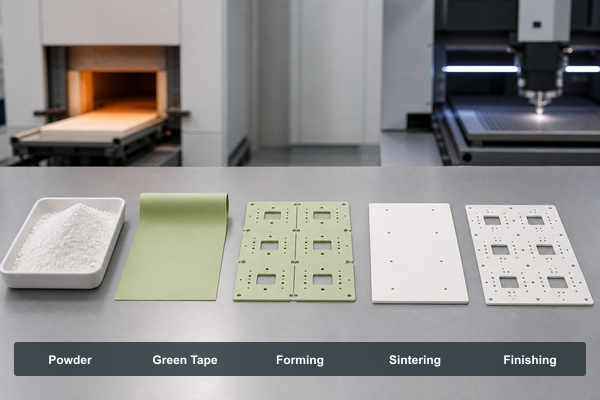
Geometry should be established as early as practical. Green machining can be economical for suitable parts, but final dimensions must account for shrinkage variation. Fired machining provides tighter local accuracy but uses diamond or laser processes and can introduce edge chips or subsurface damage if process parameters are not controlled.
Is Al2O3 Ceramic Electrically Conductive?
Dense alumina is normally an electrical insulator, not a conductor. Its high resistivity and dielectric strength make it useful as the insulating base of high-voltage circuits, heater carriers, sensor substrates and power modules. Electrical behavior still changes with temperature, purity, moisture, contamination, test frequency and electric-field geometry. A room-temperature resistivity value should not be treated as a guarantee at maximum service temperature.
A conductive ceramic circuit is created by adding metal to the insulating ceramic. Silver, silver-palladium, gold, copper, tungsten-molybdenum systems and plated finishes can form traces, pads or vias. The metal layer carries current; the Al2O3 body provides isolation, mechanical support and part of the thermal path.
How Does Al2O3 Ceramic Manage Heat and Thermal Expansion?
Alumina transfers heat much better than FR4 but less efficiently than aluminum nitride. Dense commercial grades commonly fall in the approximate 18-35 W/m-K range at room temperature, and conductivity generally decreases as temperature rises. The actual temperature drop through a substrate is also proportional to ceramic thickness and heat-flow area. A thin alumina substrate can therefore outperform a thicker substrate made from the same grade even though both share the same material conductivity.
The coefficient of thermal expansion is commonly around 6.5-8.5 ppm/K across useful engineering temperature ranges. Copper expands faster, so thick copper bonded to alumina can create cyclic stress at conductor edges and ceramic corners. Copper thickness, pattern balance, ceramic thickness, edge geometry, solder area and the temperature range must be assessed together. For a deeper treatment of these variables, see the BSTCeramicPCB guide to Al2O3 thermal conductivity.
Which Metallization Methods Work on Al2O3 Ceramic?
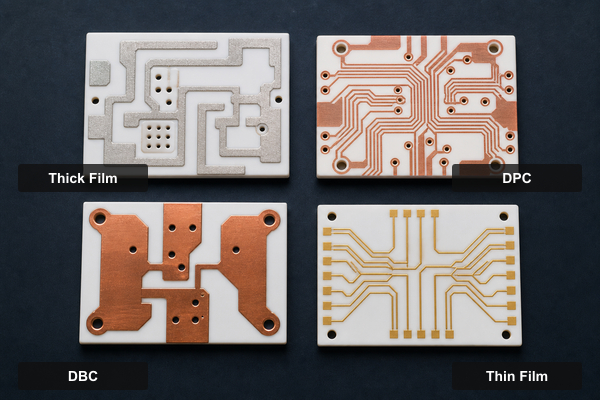
The ceramic and conductor process must be selected as one system. Each method creates a different conductor thickness, feature size, adhesion mechanism and surface-finish path.
| Process | Typical structure | Best fit | Important limitation |
|---|---|---|---|
| Thick film | Screen-printed conductive paste fired on ceramic | Mature hybrid circuits, heaters, sensors and thick-film resistive networks | Printed geometry and paste system limit fine features and resistivity |
| Thin film | Sputtered or evaporated seed layers with patterned metal | Fine lines, controlled surfaces and precision circuits | Requires clean, smooth substrates and more demanding processing |
| DPC | Seed layer, imaging and electroplated copper | Fine copper features and controlled plated thickness | Adhesion, via quality and plating uniformity require process control |
| DBC | Thick copper directly bonded to ceramic at high temperature | Power circuits needing current capacity and lateral heat spreading | Copper-ceramic stress can limit thermal-cycle life |
| Refractory metal | Mo-Mn or tungsten-based metallization with nickel and optional gold | Hermetic packages, brazing and robust ceramic-to-metal joints | Multiple firing and plating steps increase process complexity |
Surface finish follows the assembly method. ENIG can support soldering, while ENEPIG or appropriate gold systems may be selected for wire bonding. Finish choice must be compatible with the underlying metallization, bond wire, solder alloy, storage conditions and operating temperature.
Where Is Al2O3 Ceramic Used?
In electronics, Al2O3 substrates are used in thick-film hybrids, resistor networks, LED modules, heater circuits, 96% Al2O3 DPC sensor substrates, power-control boards, high-voltage insulation and selected DPC or DBC assemblies. Application-specific examples include DPC Al2O3 boards for thermal-management assemblies and Al2O3 DPC substrates for inverter circuits. The material is also used in feedthroughs, sealing components, wear plates, valve parts, guides and laboratory hardware because it resists abrasion and many chemical environments.
For circuit applications, the substrate is most useful when the design needs more heat resistance, insulation stability or dimensional rigidity than an organic laminate can provide, but does not require the much higher thermal conductivity of AlN. BSTCeramicPCB supports bare ceramic substrates and metallized ceramic PCB structures for applications that fit this range.
When Should Al2O3 Be Chosen Instead of AlN, Zirconia or FR4?
Material selection should begin with the failure mode the substrate must prevent. Alumina is a balanced electronic ceramic, but it is not the universal best material.
| Material | Primary advantage | Choose it when | Main trade-off |
|---|---|---|---|
| Al2O3 ceramic | Balanced insulation, rigidity, wear resistance and cost | Moderate heat transfer and stable ceramic behavior are sufficient | Brittle and thermally below AlN |
| AlN ceramic | Much higher thermal conductivity with electrical insulation | Ceramic-layer thermal resistance is a dominant constraint | Higher cost and more sensitive processing |
| Zirconia | Higher fracture toughness | Mechanical shock and crack resistance matter more than heat transfer | Lower thermal conductivity and different dielectric behavior |
| FR4 | Economical multilayer routing and mature PCB assembly | Standard temperatures and heat flux permit an organic laminate | Lower thermal conductivity and reduced high-temperature stability |
The Al2O3 ceramic option is strongest when the system needs an electrically insulating, dimensionally stable substrate with mature manufacturing routes and controlled cost. AlN is justified when calculations show that alumina thickness creates an unacceptable temperature rise. Zirconia is preferred when toughness dominates. FR4 remains appropriate when dense multilayer routing and conventional PCB economics matter more than ceramic performance.
What Manufacturing Limits Matter for Al2O3 Ceramic Parts and Substrates?
Alumina tolerances are governed by process sequence. As-fired parts carry forming and sintering variation. Lapping and grinding improve thickness, flatness and local dimensions but add cost and may constrain panel size. Thin ceramic is more vulnerable to handling damage, while thick ceramic increases through-plane thermal resistance.
- Edges and corners: sharp internal corners concentrate stress; appropriate radii, edge relief and controlled separation reduce chipping.
- Holes and slots: diameter, spacing, ceramic thickness and laser taper affect strength and metal coverage.
- Flatness: conductor balance, firing support and panel geometry influence bow and twist.
- Surface roughness: thick film can accept a different surface than fine-line thin film or wire bonding.
- Metallization adhesion: cleaning, surface preparation, firing or activation, and metal-stack compatibility are critical.
- Thermal cycling: large copper islands, abrupt copper edges and asymmetric patterns can increase ceramic stress.
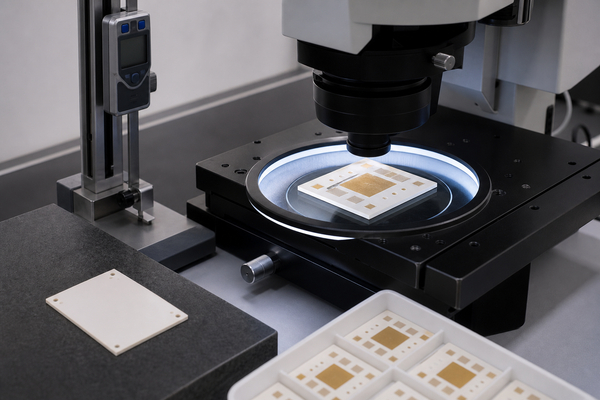
Dimensional and process limits should be verified on the intended material grade and panel format. A capability demonstrated on a small, thick coupon may not transfer directly to a large, thin substrate with dense holes and thick copper.
FAQ About Al2O3 Ceramic
Is Al2O3 a ceramic?
Al2O3 is a chemical compound. When alumina powder is shaped and sintered into a dense polycrystalline body, the result is an Al2O3 technical ceramic. The same compound can also exist as powder or as single-crystal sapphire, which are different product forms.
What color is Al2O3 ceramic?
Dense electronic-grade alumina is commonly white or ivory. Color can vary with purity, additives, firing atmosphere, grain structure and surface finish. A color difference alone does not establish the material grade.
Is alumina ceramic brittle?
Yes. Alumina has high hardness and compressive strength but limited fracture toughness compared with metals. Edge chips, scratches, impact and tensile stress can initiate cracks, so part support and handling matter.
How hard is alumina ceramic?
Alumina is substantially harder than common metals and polymers and is widely used for wear-resistant components. The exact hardness depends on purity, density and test method. This hardness is beneficial in service but requires diamond grinding or controlled laser processing after sintering.
Can Al2O3 ceramic be soldered directly?
Not without a compatible metallized surface. Solder bonds to an appropriate metal finish, not to bare dense alumina. The metallization stack must provide ceramic adhesion and a solderable top surface.
Conclusion
Al2O3 ceramic combines electrical insulation, hardness, chemical stability and moderate thermal conductivity in a mature technical material. Reliable use depends on selecting the purity, thickness, surface, geometry and metallization as one manufacturing system. For ceramic substrate and metallized PCB support, contact BSTCeramicPCB at sales@bstceramicpcb.com.
 Products
 About us
 Contact us