




















































 HOME
HOME


-

Ceramic PCB for Humanoid Robot joint actuators
2026 04,07 -
LTCC PCB Surprises: What Most People Miss
2025 12,09 -
Step-by-Step Guide to DPC PCB Design for Sensor Systems
2025 12,03 -
Ceramic PCBs Essential Benefits and Applications
2025 12,01 -
How Al2O3 DPC Ceramic Substrate PCB Enhances Heat Dissipation in Modern Electronics?
2025 11,28 -
How to Choose Between Ceramic, FR4, and Metal Core PCBs
2025 11,27 -
DPC Ceramic PCB Materials: Surprising Science Inside
2025 11,26 -
Wire bondable 2-layer Alumina substrates PCB | Bstceramic PCB
2025 09,22 -
Silicon Nitride Substrate, Silicon Nitride Ceramic Substrate Formula
2025 05,08 -
What is thick film ceramic PCB?
2023 08,02
Al2O3 Thermal Conductivity: Values by Purity, Temperature and Thickness
Published:
Al2O3 thermal conductivity commonly falls between about 18 and 35 W/m-K at room temperature for dense, commercially available alumina ceramics. The exact value depends on purity, density, grain structure, sintering additives, and test conditions. For ceramic PCB work, this material value is only one part of the heat path: substrate thickness, copper coverage, interface layers, and heat-source area determine the thermal resistance of the finished assembly.
What Is Al2O3 Thermal Conductivity?
Al2O3 thermal conductivity measures the rate at which heat moves through aluminum oxide, also called alumina, under a specified temperature gradient. It is expressed in watts per meter-kelvin, or W/m-K. A higher value means the ceramic transfers more heat for the same thickness, area, and temperature difference.
Dense polycrystalline alumina is an electrical insulator, yet it conducts heat substantially better than organic PCB laminates. That combination makes it useful as the dielectric body in thick-film, DPC, DBC, and other ceramic circuit structures. The value must always be tied to a specific grade and temperature; a single number without those conditions is incomplete.
What Values Are Typical for Different Al2O3 Purity Grades?
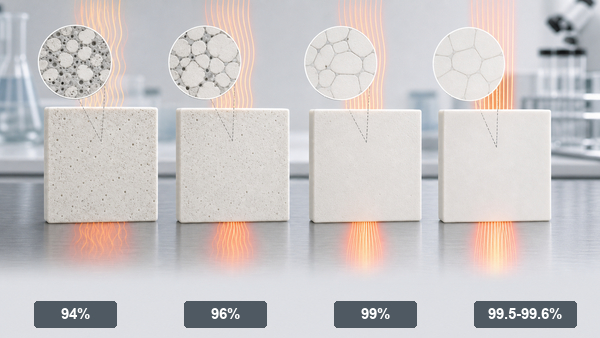
Typical room-temperature values increase as secondary phases and processing additives decrease, but purity alone does not guarantee a particular result. Supplier data should identify the ceramic grade, density, test temperature, and test method.
| Al2O3 grade | Typical room-temperature conductivity | Technical interpretation |
|---|---|---|
| 94% alumina | About 18 W/m-K | More secondary phase; often selected for metallization compatibility and economical technical ceramic parts. |
| 96% alumina | About 22-25 W/m-K | Common electronic-substrate grade with a mature balance of thermal, dielectric, mechanical, and processing properties. |
| 99% alumina | Often about 27-32 W/m-K | Lower additive content can improve heat transfer, although the exact formulation still matters. |
| 99.5-99.6% alumina | Often about 30-35 W/m-K | Used where a higher-purity body and more consistent thermal or dielectric behavior justify tighter processing control. |
These are comparison values, not universal specifications. For example, one published technical-ceramic dataset lists 96% alumina at 25 W/m-K and 99.5% alumina at 35 W/m-K, while a 96% ceramic PCB material table lists 24 W/m-K at 25 degrees C. Both values can be reasonable for their stated materials.
Why Does Al2O3 Thermal Conductivity Vary by Grade?
The conductivity varies because heat in alumina is carried mainly by lattice vibrations. Anything that scatters those vibrations reduces heat transport. The important variables are not limited to the percentage printed on the datasheet.
- Secondary phases: Sintering aids and glass-rich grain boundaries can interrupt heat flow between alumina grains.
- Porosity: Pores replace a solid heat path with low-conductivity voids, so a less dense body generally performs worse.
- Grain structure: Grain size and boundary chemistry affect phonon scattering.
- Crystal form: Dense alpha-alumina substrates differ from amorphous films, porous anodic oxide, powders, and sapphire.
- Measurement direction: Anisotropic or layered samples can show different in-plane and through-plane results.
- Test temperature: The room-temperature value should not be reused unchanged at several hundred degrees C.
This is why two nominally 96% substrates can have different published conductivity values. Material designation, density, composition, and test conditions must be compared together.
How Does Al2O3 Thermal Conductivity Change with Temperature?
Al2O3 thermal conductivity generally decreases as temperature rises. Increased lattice vibration produces more phonon scattering, reducing the distance over which heat can travel efficiently.
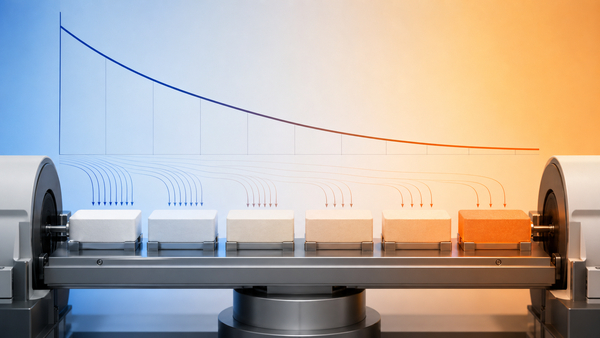
A laser-flash measurement example reports an alumina sample near 32 W/m-K at room temperature and a continuing decline toward 1000 degrees C. Historical thermophysical tables for dense polycrystalline Al2O3 show the same overall trend. The exact curve depends on grade, so a generic curve should be used only for early comparison.
For a heater, high-temperature sensor, power resistor, or continuously loaded module, thermal analysis should use data close to the actual operating temperature. Using a 25 degrees C datasheet value at 300 degrees C can understate the ceramic-layer temperature drop.
How Is Al2O3 Thermal Conductivity Measured?
Alumina conductivity is commonly derived from thermal diffusivity, density, and specific heat. Laser flash analysis measures how quickly a heat pulse travels through a sample, after which conductivity is calculated as:
k = alpha x rho x Cp
Here, k is thermal conductivity, alpha is thermal diffusivity, rho is density, and Cp is specific heat capacity. Each input is temperature-dependent. Sample thickness, surface coating, pulse correction, atmosphere, and data-reduction method can also influence the reported result.
When comparing datasheets, check whether the value is measured, calculated, or described only as typical. Also confirm whether it represents a dense bulk ceramic, a thin film, an anodized layer, or a composite. These forms are not interchangeable.
What Is the Difference Between Conductivity, Diffusivity and Thermal Resistance?
Thermal conductivity is a material property, thermal diffusivity describes the speed of temperature equalization, and thermal resistance describes a specific heat-flow geometry. Confusing these parameters can produce an incorrect comparison even when every number is technically valid.
| Parameter | Meaning | Common unit | Design use |
|---|---|---|---|
| Thermal conductivity, k | Ability of the material to carry heat | W/m-K | Compare materials under stated conditions. |
| Thermal diffusivity, alpha | Rate at which a temperature change spreads | mm2/s or m2/s | Evaluate transient heating and support conductivity calculation. |
| Specific heat, Cp | Energy needed to raise unit mass by one degree | J/kg-K | Estimate thermal storage and transient response. |
| Thermal resistance, Rth | Temperature rise per unit heat flow for a defined structure | K/W | Calculate the temperature drop across a substrate or assembly. |
A high-conductivity material can still create a large thermal resistance if it is thick or if the heat enters through a very small area. Conversely, a moderate-conductivity ceramic can perform effectively when the layer is thin and copper spreads heat over a larger footprint.
How Does Al2O3 Thickness Change Thermal Resistance?
For one-dimensional conduction through a flat ceramic layer, thermal resistance can be estimated from:
Rth = t / (k x A)
In this expression, t is ceramic thickness, k is conductivity, and A is the effective heat-flow area. Resistance increases directly with thickness and decreases with conductivity and area.
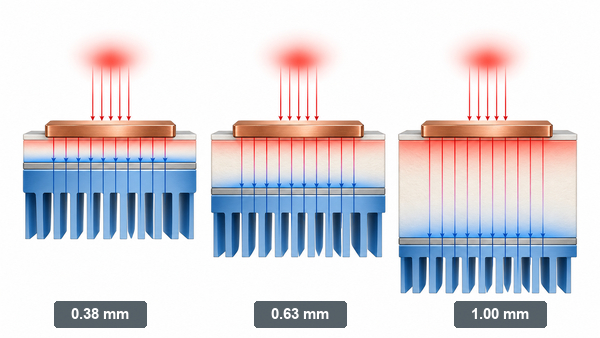
Consider 96% alumina at 24 W/m-K with an effective heat-flow area of 10 x 10 mm. A 0.38 mm layer gives an idealized ceramic resistance of about 0.158 K/W, while a 1.0 mm layer gives about 0.417 K/W. The thicker layer produces roughly 2.6 times the through-plane resistance because all other inputs are unchanged.
This simple equation does not include lateral spreading, edge losses, copper, solder, adhesives, contact resistance, or heat-sink geometry. It is useful for first-pass comparison, not as a complete junction-to-ambient model.
How Do Copper and Interface Layers Change a Ceramic PCB Heat Path?
The finished ceramic PCB heat path includes every layer between the heat source and the cooling surface. Copper can spread heat laterally, while solder, die attach, thermal grease, adhesives, plating, surface roughness, and mounting pressure add interface resistance.
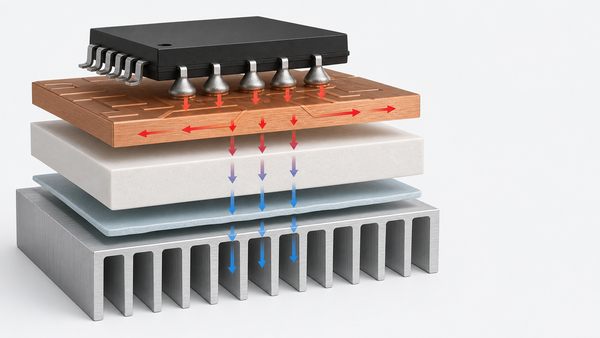
A small component pad concentrates heat into a limited ceramic area. A larger copper land can spread that heat before it crosses the alumina, reducing local heat flux. However, narrow thermal necks, isolated pads, voided solder, warped mating surfaces, or an uneven adhesive layer can dominate the temperature rise even when the alumina grade is unchanged.
Thermal models should therefore separate bulk ceramic resistance from spreading resistance and interface resistance. Measuring only the substrate conductivity cannot predict the final component junction temperature.
How Does Al2O3 Compare with AlN, Si3N4 and FR4?
Al2O3 occupies the practical middle ground between organic laminates and premium high-conductivity ceramics. The useful comparison combines heat transfer with dielectric behavior, mechanical reliability, processing route, and cost rather than ranking materials by one number.
| Material | Typical thermal-conductivity range | Primary thermal-design position | Main limitation |
|---|---|---|---|
| FR4 | About 0.3-0.5 W/m-K | Low-power electronics with copper planes and conventional assembly | Organic dielectric limits through-thickness heat transfer. |
| Al2O3 | About 18-35 W/m-K by grade | Moderate heat flux requiring electrical insulation and mature ceramic processing | Lower conductivity than AlN and lower fracture toughness than Si3N4. |
| Si3N4 | Grade-dependent, commonly tens of W/m-K | Power substrates where toughness and thermal cycling reliability are decisive | Material and process cost can exceed standard alumina. |
| AlN | Common electronic grades are much higher than alumina | Compact, high-heat-flux assemblies requiring an electrically insulating heat path | Higher cost and tighter material and processing control. |
For a broader material overview, see the existing aluminum oxide thermal conductivity overview. Related material-selection articles should be used when thermal cycling or maximum heat flux is more important than the Al2O3 data itself.
When Is Al2O3 Suitable for a Ceramic PCB?
Al2O3 is suitable when the heat flux is moderate, electrical insulation is required, and the calculated ceramic and interface temperature drops remain within the component limit. It is widely used in LED modules, sensors, heaters, power resistors, industrial controls, medical circuits, and compact electronic substrates.
A 96% alumina body is often a practical starting point for mature thick-film or Alumina DPC ceramic substrates for LED applications. Thermal performance can often be improved by reducing ceramic thickness, increasing useful copper spreading area, shortening the interface stack, or improving contact quality before changing to a higher-cost ceramic.
BSTCeramicPCB supports ceramic PCB structures using alumina materials and processes such as thick film, DPC, and DBC. Material grade and achievable construction remain subject to the selected process, dimensions, copper design, and engineering review.
When Should AlN Replace Al2O3?
AlN should replace Al2O3 when the ceramic layer remains the dominant thermal bottleneck after thickness, copper spreading, and interface quality have been optimized. This often occurs in compact laser-diode mounts, concentrated power-semiconductor heat sources, high-power LEDs, and modules with limited cooling area.
The change is less useful when solder voids, a thick adhesive, poor heat-sink contact, or a small copper pad dominates the thermal path. In that case, increasing bulk ceramic conductivity may produce only a limited junction-temperature improvement. The model should be recalculated with the proposed AlN grade before the material is changed.
Which Thermal Parameters Should Be Verified Before Prototyping?
A thermal prototype should verify the inputs that control the actual heat path, not only the room-temperature conductivity printed on a material table.
- Exact Al2O3 grade, nominal purity, density, and supplier conductivity data.
- Conductivity at the intended operating temperature or a justified derating curve.
- Ceramic thickness and tolerance.
- Component heat-source size, power dissipation, and duty cycle.
- Copper thickness, copper coverage, thermal necks, and spreading area.
- Solder, die-attach, adhesive, or thermal-interface thickness and void limits.
- Heat-sink flatness, mounting pressure, cooling condition, and ambient temperature.
- Steady-state hot-spot temperature and transient response during power cycling.
Temperature measurement points should be defined before the prototype test. Thermocouples, infrared imaging, and electrical junction-temperature methods observe different parts of the system and may require surface-emissivity or attachment corrections.
FAQ About Al2O3 Thermal Conductivity
Does alumina have high thermal conductivity?
Alumina has high thermal conductivity compared with FR4 and many insulating polymers, but it is moderate compared with AlN or high-conductivity SiC. Dense commercial alumina grades commonly fall around 18-35 W/m-K at room temperature.
Is Al2O3 a good conductor of electricity?
No. Dense Al2O3 is normally an electrical insulator while remaining a useful thermal conductor. This combination allows a ceramic substrate to move heat while electrically isolating circuit conductors.
Is Al2O3 the same as alumina?
Yes. Al2O3 is the chemical formula for aluminum oxide, and alumina is the common engineering name. A commercial alumina ceramic also contains grade-dependent additives and secondary phases.
Can amorphous Al2O3 thin-film data be used for a ceramic PCB?
No. Amorphous thin films, anodic oxide layers, porous coatings, and dense sintered alpha-alumina have different structures and thermal behavior. Use data for the actual substrate form and grade.
Why do datasheets list different Al2O3 conductivity values?
Values differ because purity, additives, density, porosity, grain structure, test temperature, direction, and measurement method differ. Compare the complete test conditions instead of treating one published number as universal.
Conclusion
Al2O3 thermal conductivity is not one fixed value. Dense commercial grades commonly span about 18-35 W/m-K at room temperature, conductivity decreases with rising temperature, and the finished thermal resistance changes directly with ceramic thickness and effective heat-flow area. Copper spreading and interface layers must be included before deciding whether alumina is sufficient or AlN is necessary.
For an Al2O3 ceramic PCB project, BSTCeramicPCB can review material grade, substrate thickness, copper structure, metallization process, and thermal-path feasibility. Contact sales@bstceramicpcb.com with the drawing and operating conditions.
 Products
 About us
 Contact us