










































 HOME
HOME


-

Ceramic PCB for Humanoid Robot joint actuators
2026 04,07 -
LTCC PCB Surprises: What Most People Miss
2025 12,09 -
Step-by-Step Guide to DPC PCB Design for Sensor Systems
2025 12,03 -
Ceramic PCBs Essential Benefits and Applications
2025 12,01 -
How Al2O3 DPC Ceramic Substrate PCB Enhances Heat Dissipation in Modern Electronics?
2025 11,28 -
How to Choose Between Ceramic, FR4, and Metal Core PCBs
2025 11,27 -
DPC Ceramic PCB Materials: Surprising Science Inside
2025 11,26 -
Wire bondable 2-layer Alumina substrates PCB | Bstceramic PCB
2025 09,22 -
Silicon Nitride Substrate, Silicon Nitride Ceramic Substrate Formula
2025 05,08 -
What is thick film ceramic PCB?
2023 08,02
Aluminum Nitride Ceramics: Properties, Uses and Selection
Published:
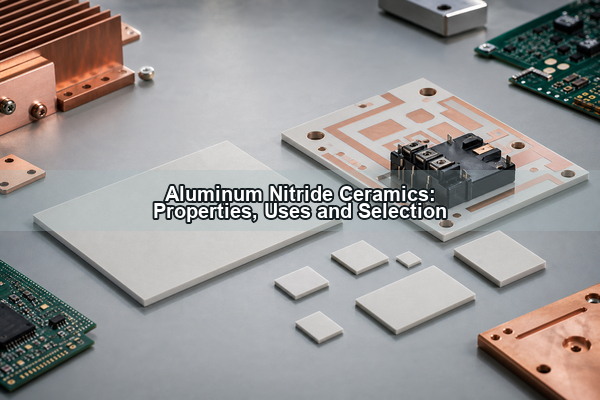
Aluminum nitride ceramics combine high thermal conductivity with electrical insulation, making them useful for power electronics, semiconductor equipment, LED modules, laser systems, and ceramic circuit substrates. Their performance is not defined by the AlN name alone. Ceramic grade, oxygen content, density, thickness, metallization, copper geometry, interfaces, and operating environment determine whether an AlN component will improve the finished assembly.
What Are Aluminum Nitride Ceramics?
Aluminum nitride is a non-oxide ceramic compound made from aluminum and nitrogen in a 1:1 atomic ratio. Its chemical formula is AlN, and the stable bulk material normally has a hexagonal wurtzite crystal structure. Commercial AlN ceramic is produced by forming and sintering fine powder into a dense body rather than by using metallic aluminum as a structural layer.
The useful combination is unusual: heat can move through the crystal lattice efficiently, while the material remains an electrical insulator. Its coefficient of thermal expansion is also relatively close to silicon, which helps reduce thermomechanical stress between a semiconductor die and its supporting substrate. These characteristics distinguish a sintered AlN ceramic from an AlN thin film, an AlN powder-filled polymer, and aluminum oxynitride, which are different material systems.
Which Properties Make Aluminum Nitride Ceramics Useful?
Property values should be tied to a specified grade and test method. The following ranges are representative of dense commercial AlN ceramics, not guaranteed limits for every supplier or geometry.
| Property | Representative Range | Engineering Relevance |
|---|---|---|
| Thermal conductivity at room temperature | Approximately 140-200 W/m·K for many commercial grades | Spreads heat through an electrically insulating substrate |
| Coefficient of thermal expansion | Approximately 4.4-4.8 × 10⁻⁶/K | Closer to silicon than many metals and organic laminates |
| Dielectric constant | Approximately 8.5-9 at 1 MHz | Relevant to impedance, capacitance, and high-frequency behavior |
| Dielectric strength | Often about 14-20 kV/mm | Supports electrical isolation when thickness and surface condition are controlled |
| Volume resistivity at room temperature | Commonly above 1013 Ω·cm | Limits leakage through the ceramic body |
| Flexural strength | Often about 300-400 MPa | Affects handling, mounting, and resistance to assembly stress |
| Density | Approximately 3.2-3.3 g/cm3 | Useful for package mass and material-quality checks |
Electrical and thermal properties both change with temperature. Surface condition, porosity, test frequency, electrode construction, sample thickness, and atmospheric exposure also affect measured values. Design calculations should therefore use the data sheet for the selected production grade.
Why Does Aluminum Nitride Thermal Conductivity Vary?
Aluminum nitride thermal conductivity is often quoted as a single number, but the intrinsic crystal value, a laboratory sample, and a commercial sintered substrate are not equivalent. Heat is carried mainly by lattice vibrations. Oxygen impurities, aluminum vacancies, secondary phases, pores, and grain boundaries scatter those vibrations and reduce conductivity.
Sintering aids are needed because strongly covalent AlN powder is difficult to densify. Additives such as yttria can help remove oxygen from the AlN lattice and promote densification, but the amount and distribution of the resulting grain-boundary phase still affect heat flow. Powder purity, particle size, atmosphere, firing temperature, dwell time, cooling profile, and final density therefore produce different commercial grades.
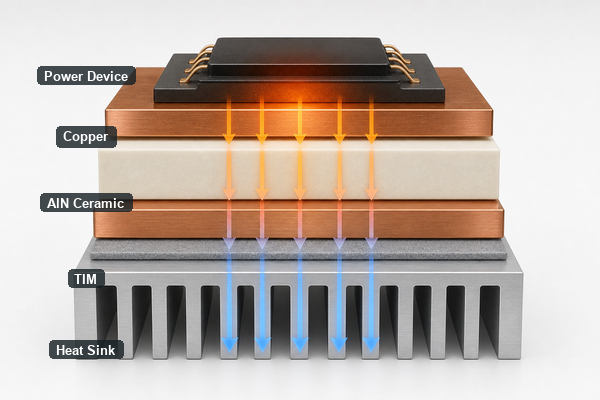
The finished circuit has additional thermal resistances. Ceramic thickness, copper thickness and area, die-attach material, solder or brazed interfaces, surface flatness, thermal interface material, and heat-sink contact can dominate the junction-to-sink path. A higher-conductivity AlN grade cannot compensate for a voided attachment layer or a poorly contacted heat sink.
How Do Aluminum Nitride and Alumina Compare?
The selection should be based on whether heat flow is actually limiting performance. Alumina is widely available, mechanically stable, and more economical. AlN is justified when the lower substrate thermal resistance, silicon-compatible expansion, or high-power density creates a measurable system benefit.
| Decision Factor | Aluminum Nitride | 96% Alumina |
|---|---|---|
| Typical thermal conductivity | Approximately 140-200 W/m·K for many commercial grades | Approximately 20-25 W/m·K |
| Electrical insulation | Excellent | Excellent |
| CTE relationship to silicon | Closer match | Higher mismatch |
| Material and processing cost | Higher | Lower |
| Machining and sourcing | More specialized | More widely available |
| Typical selection | Dense power modules, laser diodes, high-power LEDs, RF power devices | Sensors, controls, moderate-power circuits, cost-sensitive ceramic boards |
If the dominant resistance is in the die attach, package lid, interface pad, or heat sink, changing alumina to AlN may provide little improvement. A thermal model or measured temperature map is more useful than selecting the material from conductivity alone.
What Are the Disadvantages of Aluminum Nitride?
AlN is brittle and notch-sensitive, so sharp internal corners, closely spaced holes, thin bridges, unsupported edges, and concentrated mounting loads can initiate cracks. Fully sintered material requires laser processing or diamond grinding for precision features. Those operations add cost and can leave edge damage if the process is not controlled.
AlN is also more sensitive to processing history than alumina. Moisture, aggressive aqueous chemistry, and uncontrolled surface preparation can affect the surface. At elevated temperature in air, an oxide layer can form; very high operating-temperature claims therefore need the atmosphere and exposure time to be stated. Powder handling and machining dust require industrial controls even though a finished dense ceramic part is handled differently from loose powder.
Supply variation is another limitation. Two substrates sold as AlN may have different thermal conductivity, dielectric properties, surface roughness, flatness, strength, and metallization compatibility. Substituting a grade without reviewing these properties can change both assembly yield and operating temperature.
Why Are Aluminum Nitride Ceramics Expensive?
The cost begins with high-purity AlN powder and oxygen control. Forming must produce uniform density, while debinding and sintering require controlled high-temperature atmospheres. The material shrinks during densification, so green dimensions must compensate for the firing process. Warpage, pores, contamination, and nonuniform shrinkage can reduce yield.
Post-sinter machining is slow because dense AlN is hard and brittle. Diamond tools, laser cutting, grinding, polishing, inspection, and careful handling become more important as thickness decreases or tolerance tightens. Metallization adds further process steps, whether the circuit uses thick film, thin film, DPC, DBC, or AMB.
Cost can be controlled by using standard substrate thicknesses, avoiding unnecessary pockets and tight corner radii, placing holes before sintering where tolerance allows, and selecting a thermal-conductivity grade that matches the real heat load. Specifying the highest available grade for every design can increase cost without changing system performance.
How Are Aluminum Nitride Ceramics Manufactured?
Commercial production starts with AlN powder made by direct nitridation of aluminum or carbothermal reduction and nitridation of alumina. The powder is blended with sintering aids, binders, plasticizers, and dispersants. The formulation must support forming while limiting oxygen and carbon residues.
Thin substrates are commonly tape cast into green sheets. Thicker or three-dimensional parts may be dry pressed, isostatically pressed, injection molded, or machined in the green state. After forming, the binder is removed under a controlled thermal cycle. Rapid heating can create internal pressure, cracking, delamination, or residual carbon.
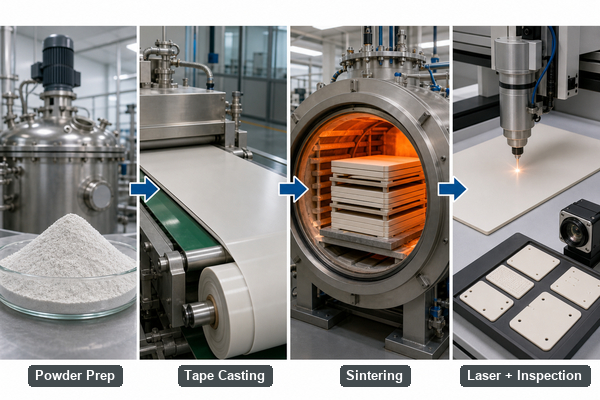
Sintering then densifies the ceramic in a protected nitrogen atmosphere, often at temperatures above 1700°C depending on the formulation and process. The fired substrate may be lapped, polished, laser cut, ground, cleaned, inspected, and metallized. Density, thermal conductivity, dimensions, flatness, surface roughness, strength, and visual defects are checked according to the intended application.
How Are Aluminum Nitride Ceramics Machined and Metallized?
Features are easiest to create before full densification, but sintering shrinkage limits final accuracy. Tight dimensions on a fired AlN ceramic usually require diamond grinding, lapping, polishing, or laser machining. Hole diameter, edge distance, corner radius, ceramic thickness, and remaining web width should be selected together to avoid cracks and excessive processing time.
For electronic circuits, the surface can receive thick-film conductor paste, thin-film sputtered layers, direct plated copper, directly bonded copper, or active-metal-brazed copper. Each route has a different combination of conductor thickness, line definition, adhesion mechanism, interface resistance, and thermal-cycle behavior.
- Thick film: practical for printed conductors and resistive functions, with dimensions governed by paste and firing behavior.
- Thin film: supports fine features and controlled interfaces, but conductor thickness is limited unless plating is added.
- DPC: combines seed-layer deposition, imaging, and copper plating for fine lines and controlled copper thickness.
- DBC: bonds thicker copper to ceramic and suits high-current power structures.
- AMB: uses an active brazing system and is valuable where thick copper and demanding power-module reliability are required.
Surface roughness cannot be selected in isolation. A smoother finish may support fine patterns and wire bonding, while a rougher or activated surface can improve selected adhesion systems. The metallization supplier should confirm the preparation route, metal stack, finish, and assembly temperature before the layout is frozen.
Where Are Aluminum Nitride Ceramics Used?
AlN is most valuable where heat must cross an electrically insulating structure. In power modules it supports semiconductor dies while moving heat toward a baseplate or cooler. In laser diode and high-power LED assemblies, it works as a submount or circuit substrate that limits local temperature rise. RF power amplifiers and microwave packages also benefit from thermal spreading and a stable dielectric platform.
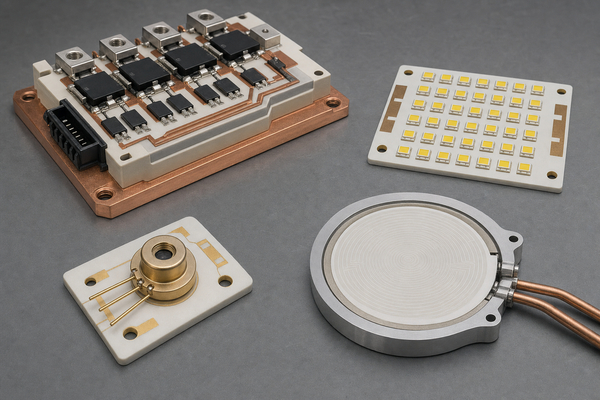
Other uses include electrostatic chucks, heater platforms, wafer-processing components, sensor carriers, high-voltage insulators, heat spreaders, and thermally conductive package parts. The material can also appear as powder filler in polymers, but a filled polymer does not have the same thermal, dielectric, or mechanical behavior as a dense AlN ceramic.
BSTCeramicPCB uses AlN in ceramic circuit technologies where the material and copper system must be selected together. A practical example is a double-sided aluminum nitride DPC ceramic circuit board. Broader material data and document resources are available through the ceramic substrate material resource page.
When Should You Choose an Aluminum Nitride Substrate?
An aluminum nitride substrate is appropriate when thermal resistance through an insulating layer is a confirmed design constraint. Useful inputs include heat-source size, loss per device, allowable junction temperature, ceramic thickness, copper area, attachment layer, cooling boundary, voltage, frequency, and thermal-cycle range.
Standard substrate thicknesses can shorten development time, but thickness should not be selected from availability alone. A thinner ceramic reduces through-thickness thermal resistance and can lower package height, while a thicker ceramic provides greater stiffness and may support higher isolation distance. Large copper areas, asymmetric copper, edge metallization, slots, and dense hole patterns affect warpage and strength.
For moderate heat loads, alumina may meet temperature limits at lower cost. For severe cycling with thick copper, silicon nitride may be considered when mechanical toughness is more important than the highest conductivity. A wider comparison is available in the ceramic PCB substrate material selection guide.
How Do DPC, DBC, and AMB Work with Aluminum Nitride?
DPC is suitable when the design needs relatively fine lines, plated vias, controlled copper build-up, or wire-bondable finishes. DBC is used for thicker copper and high-current layouts, with design rules that account for copper etching, ceramic stress, and thermal cycling. AMB is often selected for demanding power modules where an active braze joins thick copper to AlN and the interface must survive repeated temperature excursions.
| Process | Primary Strength | Typical AlN Use | Key Design Check |
|---|---|---|---|
| DPC | Fine features and plated copper control | Laser, LED, sensor, RF, compact power circuits | Line/space, via structure, finish, copper balance |
| DBC | Thick copper and high current | Power conversion and module substrates | Copper thickness, etch geometry, edge stress, warpage |
| AMB | Strong active-braze interface with thick copper | Automotive and industrial power modules | Braze system, void control, thermal-cycle reliability |
The process limits differ by substrate size, ceramic thickness, copper thickness, and pattern. BSTCeramicPCB publishes a consolidated ceramic PCB process capability overview covering thick film, DPC, DBC, and AMB routes.
FAQ About Aluminum Nitride Ceramics
Is aluminum nitride a ceramic?
Yes. Dense AlN is a non-oxide technical ceramic. It is manufactured from aluminum nitride powder through forming, debinding, high-temperature sintering, and optional precision finishing.
What is the formula for aluminum nitride?
The chemical formula is AlN, representing a 1:1 ratio of aluminum and nitrogen atoms. Commercial ceramics also contain controlled sintering-aid-derived phases and trace impurities, so a data sheet should identify the production grade rather than only the formula.
Is aluminum nitride ionic or covalent?
Its bonding is predominantly covalent with partial ionic character. The strong bonding contributes to high stiffness and makes powder densification difficult, which is why sintering aids and controlled firing conditions are normally required.
What is the dielectric constant of AlN ceramic?
Many dense commercial grades are approximately 8.5-9 at 1 MHz. The exact value depends on grade, density, temperature, frequency, and test method, so high-frequency designs should use supplier data measured near the operating frequency.
Can aluminum nitride ceramics operate at high temperature?
AlN retains useful properties at elevated temperature, but the allowable limit depends on atmosphere, load, duration, metallization, joining materials, and thermal cycling. In air, surface oxidation becomes relevant at elevated temperature, so a single maximum-temperature number is not sufficient for design approval.
Conclusion
Aluminum nitride ceramics are a strong choice when an electronic assembly needs electrical isolation, rapid heat transfer, and a thermal expansion behavior compatible with semiconductor devices. Their value depends on the complete structure: ceramic grade and thickness, copper process, attachment layers, mechanical features, cooling interface, and operating atmosphere.
BSTCeramicPCB supports AlN ceramic substrates with thick-film, DPC, DBC, and AMB circuit processes for prototypes and production. For application and manufacturing support, contact sales@bstceramicpcb.com.
 Products
 About us
 Contact us