


















































 HOME
HOME

-

Ceramic PCB for Humanoid Robot joint actuators
2026 04,07 -
LTCC PCB Surprises: What Most People Miss
2025 12,09 -
Step-by-Step Guide to DPC PCB Design for Sensor Systems
2025 12,03 -
Ceramic PCBs Essential Benefits and Applications
2025 12,01 -
How Al2O3 DPC Ceramic Substrate PCB Enhances Heat Dissipation in Modern Electronics?
2025 11,28 -
How to Choose Between Ceramic, FR4, and Metal Core PCBs
2025 11,27 -
DPC Ceramic PCB Materials: Surprising Science Inside
2025 11,26 -
Wire bondable 2-layer Alumina substrates PCB | Bstceramic PCB
2025 09,22 -
Silicon Nitride Substrate, Silicon Nitride Ceramic Substrate Formula
2025 05,08 -
What is thick film ceramic PCB?
2023 08,02
Si3N4 vs AlN Substrate: Thermal Performance or Reliability?
Si3N4 vs AlN substrate selection is usually a choice between maximum heat conduction and greater resistance to mechanical and thermal-cycling stress. Aluminum nitride (AlN) normally provides the higher bulk thermal conductivity. Silicon nitride (Si3N4) normally provides higher flexural strength and fracture toughness, allowing thinner ceramic layers in designs where reliability under repeated temperature changes is critical. The correct choice therefore depends on the complete copper-ceramic stack, not one material-property number.
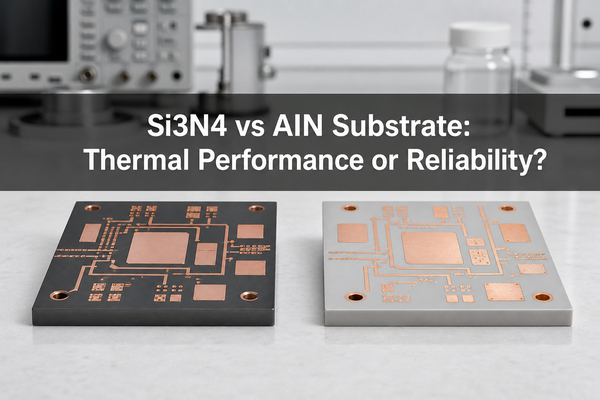
What Is the Core Difference Between Si3N4 and AlN Substrates?
AlN is the stronger option when the main constraint is moving heat through an electrically insulating ceramic layer. Common commercial AlN substrate grades are often specified around 170-180 W/mK, while premium grades can be higher. This makes AlN useful when a small die area produces high heat flux and the ceramic thickness cannot be reduced.
Si3N4 trades some thermal conductivity for mechanical robustness. Representative power-electronics grades are commonly around 80-90 W/mK, but their higher strength and toughness let designers consider thinner ceramic sections. That matters because the thermal resistance of the ceramic is proportional to its thickness and inversely proportional to its conductivity and heat-transfer area.
The practical distinction is simple: choose AlN to minimize ceramic thermal resistance at a given thickness; evaluate Si3N4 when copper stress, vibration, bending, thermal shock, or long power-cycling life is the larger risk.
How Do Si3N4 and AlN Material Properties Compare?
The values below are representative ranges for substrate-grade ceramics, not universal purchase specifications. Actual values depend on composition, sintering, porosity, test method, temperature, and supplier grade.
| Property | AlN Substrate | Si3N4 Substrate | Design Meaning |
|---|---|---|---|
| Thermal conductivity | Commonly about 170-180 W/mK; premium grades may be higher | Commonly about 80-90 W/mK | AlN conducts more heat through the same thickness and area |
| Flexural strength | Often about 350-450 MPa | Often about 650-800 MPa | Si3N4 tolerates greater mechanical and copper-induced stress |
| Fracture toughness | Often about 3 MPa·m^0.5 | Often about 6-7 MPa·m^0.5 | Si3N4 is less likely to propagate cracks from edges or stress concentrations |
| CTE | Roughly 4.4-4.7 ppm/K | Roughly 2.6-3.2 ppm/K | Si3N4 is closer to silicon; both require stack-level stress analysis |
| Electrical behavior | Electrically insulating | Electrically insulating | Both can provide isolation in power substrates when thickness and quality are controlled |
| Typical decision driver | Lowest thermal resistance at a fixed geometry | Mechanical reliability and thermal cycling | Selection should follow the dominant failure mode |
Material data should be checked at the actual operating temperature. Room-temperature conductivity alone does not describe interface resistance, metallization quality, voiding, solder fatigue, or baseplate cooling.
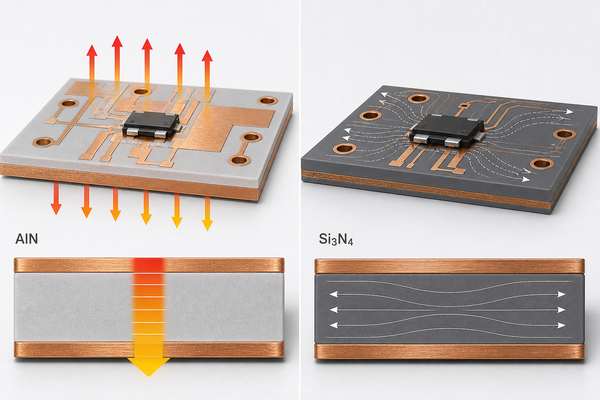
Which Substrate Provides Better Thermal Performance?
AlN provides better bulk thermal conductivity in a like-for-like comparison. If two substrates have the same ceramic thickness, copper layout, bonded area, and operating conditions, the AlN ceramic layer normally has lower through-thickness thermal resistance.
That comparison changes when the Si3N4 layer can be made substantially thinner. The first-order ceramic resistance can be estimated as:
Rth = t / (k × A)
where t is ceramic thickness, k is thermal conductivity, and A is the effective heat-flow area. A Si3N4 layer with about half the conductivity of AlN can approach the ceramic-layer resistance of AlN if its thickness is also approximately halved and the heat-spreading geometry remains comparable.
This does not guarantee equal junction temperature. Copper thickness, die-attach material, metallization interfaces, solder voids, module baseplate, thermal interface material, and cooler performance can contribute more resistance than the ceramic. Thermal simulation should therefore use the complete stack and realistic contact conditions.
Which Substrate Better Resists Cracking and Thermal Cycling?
Si3N4 normally has the advantage when cracking and cyclic stress control the design. Its higher flexural strength and fracture toughness make it more tolerant of stress generated by thick copper, temperature gradients, edge defects, mounting loads, and repeated expansion and contraction.
AlN can still be reliable when the substrate geometry, copper balance, edge condition, bonding process, and assembly profile are well controlled. Problems arise when high conductivity is selected without checking the mechanical consequences of asymmetric copper, large uninterrupted copper areas, sharp internal corners, or excessive ceramic thinning.
Power-cycling results must be interpreted with their test conditions. Cycle count changes with ceramic and copper thickness, bonding method, temperature swing, dwell time, sample geometry, and failure criterion. A result from one test vehicle should not be treated as a guaranteed lifetime for another module.
How Do CTE and Ceramic Thickness Change the Result?
CTE mismatch creates stress whenever the copper, ceramic, die, solder, and baseplate change temperature. Copper expands much more than either AlN or Si3N4, so the ceramic-to-copper thickness ratio, copper pattern symmetry, and bonded area strongly influence warpage and interfacial stress.
Si3N4 has a lower CTE and greater toughness, which can be valuable near silicon and SiC devices exposed to wide temperature swings. AlN's CTE is also reasonably compatible with semiconductor packaging, but its lower toughness gives the designer less margin around stress concentrators.
Ceramic thickness is therefore both a thermal and mechanical variable. Reducing thickness lowers thermal resistance but also changes stiffness, handling strength, dielectric margin, warpage response, and process yield. Minimum thickness should be validated against substrate size, copper thickness, isolation requirement, panel handling, and the selected bonding process.
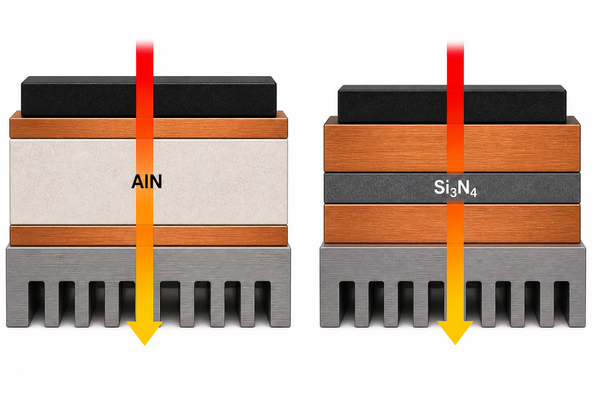
How Do DBC and AMB Affect Substrate Selection?
DBC and AMB describe copper-bonding routes, not ceramic compositions. DBC uses a controlled high-temperature bonding mechanism to join copper and ceramic. AMB uses an active-metal braze system that can bond copper to ceramics that are difficult to join directly and is widely used for demanding power-module substrates.
AlN is available in DBC and AMB structures, while Si3N4 is commonly associated with AMB in high-reliability modules. The process choice affects interface integrity, usable copper thickness, pattern capability, warpage, edge quality, and cycling performance. It is incorrect to compare bare AlN with a finished Si3N4 AMB stack and attribute every difference to the ceramic alone.
For high-current modules, a double-sided AMB ceramic PCB provides a relevant reference for copper-bonded structures that require robust interfaces. A DCB ceramic substrate for IGBT modules illustrates the alternative DBC route. Final selection should compare finished-stack data under the same test conditions.
Which Material Fits IGBT, SiC and EV Power Modules?
Si3N4 is often favored in traction inverters, automotive power modules, railway drives, wind converters, and other systems exposed to high vibration and repeated power cycling. Its toughness supports thin ceramic designs with heavy copper, especially when module life is limited by thermo-mechanical fatigue rather than steady-state temperature alone.
AlN is often favored for concentrated heat sources, laser and optoelectronic assemblies, high-power RF devices, and power modules where the available heat-spreading area is small. It is also useful when the cooling system has limited margin and reducing the ceramic contribution to junction-to-coolant resistance is the primary goal.
For SiC modules, neither material wins automatically. Higher switching speed and power density increase the value of low thermal resistance, but automotive temperature swings and long service-life targets increase the value of toughness. The decision must use the actual loss map, die layout, mission profile, copper geometry, and cooling boundary conditions.
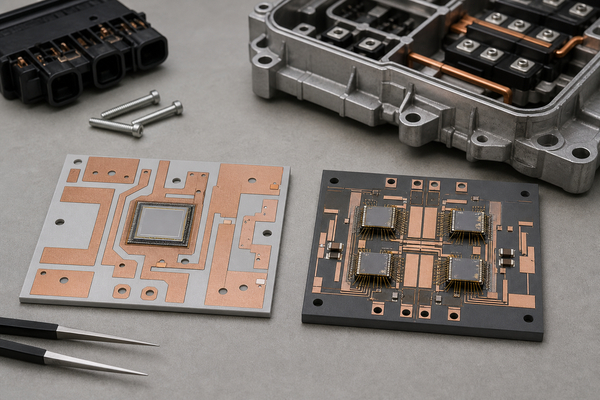
When Should You Choose an AlN Substrate?
Choose AlN when the heat path through the ceramic is a dominant part of the thermal budget and the substrate thickness cannot be reduced enough with another material. It is a strong candidate when:
- Heat flux is concentrated under a small die or laser device.
- The design needs electrical isolation with substantially higher conductivity than alumina.
- The cooler, die attach, and interfaces are already optimized, so ceramic resistance remains important.
- Mechanical loads and thermal-cycle severity can be controlled through geometry and process design.
An AlN DPC ceramic substrate can support fine copper patterns and localized heat spreading where thick bonded copper is not the main requirement. The metallization route should match current density, line definition, assembly temperature, and reliability targets.
When Should You Choose a Si3N4 Substrate?
Choose Si3N4 when the design is more likely to fail from cracking, copper-induced stress, vibration, or thermal fatigue than from the ceramic's steady-state conductivity. It is a strong candidate when:
- The application has a wide and frequent temperature swing.
- Heavy or asymmetric copper creates high mechanical stress.
- A thin ceramic layer is needed to recover thermal performance.
- Automotive, railway, industrial drive, or other long-life power cycling is central to the mission profile.
- Edge damage or mounting loads are difficult to eliminate completely.
The thermal case still needs verification. A mechanically robust substrate does not compensate for insufficient cooling area, poor die attach, excessive solder voiding, or an unrealistic junction-temperature limit.
What Design and Manufacturing Details Need Validation?
Before freezing the substrate, validate the finished construction rather than only the ceramic datasheet. The review should include ceramic grade and thickness, copper thickness on both sides, copper balance, minimum spacing, edge clearance, metallization or bonding route, surface finish, flatness, bow and twist, singulation method, and inspection criteria.
Large copper islands and sharp corners can concentrate stress. Rounded copper corners, balanced copper coverage, appropriate ceramic edge distance, and controlled etching reduce the risk. Thick copper also changes conductor sidewall geometry and the minimum repeatable spacing, so the circuit drawing should reflect the chosen DBC or AMB process.
Testing should match the failure risk. Useful checks can include thermal resistance measurement, dielectric withstand, partial discharge where required, metallization adhesion, X-ray inspection, flatness measurement, temperature cycling, power cycling, and cross-section analysis. A DPC ceramic PCB for new-energy vehicle electronics is another process reference when finer conductor definition is more important than a thick bonded-copper stack.
Si3N4 vs AlN Substrate FAQ
Is Si3N4 more thermally conductive than AlN?
No. Standard substrate-grade AlN normally has higher bulk thermal conductivity than Si3N4. Si3N4 can still achieve competitive through-thickness resistance when its greater strength permits a thinner ceramic layer.
Is Si3N4 stronger than AlN?
Representative Si3N4 grades normally have higher flexural strength and fracture toughness. Exact values must be taken from the selected supplier grade and relevant test method.
Can AlN be used with AMB?
Yes. AlN can be used in AMB structures as well as DBC structures. Process choice depends on copper thickness, interface requirements, geometry, and reliability targets.
Is Si3N4 always an AMB substrate?
No. Si3N4 is a ceramic material, while AMB is a bonding process. They are often paired in high-reliability power modules, but the terms are not interchangeable.
Which material is better for SiC power modules?
AlN is attractive when minimizing thermal resistance dominates. Si3N4 is attractive when thermal cycling, vibration, and crack resistance dominate. Many SiC designs require a stack-level comparison because both constraints are severe.
Can thermal conductivity alone predict module temperature?
No. Junction temperature also depends on die attach, copper spreading, interface voids, baseplate, thermal interface material, cooler design, and operating losses.
Does a thinner Si3N4 substrate always replace AlN?
No. Thickness is limited by dielectric requirements, handling, substrate size, copper stress, manufacturing capability, and yield. The proposed construction must be validated as a complete stack.
Conclusion
The Si3N4 vs AlN substrate decision should follow the dominant design constraint. AlN offers lower ceramic thermal resistance at the same thickness, while Si3N4 offers greater mechanical strength and crack resistance and may support a thinner, more cycle-resistant construction. Compare the complete copper-ceramic assembly using the same geometry, operating temperature, and reliability test conditions.
For a substrate review, send the ceramic preference, dimensions, ceramic and copper thicknesses, circuit drawing, isolation requirement, operating temperature range, and reliability test conditions to sales@bstceramicpcb.com. BSTCeramicPCB can review AlN, Si3N4, DBC, AMB, and DPC options against the actual thermal and mechanical constraints.
 Products
 About us
 Contact us