













































 HOME
HOME


-

Ceramic PCB for Humanoid Robot joint actuators
2026 04,07 -
LTCC PCB Surprises: What Most People Miss
2025 12,09 -
Step-by-Step Guide to DPC PCB Design for Sensor Systems
2025 12,03 -
Ceramic PCBs Essential Benefits and Applications
2025 12,01 -
How Al2O3 DPC Ceramic Substrate PCB Enhances Heat Dissipation in Modern Electronics?
2025 11,28 -
How to Choose Between Ceramic, FR4, and Metal Core PCBs
2025 11,27 -
DPC Ceramic PCB Materials: Surprising Science Inside
2025 11,26 -
Wire bondable 2-layer Alumina substrates PCB | Bstceramic PCB
2025 09,22 -
Silicon Nitride Substrate, Silicon Nitride Ceramic Substrate Formula
2025 05,08 -
What is thick film ceramic PCB?
2023 08,02
Al2O3 Melting Temperature: Melting Point, Service Limits and PCB Design
Published:
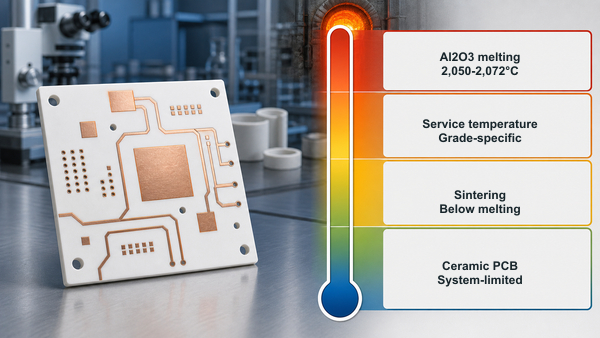
Al2O3 melting temperature is commonly reported at about 2,050-2,072°C (3,722-3,762°F). The range reflects differences in purity, atmosphere, sample condition, and measurement method. This exceptionally high melting point explains why alumina is useful in high-temperature insulation and ceramic substrates, but it is not the allowable operating temperature of a finished ceramic PCB.
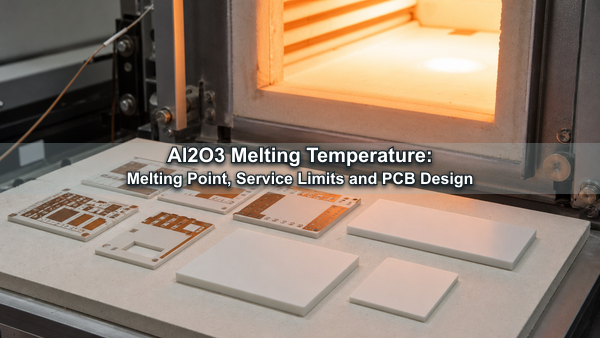
For electronic designs, four values must remain separate: the melting point of the ceramic, its firing or sintering temperature, the continuous service temperature of the alumina grade, and the temperature limit of the complete circuit assembly. Confusing them can produce a specification that looks impressive on paper but fails at the metallization, solder joint, component, or interface.
What Is the Al2O3 Melting Temperature?
The melting point of high-purity aluminum oxide is generally stated as approximately 2,050-2,072°C. A frequently cited reference value is 2,072°C, equivalent to about 3,762°F. Experimental values are not perfectly identical: high-purity material tested by NIST under vacuum was reported near 2,051°C, while other reference sources list values around 2,030-2,054°C.
The practical answer is therefore a narrow range rather than one universal number. The reported value can change with the test atmosphere, impurity content, crystal form, temperature calibration, and whether the observation identifies initial softening, a solidus, or complete melting. For engineering work, the material supplier's grade-specific datasheet remains more useful than treating 2,072°C as a guaranteed value for every commercial alumina body.
Is Al2O3 the Same as Alumina?
Yes. Al2O3 is the chemical formula for aluminum oxide, which is commonly called alumina in ceramic engineering. The stable crystalline phase used in most technical ceramic substrates is alpha-alumina. Sapphire and corundum are also crystalline forms of Al2O3, although their product forms, purity, microstructure, and applications differ from a sintered polycrystalline PCB substrate.
Alumina should not be confused with aluminum metal. Aluminum melts at about 660°C, far below the Al2O3 melting point. The two materials also behave differently electrically: aluminum is a conductor, while dense alumina is normally used as an electrical insulator.
Why Does Al2O3 Have a High Melting Point?
Al2O3 has a high melting point because aluminum and oxygen ions form a strong, stable crystal lattice. Breaking this lattice requires far more thermal energy than weakening the metallic bonds in aluminum or softening an organic PCB laminate. The same bonding contributes to alumina's hardness, chemical stability, dielectric strength, and resistance to oxidation.
High bond strength does not make alumina immune to thermal stress. The material is rigid and brittle, so a steep temperature gradient can generate tensile stress and crack a substrate even when the temperature is thousands of degrees below melting. Edge condition, thickness, mounting constraint, copper distribution, and heating rate are therefore critical in a ceramic PCB.
Does Alumina Purity Change Its Melting Point?
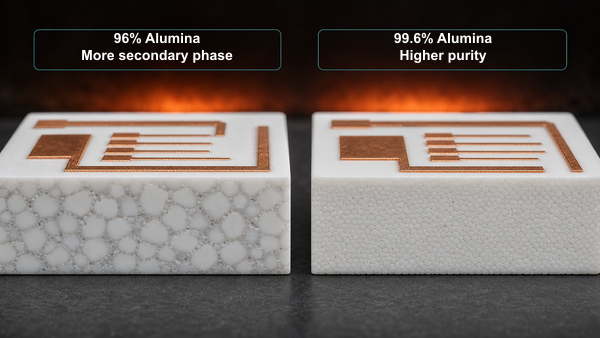
Purity can change the observed melting and softening behavior of a commercial alumina ceramic, but the effect is not represented by one fixed correction for every grade. A 96% alumina body contains sintering aids and secondary phases. Some of these phases can form lower-melting glassy regions at grain boundaries, so creep, dielectric loss, or dimensional change may begin earlier than in a high-purity body.
In 99.6% or higher-purity alumina, fewer secondary phases generally support better high-temperature electrical stability and reduced contamination. However, porosity, grain size, firing history, and the chemistry of the remaining additives still matter. Selecting among different grades of alumina should therefore be based on grade-specific performance data rather than the assumption that purity alone defines the complete temperature limit.
What Happens When Al2O3 Is Heated?
Al2O3 does not remain completely unchanged until it suddenly melts. As temperature rises, the substrate expands, thermal conductivity normally decreases, dielectric behavior changes, and grain-boundary phases become more influential. Under mechanical load and prolonged exposure, creep can become relevant well below the melting point.
Heating also creates gradients through the substrate and across metal patterns. If one area heats faster than another, differential expansion generates stress. Repeated heating and cooling can fatigue metallization interfaces or solder joints even when the alumina itself remains intact. Close to the melting range, the crystal structure loses long-range stability and the material becomes liquid, but electronic assemblies will have exceeded their usable limits long before that stage.
Is Melting Temperature the Same as Sintering Temperature?
No. Melting converts the bulk material into a liquid, while sintering densifies ceramic powder below the melting point. During sintering, diffusion bonds particles, reduces porosity, and develops the required microstructure without fully melting the alumina body.
Commercial alumina substrates are commonly sintered at temperatures substantially below 2,050°C. The exact firing profile depends on purity, powder characteristics, binders, sintering aids, thickness, furnace atmosphere, and target density. Thick-film conductor and resistor pastes are fired later at much lower temperatures specified by the paste system. These are separate thermal processes and should not be treated as the substrate melting point.
What Is the Maximum Service Temperature of Alumina?
The maximum service temperature is lower than the melting point and must be tied to a specific grade, load, atmosphere, and exposure time. High-purity alumina material data may list no-load service capability around 1,600-1,750°C for suitable standalone ceramic parts. A mechanically loaded part, a porous grade, or a body containing more glassy phase can require a lower limit.
A ceramic PCB normally operates at a much lower temperature. Its limit depends on metal conductors, adhesion layers, surface finish, solder or braze, passivation, attached components, and thermal cycling. Some thick-film alumina circuit constructions are specified for operation in the several-hundred-degree-Celsius range, but that value cannot be transferred automatically to DPC, DBC, wire-bonded, soldered, or assembled products.
How Do 96% and 99.6% Alumina Behave at High Temperature?
The decision is less about a dramatic change in the theoretical Al2O3 melting point and more about the amount and behavior of secondary phases. A high-purity grade is preferred when insulation resistance, contamination control, dimensional stability, or vacuum performance must remain tightly controlled at elevated temperature. A 96% grade is often sufficient when cost, mature processing, and balanced mechanical and electrical properties matter more.
| High-temperature factor | 96% alumina | 99.6% alumina |
|---|---|---|
| Secondary phases | Higher proportion of sintering-aid and glassy phases | Lower proportion of secondary phases |
| Electrical stability at heat | Adequate for many thick-film and standard ceramic circuits | Usually preferred for tighter insulation and low-loss requirements |
| Dimensional and creep behavior | More dependent on additive chemistry and exposure time | Generally more stable when the microstructure is well controlled |
| Manufacturing economics | Lower material cost and broad process availability | Higher material and processing cost |
The expansion coefficient must also be checked over the actual temperature range. The article on 96% alumina CTE explains why an average CTE value should be matched to the component and metal system rather than used as an isolated specification.
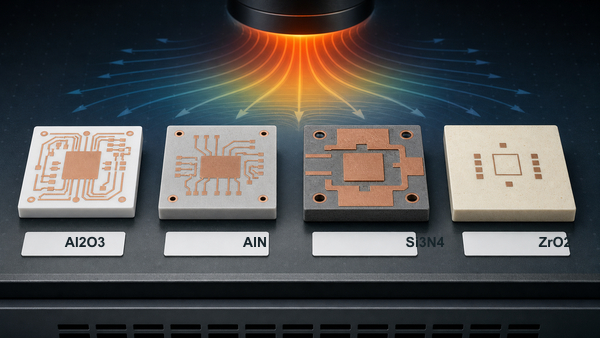
How Does Al2O3 Compare with Other Ceramic Substrate Materials?
Melting or decomposition temperature is only one selection parameter. Thermal conductivity, fracture toughness, dielectric performance, copper-bonding compatibility, and cost often determine whether a material fits an electronic assembly.
| Material | High-temperature behavior | Electronic design relevance |
|---|---|---|
| Al2O3 | Melting point about 2,050-2,072°C | Balanced insulation, cost, chemical stability, and mature processing |
| AlN | Decomposes or sublimates at very high temperature rather than behaving like a simple atmospheric-pressure melt | Much higher thermal conductivity; processing and moisture control are more demanding |
| Si3N4 | Decomposes at high temperature before conventional melting under normal conditions | High fracture toughness and strong thermal-cycling performance |
| ZrO2 | Very high melting point, but temperature-driven phase changes require control | High toughness, lower thermal conductivity than AlN, and specialized stabilization chemistry |
For many circuit applications, an alumina circuit board provides the most economical combination of insulation and temperature stability. AlN becomes more attractive when heat spreading dominates, while Si3N4 is often selected when mechanical toughness and power-module cycling are decisive.
What Limits the Temperature of an Alumina Ceramic PCB?
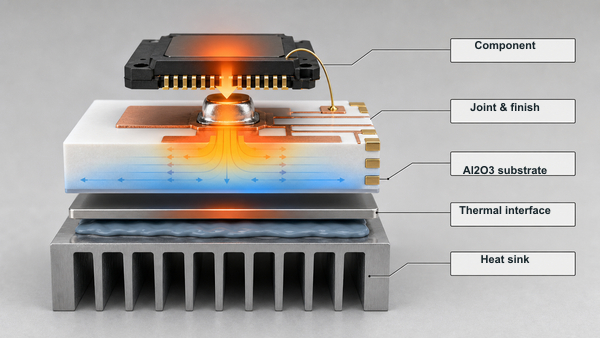
The substrate is rarely the first part of an alumina ceramic PCB to reach its limit. A realistic temperature rating must be based on the weakest temperature-sensitive layer and on the duration and cycling profile.
- Metallization: adhesion layers, conductor composition, oxidation, diffusion, and grain growth can change electrical and mechanical performance.
- Surface finish: nickel, gold, silver, tin, or other finishes have process-specific diffusion and oxidation limits.
- Joining material: solder, conductive adhesive, wire bonds, and brazes each have different creep, intermetallic, and fatigue behavior.
- Components: packages, encapsulants, terminations, and semiconductor junction ratings are normally far below the alumina melting point.
- Mechanical design: rigid mounting, asymmetric copper, and local hot spots can crack the ceramic during cycling.
An Alumina DPC ceramic substrate PCB, a thick-film silver circuit, and a DBC copper substrate can use the same base ceramic yet have different practical temperature limits because their metal interfaces and assembly routes are different.
How Do Metallization and Assembly Materials Change the Temperature Limit?
Metal and joining systems introduce lower melting points and temperature-dependent failure mechanisms. Copper melts near 1,085°C, silver near 962°C, and nickel near 1,455°C, but these bulk melting points still do not define an assembly's service rating. Oxidation, diffusion, interface reactions, stress relaxation, and adhesion loss can begin at much lower temperatures.
Soft solder alloys are especially sensitive to sustained temperature because creep accelerates as operating temperature approaches the alloy's melting range. High-temperature solder, sintered silver, active-metal braze, wire bonding, and fired thick-film pastes solve different problems; none is a universal replacement. The correct stack must be qualified as one system, including atmosphere and cycling, rather than by comparing substrate melting points alone.
How Should High-Temperature Alumina PCB Reliability Be Validated?
Validation should reproduce the intended thermal exposure and the dominant failure mechanism. A single high-temperature storage test cannot replace thermal cycling when the product repeatedly heats and cools.
- High-temperature storage: checks resistance drift, insulation, oxidation, diffusion, and adhesion after sustained exposure.
- Thermal cycling: reveals fatigue caused by CTE mismatch among ceramic, copper, solder, and packages.
- Thermal shock: applies faster transitions to expose cracking and weak interfaces.
- Insulation resistance and dielectric testing at temperature: confirms that electrical isolation remains acceptable under heat.
- Metallization adhesion testing: compares pull or peel performance before and after thermal exposure.
- Microsection and microscopy: identify cracks, delamination, void growth, intermetallic layers, and interface degradation.
Test temperatures, dwell times, ramp rates, atmosphere, electrical bias, and acceptance criteria should match the actual product environment. Passing a substrate-only heat test does not validate a populated assembly.
FAQ About Al2O3 Melting Temperature
What is the melting point of aluminum oxide in Fahrenheit?
A commonly cited Al2O3 melting point of 2,072°C equals approximately 3,762°F. Published sources may show nearby values because of test conditions and material differences.
What is the boiling point of alumina?
Reference values are commonly around 2,977-3,000°C, or about 5,390-5,432°F. At these temperatures, atmosphere, vapor species, and decomposition behavior become important, so a simple boiling-point number has little relevance to ceramic PCB service limits.
Can a standard furnace melt Al2O3?
Most industrial heat-treatment furnaces used for electronics cannot melt dense alumina. Reaching and controlling a temperature above 2,000°C requires specialized furnace materials, atmosphere control, temperature measurement, and containment.
Does alumina lose strength before it melts?
Yes. Strength, creep resistance, grain-boundary behavior, and thermal-shock performance can change far below the melting point. The effect depends on purity, microstructure, load, time, atmosphere, and geometry.
Is a higher alumina purity always necessary for a ceramic PCB?
No. Higher purity can improve selected electrical and high-temperature properties, but 96% alumina is sufficient for many thick-film and general ceramic circuit applications. The material should be matched to insulation, thermal, dimensional, metallization, and cost requirements.
Conclusion
The Al2O3 melting temperature is typically reported around 2,050-2,072°C, but this is a material transition point rather than a ceramic PCB operating rating. Purity, secondary phases, thermal gradients, metallization, joining materials, components, and cycling determine the usable limit of a real circuit.
BSTCeramicPCB can review alumina grade, circuit construction, metallization, and validation requirements as one thermal system. For a technical discussion about an alumina ceramic PCB, contact sales@bstceramicpcb.com.
 Products
 About us
 Contact us