




















































 HOME


-

Aluminum Nitride Thermal Conductivity vs Temperature
2026 10,21 -
Wire Bonding EPIG Thickness: Selecting Pd/Au for Ceramic Bond Pads
2026 10,19 -
When Does a Thin-Film Circuit Need a Polished Alumina Substrate?
2026 10,18 -
Ceramic PCB for Humanoid Robot joint actuators
2026 04,07 -
LTCC PCB Surprises: What Most People Miss
2025 12,09 -
Step-by-Step Guide to DPC PCB Design for Sensor Systems
2025 12,03 -
Ceramic PCBs Essential Benefits and Applications
2025 12,01 -
How Al2O3 DPC Ceramic Substrate PCB Enhances Heat Dissipation in Modern Electronics?
2025 11,28 -
How to Choose Between Ceramic, FR4, and Metal Core PCBs
2025 11,27 -
DPC Ceramic PCB Materials: Surprising Science Inside
2025 11,26 -
Wire bondable 2-layer Alumina substrates PCB | Bstceramic PCB
2025 09,22 -
Silicon Nitride Substrate, Silicon Nitride Ceramic Substrate Formula
2025 05,08 -
What is thick film ceramic PCB?
2023 08,02
Aluminum Nitride Thermal Conductivity vs Temperature
Published:
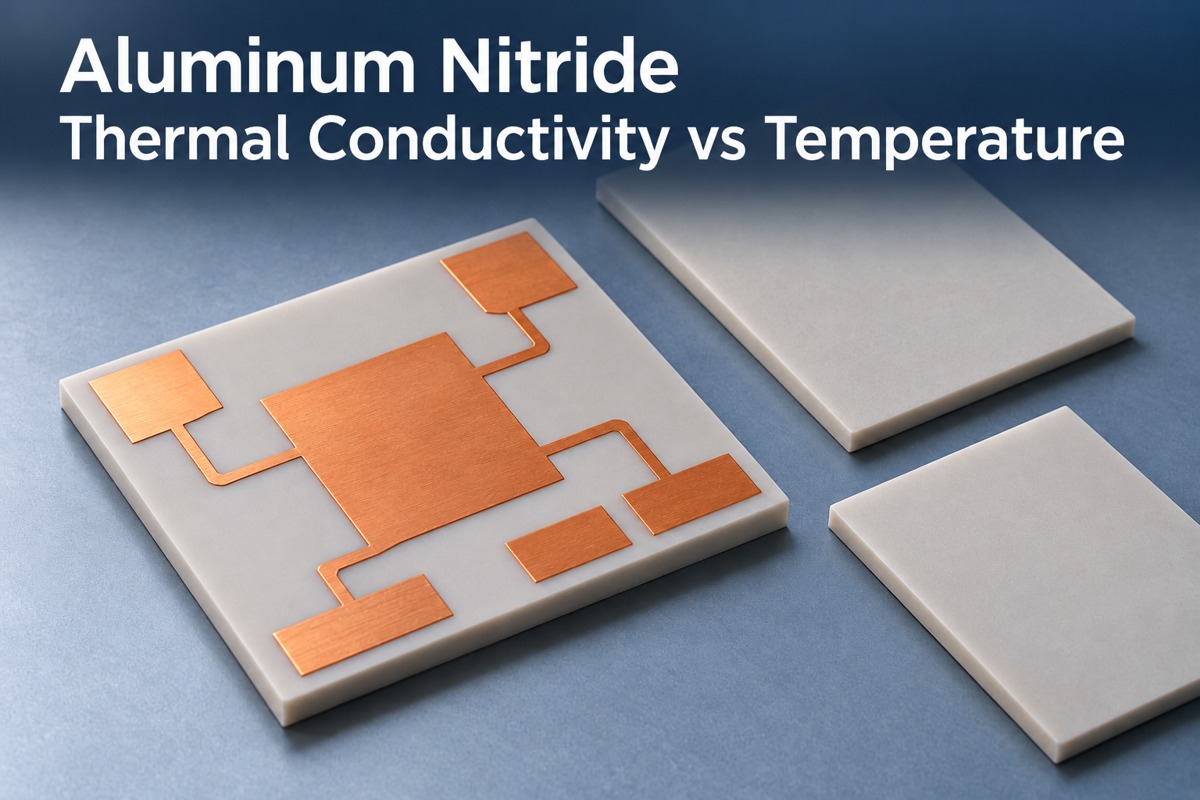
Aluminum nitride thermal conductivity vs temperature describes how AlN’s ability to conduct heat changes as it becomes hotter or colder. Above room temperature, its thermal conductivity generally decreases. This means a room-temperature datasheet value can overestimate heat conduction in a hotter substrate.
For ceramic PCB designs, the practical question is how that change affects heat flow through the board. BSTCeramicPCB supports these projects with engineering consultation, DFM review, and prototype manufacturing, helping connect material requirements with a manufacturable circuit structure.
How Does AlN Thermal Conductivity Change with Temperature?
AlN generally conducts heat less effectively as temperature rises above room temperature. The size of that decrease depends on the material grade and its structure.
One crystalline AlN study measured the following values using the 3ω method:
| Temperature | Thermal conductivity | Meaning |
|---|---|---|
| 100 K, approximately −173°C | 674 ± 56 W/(m·K) | High conductivity at this cryogenic test point |
| Room temperature | 237 ± 6 W/(m·K) | Reference value for the tested crystal |
| 400 K, approximately 127°C | 186 ± 7 W/(m·K) | Lower conductivity at elevated temperature |
The reported conductivity fell by approximately 22% between room temperature and 127°C. That change illustrates why a single room-temperature number cannot fully describe thermal performance.
Temperature units need careful attention. A value measured at 300 K represents approximately 27°C, not 300°C. Likewise, 400 K corresponds to approximately 127°C.
Commercial sintered substrates have their own conductivity ratings and temperature curves. Their values should remain separate from single-crystal measurements, even when both materials are described as AlN.
Scope of these data
The table presents crystalline AlN measurements from Xu and co-authors, published in the Journal of Applied Physics in 2019. These are research-sample results, not specifications for BSTCeramicPCB products or all commercial AlN substrates.
Why Does AlN Thermal Conductivity Decrease as Temperature Rises?
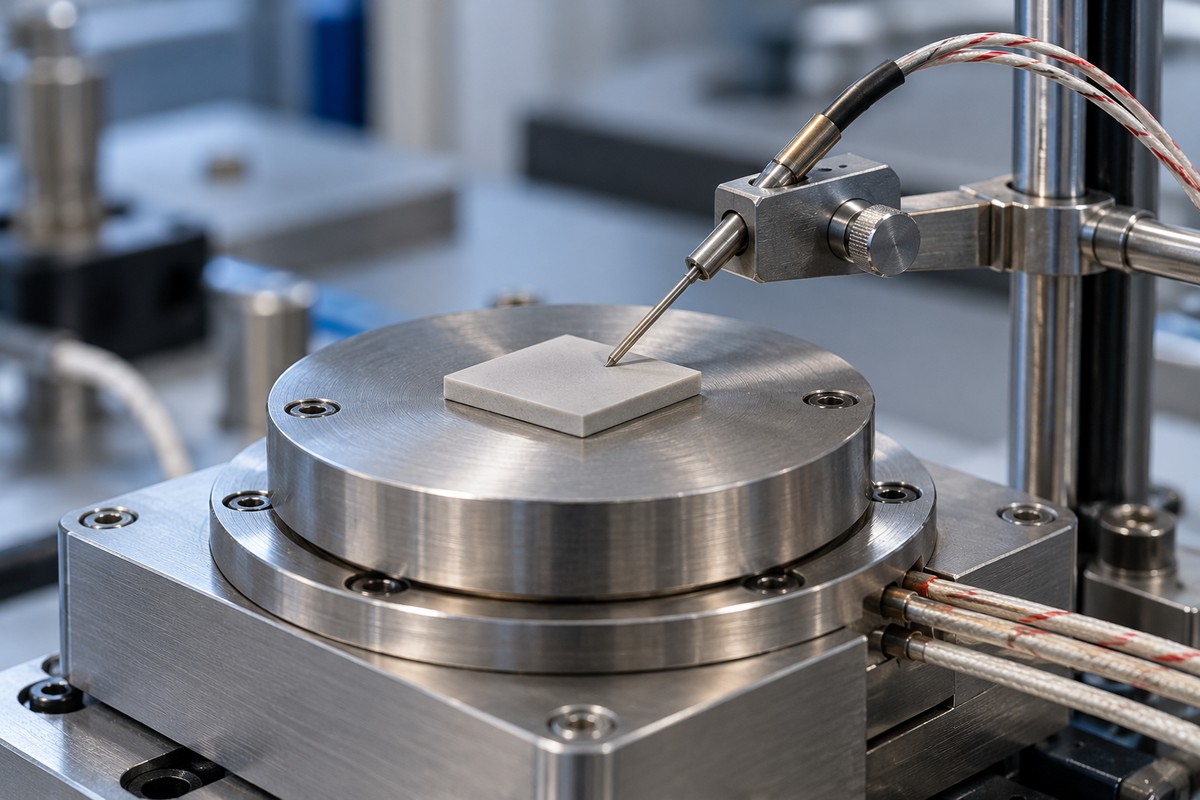
Heat travels through AlN mainly through lattice vibrations called phonons. At higher temperatures, increased phonon scattering makes heat transport less effective.
A useful analogy is a path that becomes more crowded. Energy still moves through the material, but more interactions interrupt its progress. The resulting reduction in thermal conductivity does not necessarily mean the ceramic has suffered damage.
Some AlN measurements show an approximately inverse relationship between conductivity and absolute temperature. A simplified expression is:
k(T) ≈ k(T₀) × T₀ / T
Here, k(T₀) is conductivity at the reference temperature, and both temperatures must be expressed in kelvin.
This relationship explains the direction of change without supplying a universal curve. Actual substrate behavior also depends on defects, microstructure, and the temperature range.
Scope of this relationship
An inverse-temperature trend was reported for a polycrystalline AlN specimen measured from room temperature to 300°C by Jackson and co-authors. Applying it to another grade requires validation; it should not be extended across all temperatures, particularly the cryogenic range.
Why Do AlN Grades Have Different Thermal Conductivity Curves?
AlN grades differ because their internal structures provide different paths for heat transport. Chemical composition alone does not determine the complete thermal response.
Several material features explain the differences:
| Material feature | Effect on heat transport |
|---|---|
| Impurities and crystal defects | Disturb the lattice and scatter phonons |
| Grain boundaries | Introduce additional boundaries in sintered ceramics |
| Residual porosity | Interrupts heat-conduction paths |
| Secondary phases | Changes heat transport between grains |
| Thin-film dimensions | Can increase boundary scattering and reduce effective conductivity |
Processing conditions influence these features. Two substrates can therefore have different conductivity values despite sharing the same basic chemical formula.
Single crystals, sintered substrates, and deposited films should be compared separately. A high-quality crystal’s conductivity is not automatically available in a manufactured ceramic board. A deposited AlN film can also behave differently from a bulk substrate.
Measurement methods add another source of variation. Some techniques measure thermal diffusivity and calculate conductivity using density and specific heat. The quality and temperature dependence of those inputs affect the calculated result.
For a meaningful comparison, each conductivity value should identify the material, temperature, and measurement conditions. Similar room-temperature ratings alone do not establish identical elevated-temperature performance.
How Does Temperature-Dependent Conductivity Affect AlN Substrate Thermal Resistance?
Lower conductivity increases the ceramic layer’s thermal resistance when thickness and heat-transfer area remain unchanged. More temperature difference is then required to move the same amount of heat through it.
For a flat layer with approximately one-dimensional heat flow:
Rθ = t / (k × A)
The temperature difference across the layer is:
ΔT = Q × Rθ
In these equations:
- Rθ: Thermal resistance, K/W.
- t: Ceramic thickness, m.
- k: Thermal conductivity, W/(m·K).
- A: Heat-transfer area, m².
- Q: Heat passing through the ceramic, W.
The following sensitivity example uses identical dimensions and heat flow, changing only the assumed conductivity.
| Parameter | Higher-conductivity assumption | Lower-conductivity assumption |
|---|---|---|
| Ceramic thickness | 0.635 mm | 0.635 mm |
| Heat-transfer area | 5 × 5 mm | 5 × 5 mm |
| Assumed conductivity | 170 W/(m·K) | 100 W/(m·K) |
| Heat passing through the layer | 50 W | 50 W |
| Calculated thermal resistance | 0.149 K/W | 0.254 K/W |
| Calculated temperature difference | 7.47 K | 12.70 K |
What the numbers mean
Lowering the assumed conductivity from 170 to 100 W/(m·K) increases the ceramic layer’s thermal resistance by 70%. At the same 50 W heat flow, the temperature difference across the ceramic rises from 7.47 K to 12.70 K.
Why it matters
With the cold-side temperature held constant, the ceramic’s hot side would be approximately 5.2°C warmer in this simplified model. Using an overly high conductivity value can therefore underestimate the temperature rise through the substrate.
Scope of this example
These are illustrative conductivity inputs, not measured points on an AlN temperature curve. The calculation isolates the ceramic layer; a complete assembly also requires heat-spreading, interface, and cooling effects.
For a broader comparison of substrate structures and complete heat-flow paths, see IMS PCB vs ceramic substrate.
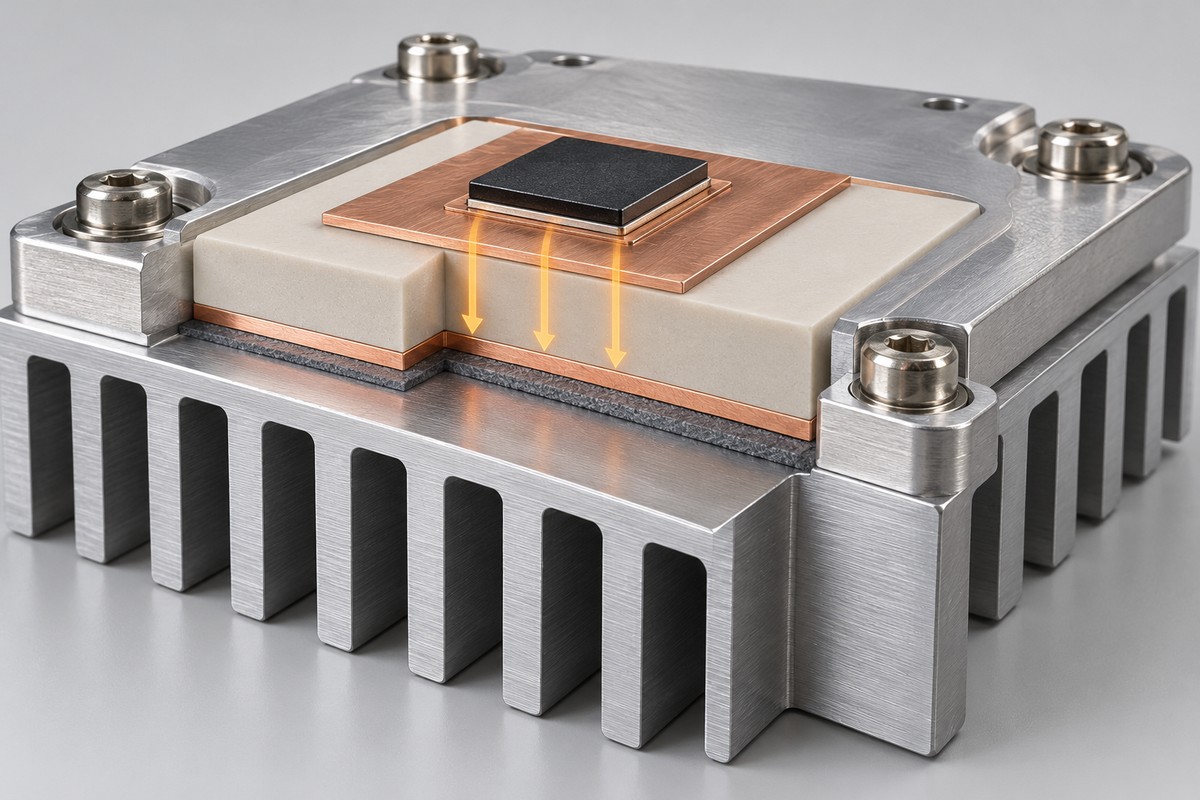
Why Choose BSTCeramicPCB for Your AlN Ceramic PCB Project?
BSTCeramicPCB helps connect ceramic material requirements with practical fabrication and assembly needs. The focus is on developing a board structure that can be manufactured and evaluated in your application.
- Dedicated technical coordination: A business contact and three-engineer support team help address design and manufacturing questions throughout the project.
- DFM and process guidance: Engineering review helps identify fabrication constraints and assess compatibility between the proposed structure and manufacturing process.
- Prototype and small-batch support: Early builds give customers an opportunity to evaluate their designs before committing to larger quantities.
- Integrated manufacturing services: PCB fabrication, component sourcing, and PCBA assembly and testing support projects extending beyond the bare ceramic board.
Material-specific thermal data remains an essential input to the design. Prototype evaluation can then help assess how the selected material performs within the complete assembly.
FAQs About AlN Thermal Conductivity
Is thermal conductivity the same as thermal diffusivity?
No. Thermal conductivity describes heat conduction under a temperature gradient. Thermal diffusivity describes how quickly temperature changes spread through a material.
They are related by k = α × ρ × Cp, where α is diffusivity, ρ is density, and Cp is specific heat.
Does lower conductivity at high temperature mean AlN has been permanently damaged?
Not necessarily. Increased phonon scattering can reduce conductivity without permanently changing the ceramic.
Cracking, oxidation, or other irreversible changes are separate mechanisms. Their occurrence depends on temperature, exposure time, atmosphere, and material condition.
Does adding copper increase the thermal conductivity of the AlN itself?
Copper changes the combined structure’s thermal behavior, particularly lateral heat spreading. It does not change the ceramic’s intrinsic conductivity into that of copper.
A thermal model should account for the copper, ceramic, and interfaces as separate parts of the heat path.
Does a measurement at 300°C mean an AlN PCB can operate continuously at 300°C?
No. A conductivity measurement does not establish the operating-temperature rating of a finished board.
Components, metallization, attachment materials, interfaces, and environmental exposure also determine whether an assembly can operate reliably at that temperature.
Which temperature should be used when choosing an AlN conductivity value?
Use a temperature representative of the ceramic itself. Ambient temperature and semiconductor junction temperature may differ substantially from the substrate temperature.
When conductivity varies significantly across the operating range, a model using temperature-dependent material data is more appropriate than a single fixed value.
Will a thinner AlN substrate always produce a cooler device?
A thinner ceramic layer lowers through-thickness thermal resistance when other conditions remain unchanged. Actual device temperature also depends on heat spreading, interfaces, and cooling.
Mechanical strength, handling, and manufacturing constraints must also be considered when selecting substrate thickness.
Understanding aluminum nitride thermal conductivity vs temperature helps turn a room-temperature material rating into a more realistic thermal design. Discuss your substrate thickness, metallization, operating conditions, and prototype requirements with BSTCeramicPCB at sales@bstceramicpcb.com.
 Products
 About us
 Contact us