





















































 HOME
HOME


-

Ceramic PCB for Humanoid Robot joint actuators
2026 04,07 -
LTCC PCB Surprises: What Most People Miss
2025 12,09 -
Step-by-Step Guide to DPC PCB Design for Sensor Systems
2025 12,03 -
Ceramic PCBs Essential Benefits and Applications
2025 12,01 -
How Al2O3 DPC Ceramic Substrate PCB Enhances Heat Dissipation in Modern Electronics?
2025 11,28 -
How to Choose Between Ceramic, FR4, and Metal Core PCBs
2025 11,27 -
DPC Ceramic PCB Materials: Surprising Science Inside
2025 11,26 -
Wire bondable 2-layer Alumina substrates PCB | Bstceramic PCB
2025 09,22 -
Silicon Nitride Substrate, Silicon Nitride Ceramic Substrate Formula
2025 05,08 -
What is thick film ceramic PCB?
2023 08,02
Color of Al2O3: Why Alumina Appears White, Ivory, Pink or Gray
Published:
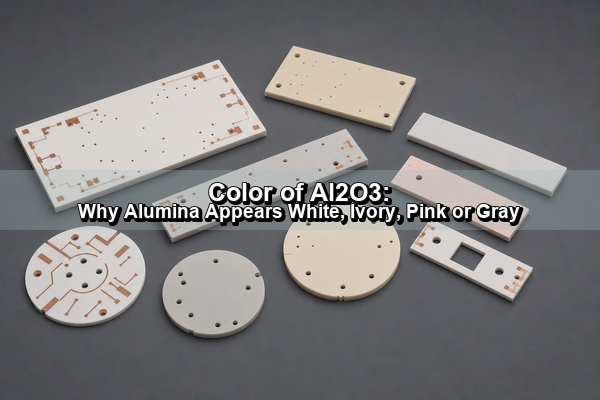
Color of Al2O3 is normally described as colorless for a pure single crystal and white to ivory for dense industrial alumina ceramic. Pink, red, blue, gray, brown, or black shades can appear when trace oxides, intentional dopants, furnace conditions, porosity, grain structure, or surface finish change the way the material absorbs and scatters light. Color is therefore a useful visual clue, but it is not a reliable stand-alone measurement of alumina purity or ceramic PCB performance.
What Is the Normal Color of Al2O3?
Pure aluminum oxide, Al2O3, has no strong visible-light absorption of its own. A transparent, high-quality single crystal can therefore be colorless. Commercial alumina powder and sintered polycrystalline ceramic usually look white because light is scattered at particle surfaces, grain boundaries, pores, and microscopic changes in refractive index.
Electronic-grade alumina substrates are commonly white or slightly ivory. The exact shade depends on material formulation and firing conditions. A consistent ivory tone is not automatically inferior to a bright white tone, and a bright white part is not automatically purer. The acceptable appearance must be defined for the selected ceramic grade and production process.
Why Can Pure Al2O3 Be Colorless but Alumina Ceramic Looks White?
The difference comes from optical structure rather than a contradiction in chemistry. A large, well-formed sapphire crystal can transmit visible light with limited scattering. A sintered substrate contains many small alumina grains, grain boundaries, and sometimes residual pores. Light changes direction at these interfaces and returns to the observer, making the body appear opaque white.
Powder appears white for the same reason: even a material that is transparent as one continuous crystal can look white when divided into many particles. Density, grain size, pore size, and surface roughness determine how strongly the ceramic scatters light. This is why two nominally pure Al2O3 bodies can have different opacity or whiteness.
How Does Alumina Purity Change Its Color?
Purity changes the amount and type of secondary phases in the ceramic, but it does not create a simple color scale. A 96% alumina body contains controlled sintering aids and glass-forming constituents that help densification and metallization. It often appears white, cream, or light ivory. High-purity 99%, 99.6%, or 99.8% alumina can also be white or ivory, depending on raw powder, binders, furnace materials, density, and surface condition.
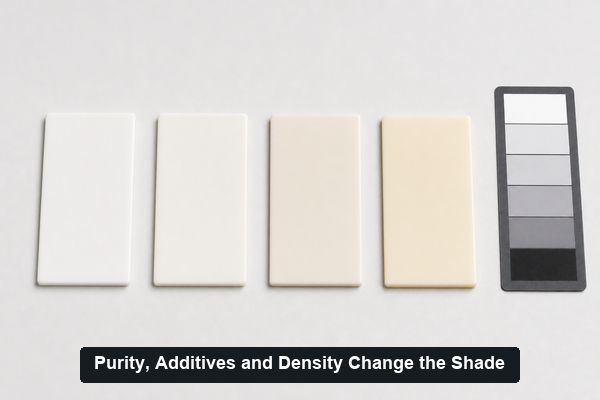
Visual comparison is meaningful only when samples have the same thickness, surface finish, lighting, background, and cleanliness. A polished 99.6% specimen may appear darker or more translucent than a rough 96% specimen because the polished surface scatters less light. For a detailed composition comparison, see the difference between 96% and 99% aluminum oxide.
Which Impurities and Dopants Create Pink, Red, Blue, Gray or Black Alumina?
Small concentrations of transition-metal ions can create strong colors because their electronic states absorb selected wavelengths of visible light. Chromium oxide can produce pink or red alumina and is responsible for ruby coloration in corundum. Iron, titanium, cobalt, manganese, nickel, or mixed oxidation states can create yellow, brown, blue, green, gray, or black shades.
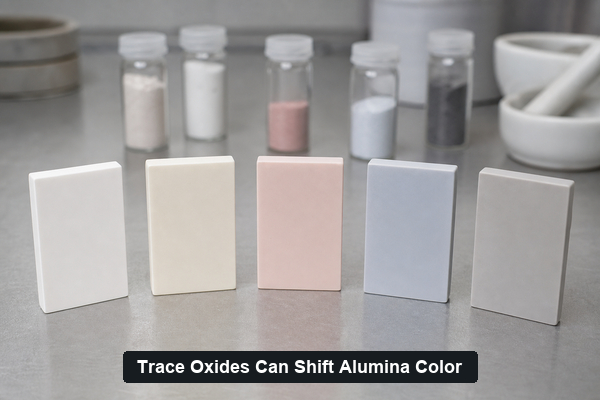
Not every colored alumina is contaminated. Dopants may be intentionally added for optical, electrical, wear, antistatic, laser, heater, or identification functions. The key question is whether the color matches the specified formulation. An unexpected local stain, streak, edge discoloration, or metallic mark is more significant than a uniform color designed into the material.
How Do Sintering Atmosphere and Density Affect Al2O3 Color?
Sintering changes both the chemical state of trace elements and the microstructure that scatters light. Oxygen availability can change the oxidation state of iron, titanium, manganese, or other minor constituents. Furnace setters, heating elements, organic binder residues, and airborne particles can also introduce discoloration if the process is not controlled.
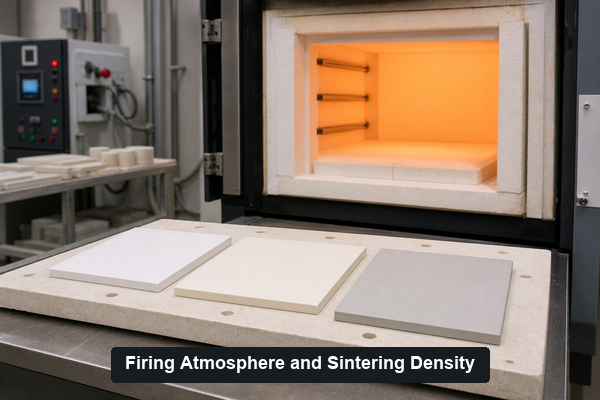
As a ceramic densifies, open pores shrink and grain boundaries evolve. A more porous body often looks brighter and more opaque because it scatters more light, while a dense or polished body may look slightly darker, ivory, or translucent. Uneven firing can produce gradients between the surface and interior. Consistent kiln loading, temperature uniformity, atmosphere, and cleaning are therefore part of color control.
Does Surface Finish Change the Apparent Color of Alumina Substrates?
Yes. A lapped, polished, as-fired, ground, or blasted alumina surface can look different even when the bulk material is identical. Rough surfaces create diffuse reflection and often look brighter or chalkier. Smooth polished surfaces reflect light directionally and may reveal translucency, making the same ceramic appear darker or more saturated.
Thickness also matters. A thin polished substrate can transmit more light than a thick substrate. Copper, nickel, gold, glass, ink, laser marks, cleaning residues, and fingerprints further change the observed color. Color inspections should therefore compare the same surface finish and exclude metallized areas unless the finish itself is being evaluated.
What Is the Difference Between White Alumina, Brown Alumina and Colored Corundum?
White alumina in electronic substrates usually refers to refined, sintered technical ceramic with tightly controlled composition. White fused alumina and brown fused alumina are abrasive materials produced by fusion and crushing. Brown fused alumina contains more titanium and iron compounds and is selected for abrasive toughness and cost, not for electronic substrate dielectric performance.
Ruby and sapphire are crystalline corundum colored by trace elements. They share the Al2O3 crystal family, but gemstone color terminology does not define a ceramic PCB grade. Material form, purity, density, grain structure, dielectric data, thermal properties, and metallization compatibility must be specified separately.
Can Color Identify 96%, 99% or 99.6% Alumina?
No. Color alone cannot reliably identify 96%, 99%, or 99.6% alumina because these grades overlap in visible appearance. Each may be white or ivory, and surface texture can create a larger visual difference than the purity change. A gray or pink part may be an intentional formulation rather than a lower-purity version of a white substrate.
Grade verification should use traceable material documentation and, when required, chemical analysis such as X-ray fluorescence or inductively coupled plasma testing. Density, water absorption, dielectric properties, thermal conductivity, and microstructure tests can confirm whether the ceramic meets its functional specification. The article on different grades of alumina explains why grade selection must use more than appearance.
Does Al2O3 Color Affect Ceramic PCB Performance?
Color affects performance only when it reflects a real change in composition, microstructure, contamination, or optical behavior. White alumina can provide high diffuse reflectance for LED and optical modules. A deliberately dark ceramic may absorb radiant energy or suppress stray light. These are designed optical functions, not universal indicators of electrical or thermal quality.
For most ceramic PCBs, thermal conductivity, dielectric strength, dielectric loss, coefficient of thermal expansion, surface roughness, flatness, flexural strength, and metallization adhesion matter more than visual shade. Two substrates with nearly identical color can have different thermal or electrical properties, while two different-looking substrates can both meet the same specification.
Unexpected discoloration still deserves investigation when it is localized or changes between qualified production lots. Possible causes include furnace contamination, incomplete binder removal, cleaning residue, oxidation of exposed metal, laser redeposition, or handling contamination. The defect decision should be tied to location, pattern, material certificate, and functional tests.
How Should Color Variation Be Inspected in Alumina Ceramic Substrates?
Visual inspection should be standardized before limits are applied. Samples need the same surface condition and should be clean, dry, and free from fingerprints. Use a controlled daylight light source, neutral background, fixed viewing angle, and consistent distance. Compare parts with an approved reference sample from the same material and finish.
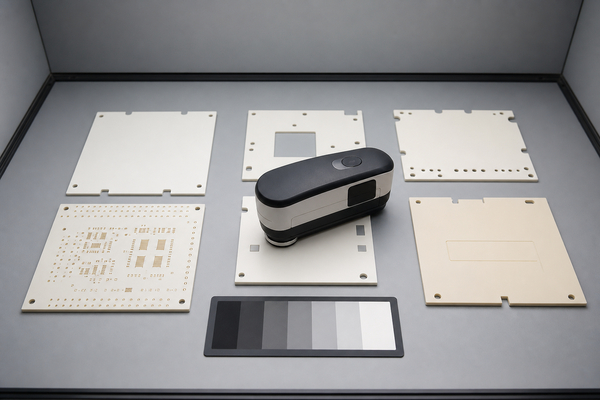
When color is functionally important, a colorimeter or spectrophotometer provides objective L*, a*, and b* values. A delta-E limit can then define total color difference between the sample and reference. The measurement aperture must avoid holes, copper, printed features, shadows, and edge chamfers. Instrument geometry, illuminant, observer setting, backing color, and measurement location must remain fixed between lots.
Color data should be evaluated together with dimensional, surface, metallization, and material tests. A cosmetic limit should not reject harmless shade variation, and an acceptable average color should not hide isolated stains, cracks, chips, exposed pores, or contamination.
Where Is White Al2O3 Used in Electronics?
White alumina is widely used for thick-film circuits, DPC and DBC substrates, LED packages, heater circuits, sensors, power resistors, hybrid microelectronics, RF modules, and insulated feedthroughs. Its white surface is especially useful when optical reflection, visual contrast for inspection, or stable appearance is required.
In a ceramic circuit board, the Al2O3 body supplies electrical insulation, mechanical support, temperature capability, and a heat path beneath the conductor. The exact grade and metallization route depend on feature size, conductor thickness, operating temperature, voltage, and assembly process. For related constructions, review alumina circuit board types and applications or a single-sided alumina DPC ceramic circuit board.
Frequently Asked Questions About the Color of Al2O3
What color is alumina?
Dense industrial alumina is usually white or ivory. Pure single-crystal Al2O3 can be colorless, while trace elements, dopants, firing conditions, porosity, and surface finish can produce other colors.
What is the color of alumina oxide?
Aluminum oxide has no inherent strong visible color when pure. Powders and polycrystalline ceramics commonly appear white because they scatter light. Commercial grades may be cream, ivory, pink, gray, brown, blue, or black.
What does Al2O3 look like?
Al2O3 may look like a fine white powder, an opaque white or ivory ceramic, or a transparent single crystal. Its appearance depends on whether it is powder, porous ceramic, dense substrate, polished crystal, or a doped material.
Is Al2O3 a white solid?
It is commonly described as a white solid in powder and technical-ceramic form. At the crystal level, pure Al2O3 can be transparent and colorless, so both descriptions are correct for different physical forms.
Does darker alumina always mean lower purity?
No. Dark color may come from intentional dopants, oxidation state, surface finish, density, or a designed functional composition. Purity must be confirmed through documentation or analysis rather than visual color alone.
Conclusion
Color of Al2O3 depends on physical form, purity, trace chemistry, firing atmosphere, density, grain structure, thickness, and surface finish. Pure crystals can be colorless, while electronic-grade polycrystalline substrates are normally white or ivory. Pink, gray, blue, brown, or black can be intentional, but unexpected local discoloration should be checked against the approved material and process.
BSTCeramicPCB supplies alumina ceramic substrates and metallized ceramic PCB structures for electronic applications. For material-grade, surface-finish, or color-consistency questions related to an Al2O3 ceramic circuit, contact sales@bstceramicpcb.com.
 Products
 About us
 Contact us