






















































 HOME
HOME

-

Ceramic PCB for Humanoid Robot joint actuators
2026 04,07 -
LTCC PCB Surprises: What Most People Miss
2025 12,09 -
Step-by-Step Guide to DPC PCB Design for Sensor Systems
2025 12,03 -
Ceramic PCBs Essential Benefits and Applications
2025 12,01 -
How Al2O3 DPC Ceramic Substrate PCB Enhances Heat Dissipation in Modern Electronics?
2025 11,28 -
How to Choose Between Ceramic, FR4, and Metal Core PCBs
2025 11,27 -
DPC Ceramic PCB Materials: Surprising Science Inside
2025 11,26 -
Wire bondable 2-layer Alumina substrates PCB | Bstceramic PCB
2025 09,22 -
Silicon Nitride Substrate, Silicon Nitride Ceramic Substrate Formula
2025 05,08 -
What is thick film ceramic PCB?
2023 08,02
Elastic Modulus Alumina: Values, Strength and PCB Design
Elastic modulus alumina values describe how strongly an alumina ceramic resists elastic deformation under load. Dense commercial grades are commonly around 300–390 GPa at room temperature, but the value changes with composition, porosity, temperature, and test method. For ceramic PCB design, this high stiffness helps maintain dimensional stability, yet it also means that local loads, sharp corners, and assembly strain must be controlled carefully.

What Is the Elastic Modulus of Alumina?
The elastic modulus of alumina—also called Young's modulus or the modulus of elasticity—is the slope of the linear elastic portion of its stress-strain response. In simple uniaxial form:
E = stress / elastic strain
A higher value means that more stress is required to produce the same reversible strain. If two ceramic strips have identical dimensions and loading, the strip with the higher modulus bends less before the load is removed.
For alumina, the answer is not one universal number. CoorsTek's alumina material table lists 303 GPa for its 94% and 96% alumina grades and values from 350 to 386 GPa for several higher-purity grades. These are useful reference points, not a specification for every alumina substrate. A PCB drawing should use the property data supplied for the actual substrate grade and thickness.
Typical Elastic Modulus Values by Alumina Grade
The following room-temperature figures are supplier-grade data published by CoorsTek. They illustrate the trend toward higher stiffness in several denser, higher-purity formulations.
| Alumina grade | Young's modulus at 20°C |
|---|---|
| AD-94 | 303 GPa |
| AD-96 | 303 GPa |
| 98.5% alumina | 350 GPa |
| 99.5% alumina | 370 GPa |
| 99.8% alumina | 380 GPa |
| 99.9% alumina | 386 GPa |
The search phrase “alumina ceramic elastic modulus 380 GPa” therefore can be valid for a particular high-purity grade, but 380 GPa should not be applied automatically to 96% alumina. Glassy phases, additives, residual pores, grain structure, and the supplier's processing route all influence the result.
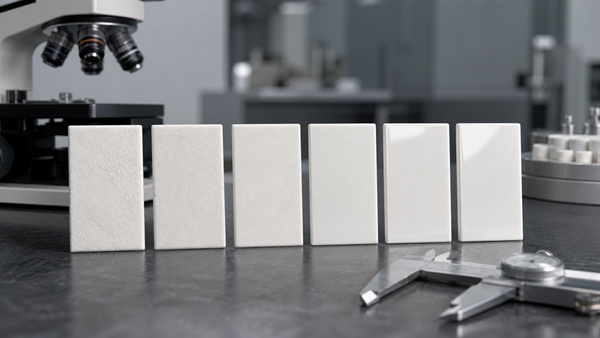
BSTCeramicPCB uses grade-specific engineering data when reviewing a ceramic circuit design. For example, this 96% Al2O3 DPC ceramic substrate PCB for sensors should be evaluated with the properties of its actual 96% substrate rather than a generic high-purity value.
How Do Purity and Porosity Affect Alumina Modulus?
Purity is only part of the explanation. In many commercial aluminas, a higher alumina content reduces the proportion of secondary glassy phases and allows a stiffer ceramic skeleton. However, composition alone does not define stiffness: two nominally similar grades may have different additives, grain sizes, firing histories, and residual porosity.
Porosity is especially important because pores interrupt the load-bearing ceramic network and concentrate local stress. As porosity increases, effective elastic modulus normally decreases. This is why density data, water absorption, and the supplier's process control are useful when comparing substrates. The relationship is not a universal straight-line correction, so a modulus should not be recalculated from density without a validated material model.
For more background on density terminology, see the BSTCeramicPCB guide to alumina density. In a finished PCB, metallization, vias, surface defects, and machined edges also affect structural behavior even though they do not change the intrinsic modulus of the bulk ceramic.
How Does Temperature Change Alumina Stiffness?
Young's modulus is temperature-dependent. As temperature rises, atomic bonding becomes less resistant to small elastic displacement, so alumina stiffness generally decreases. The exact curve depends on grade and microstructure. The NIST Ceramic Data Portal treats temperature and porosity as explicit dependencies in ceramic elasticity data. A room-temperature value should not be used unchanged for a continuously hot heater, sensor, power module, or exhaust-system assembly.
Temperature also creates a system-level problem: copper, solder, component materials, and alumina expand at different rates. A stiff substrate restrains that mismatch, converting thermal expansion into stress at metal-ceramic interfaces, solder joints, plated features, and mounting points. Designers should use the maximum and minimum service temperatures, dwell time, ramp rate, and number of cycles when assessing reliability.
What Is the Difference Between Elastic Modulus and Strength?
Elastic modulus answers “how much will it deform elastically?” Strength answers “at what stress does failure occur under a defined test?” They are related to different parts of material behavior and cannot replace one another.
| Property | What it describes | Why it matters in a ceramic PCB |
|---|---|---|
| Elastic modulus | Reversible strain under stress | Board deflection, load transfer, assembly constraint |
| Flexural strength | Failure stress in a specified bending test | Resistance to bending-induced fracture |
| Tensile strength | Failure stress under tension | Sensitivity to tensile surface flaws |
| Fracture toughness | Resistance to crack propagation | Tolerance of edge damage, notches, and impact |
| Hardness | Resistance to indentation or wear | Surface wear and machining behavior |
Published alumina tensile strength or flexural strength values depend strongly on specimen size, surface finish, edge preparation, flaw population, loading rate, and test fixture. ASTM C1161 specifically treats advanced-ceramic flexural strength as sensitive to preparation, loading, and environment. Compare strength values only when grade, specimen geometry, surface condition, and test method are compatible.
Why Does Alumina Fail Without a Conventional Yield Point?
Alumina is brittle at normal electronic operating temperatures. It usually remains approximately linear-elastic until a critical flaw propagates, after which fracture can occur rapidly. Unlike a ductile metal, it does not normally provide a long plastic-deformation stage that redistributes stress and warns of impending failure.
For that reason, “alumina yield strength” is often the wrong design concept. Engineers should work with flexural strength, fracture toughness, proof testing where applicable, Weibull statistics, and realistic stress concentrations. The practical answer to “is alumina brittle?” is yes—but brittleness does not mean weak. Alumina can be very strong under compression and highly wear-resistant while still being sensitive to tensile flaws and impact at an edge.
How Does Elastic Modulus Affect Ceramic PCB Design?
High stiffness helps a ceramic PCB stay flat and dimensionally stable, but it also transfers local forces efficiently. The layout and mechanical stack should avoid turning assembly loads into concentrated tensile stress.
- Use generous internal corner radii in cutouts and slots. A sharp re-entrant corner raises local stress.
- Keep holes, notches, and narrow ligaments away from highly loaded mounting regions.
- Avoid point clamping. Use compliant washers, controlled torque, or distributed support when a ceramic board is mechanically fastened.
- Support the substrate during connector insertion, wire bonding, press-fit operations, and manual rework.
- Evaluate copper pattern imbalance and metal thickness because asymmetric metallization can contribute to warpage or thermal curvature.
- Model solder-joint and interface stress when large components, heat spreaders, or housings have a different coefficient of thermal expansion.
- Specify edge quality and handling controls. Small chips can become fracture origins under later tensile loading.
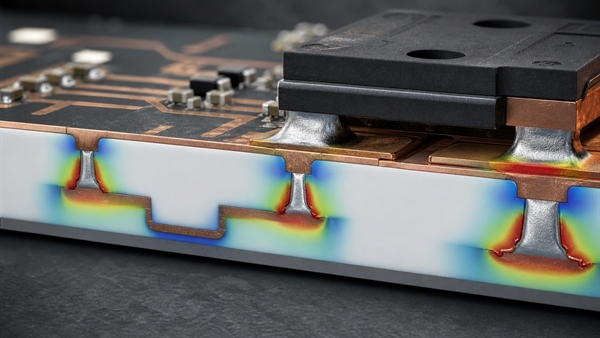
The appropriate metallization process depends on line geometry, copper thickness, thermal load, and reliability target. A fine-feature alumina DPC ceramic substrate PCB for LED applications and a 96% Al2O3 thick-film ceramic substrate PCB may use similar base chemistry but have different metal systems and stress distributions.
How Do Alumina, AlN, and Si3N4 Compare Mechanically?
Material selection should balance stiffness with toughness, thermal conductivity, electrical properties, metallization compatibility, availability, and cost. Supplier data from CoorsTek illustrates why no single material wins every category: its alumina grades span about 303–386 GPa, listed AlN grades span 276–330 GPa, and selected silicon nitride grades span roughly 290–320 GPa. These ranges overlap.
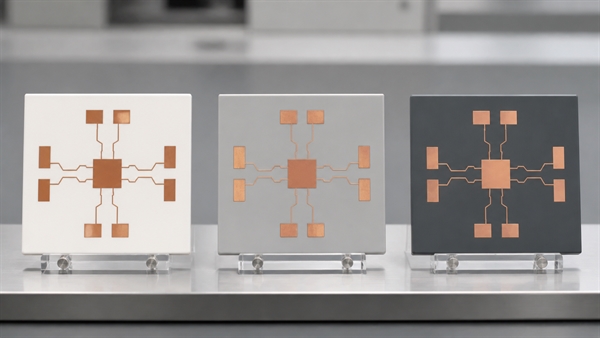
| Material | Mechanical selection point | Broader PCB consideration |
|---|---|---|
| Alumina (Al2O3) | High stiffness and hardness; lower fracture toughness than many Si3N4 grades | Established, electrically insulating, widely available in several purities |
| Aluminum nitride (AlN) | Stiffness can be comparable to alumina; grade-specific toughness must be checked | Much higher thermal conductivity is the usual reason to select it |
| Silicon nitride (Si3N4) | Often combines high strength and higher fracture toughness with a similar order of stiffness | Attractive for thermal cycling and mechanically demanding power modules, subject to process availability |
The BSTCeramicPCB article on alumina versus aluminum nitride ceramic PCBs covers the thermal and electrical trade-offs in more detail. Do not select a substrate only because one catalog lists a slightly higher modulus.
How Is Alumina Elastic Modulus Measured?
Several methods can report alumina elastic modulus, and they do not always produce identical results.
- Uniaxial tension or compression: modulus is calculated from the slope of a controlled stress-strain curve. Alignment and strain measurement are critical.
- Flexural testing: beam deflection under three-point or four-point loading can be used to estimate flexural modulus. Fixture compliance, span, thickness, and shear effects must be controlled.
- Resonance or impulse excitation: natural frequencies and specimen geometry are used to calculate dynamic modulus.
- Ultrasonic methods: wave velocity, density, and Poisson's ratio are used to derive elastic constants.
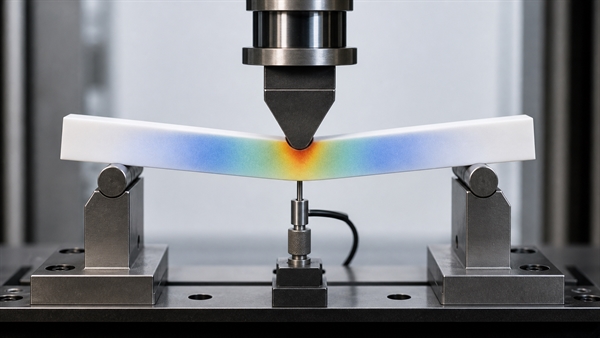
The simple elastic modulus alumina equation, E = stress/strain, is only the starting point. A useful test report also identifies material grade, orientation if relevant, density, temperature, specimen dimensions, surface condition, loading mode, and whether the reported result is static or dynamic.
How Should Engineers Specify Alumina for a Ceramic PCB?
A robust drawing or material specification should identify the alumina grade or approved equivalent, substrate thickness and tolerance, flatness, surface finish, edge condition, dimensional tolerances, metallization system, metal thickness, and applicable inspection method. Mechanical property values should be tied to a supplier datasheet or agreed test method rather than copied from an unrelated generic table.
The assembly definition should also establish mounting constraints, maximum service temperature, thermal-cycle profile, allowable bow, and any high-load handling step. If a board includes narrow bridges, large cutouts, screw mounting, heavy components, or a thick copper pattern, a mechanical review is more valuable than specifying an unrealistically tight generic modulus range.
BSTCeramicPCB supports Al2O3 designs across DPC and thick-film ceramic PCB processes. Process capability still depends on the exact layout and material stack, so the final mechanical limits should be confirmed for the selected construction.
Frequently Asked Questions
What are the properties of alumina (Al2O3)?
Alumina is an electrically insulating ceramic with high stiffness, hardness, compressive strength, wear resistance, chemical stability, and useful thermal conductivity. Exact values depend on purity, additives, porosity, grain structure, and temperature. See also Is Alumina Ceramic Durable?.
Is Young's modulus the same as the modulus of elasticity for alumina?
In a uniaxial elastic context, yes. “Young's modulus alumina,” “alumina modulus of elasticity,” and “elastic modulus of alumina” normally refer to the same E value. Shear modulus and bulk modulus are different elastic constants.
Can a higher alumina modulus prevent ceramic PCB cracking?
Not by itself. A higher modulus reduces elastic deformation but can increase stress transfer into notches, interfaces, and mounting points. Crack resistance also depends on fracture toughness, strength distribution, edge quality, geometry, residual stress, thermal expansion mismatch, and load history.
Conclusion
Elastic modulus alumina values are typically in the low-to-high 300 GPa range for dense commercial grades, but the correct number must come from the actual substrate specification. Use modulus to predict elastic deformation, then review strength, toughness, edge condition, thermal expansion, metallization, and mounting stress separately. For an Al2O3 ceramic PCB design review, contact BSTCeramicPCB at sales@bstceramicpcb.com.
 Products
 About us
 Contact us