





























 HOME


-

Aluminum Nitride Thermal Conductivity vs Temperature
2026 10,21 -
Wire Bonding EPIG Thickness: Selecting Pd/Au for Ceramic Bond Pads
2026 10,19 -
When Does a Thin-Film Circuit Need a Polished Alumina Substrate?
2026 10,18 -
Ceramic PCB for Humanoid Robot joint actuators
2026 04,07 -
LTCC PCB Surprises: What Most People Miss
2025 12,09 -
Step-by-Step Guide to DPC PCB Design for Sensor Systems
2025 12,03 -
Ceramic PCBs Essential Benefits and Applications
2025 12,01 -
How Al2O3 DPC Ceramic Substrate PCB Enhances Heat Dissipation in Modern Electronics?
2025 11,28 -
How to Choose Between Ceramic, FR4, and Metal Core PCBs
2025 11,27 -
DPC Ceramic PCB Materials: Surprising Science Inside
2025 11,26 -
Wire bondable 2-layer Alumina substrates PCB | Bstceramic PCB
2025 09,22 -
Silicon Nitride Substrate, Silicon Nitride Ceramic Substrate Formula
2025 05,08 -
What is thick film ceramic PCB?
2023 08,02
Ceramic PCB Netherlands Suppliers for Precision Electronics
Published:
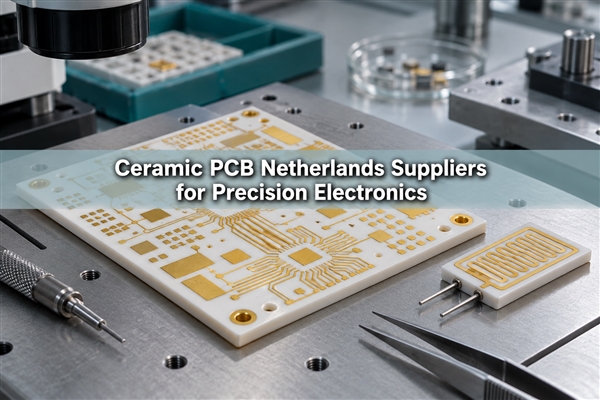
Ceramic PCB Netherlands suppliers include BHC, which develops thick-film heaters and hybrid circuits, and Neways, which manufactures ceramic assemblies for demanding electronic systems. Their work spans laboratory instruments, sensing and precision equipment. At BSTCeramicPCB, we manufacture custom ceramic circuits in China and offer component sourcing and assembly, providing another route for Dutch projects that need a patterned substrate or a populated board.
What Makes Ceramic PCB Sourcing in the Netherlands Difficult?
The main challenge is matching the circuit to the right manufacturing and assembly process. A ceramic heater for a laboratory instrument, a wire-bonded sensor module and a copper-patterned interconnect board involve different materials, interfaces and tests.
Three issues are particularly relevant to the applications served by Dutch specialists:
- Transferring a heater design: Resistance, printed geometry and temperature distribution work together. Reproducing the outline alone will not reproduce the heating performance.
- Building for a vacuum environment: Adhesives, component packages and coatings can release volatile material even when the ceramic substrate is suitable. Changing one assembly material can affect the complete module.
- Matching pads to component attachment: Soldering, wire bonding and conductive adhesive attachment need different surface characteristics. A change of finish may require changes to the assembly process.
For a board assembled in the Netherlands, the ceramic fabricator and assembler need compatible pad and handling specifications. Combining fabrication and assembly can reduce that handover; keeping them separate can suit an established local assembly process. We support both bare-board and assembled ceramic PCB orders.
Top Ceramic PCB Suppliers in the Netherlands
BHC and Neways offer distinct ceramic electronics capabilities in the Netherlands. The comparison below also includes our manufacturing service in China for projects considering an overseas supply option.
| Supplier | Location and role | Ceramic electronics capabilities | Relevant applications |
|---|---|---|---|
| BHC / Bergh Hybrid Circuits | Netherlands; hybrid electronics manufacturer | Thick-film circuits, ceramic heaters, sensors, resistor trimming and electronic assembly | Laboratory heating, temperature sensing and custom hybrid modules |
| Neways | Netherlands-based electronics manufacturer with international operations | Additive thick-film ceramic PCBAs, wire bonding, flip-chip and adhesive bonding | Precision electronics, semiconductor equipment and demanding vacuum or high-temperature assemblies |
| BSTCeramicPCB | China; custom ceramic PCB manufacturer | Thick-film, thin-film and copper-patterned ceramic circuits, component sourcing and ceramic PCB assembly | Custom interconnect and sensor boards supplied bare or assembled |
BHC's heater work is relevant when the ceramic carries a heating function as well as electrical connections. Neways combines ceramic circuitry with precision interconnection and module integration. Our service suits projects centered on custom circuit fabrication, with assembly available in the same order.
How Are Ceramic Heaters Used in Laboratory Instruments?
Ceramic heaters provide heat close to the sample or working surface while electrically insulating the printed circuit. BHC develops thick-film heaters for robotic liquid-handler incubators, a practical example of ceramic electronics used in automated laboratory equipment.
In this type of instrument, the heater temperature and sample temperature are not necessarily equal. The sample holder, contact pressure and surrounding structure introduce thermal resistance. A sensor placed beside the heater can respond quickly while the sample is still warming.
The printed heating pattern also matters. Closely spaced tracks concentrate power; wider spacing spreads the heated area. Edge losses and the contact with the sample holder can produce a temperature gradient even with uniform electrical resistance. Evaluating the assembled instrument reveals these effects more clearly than measuring the heater alone.
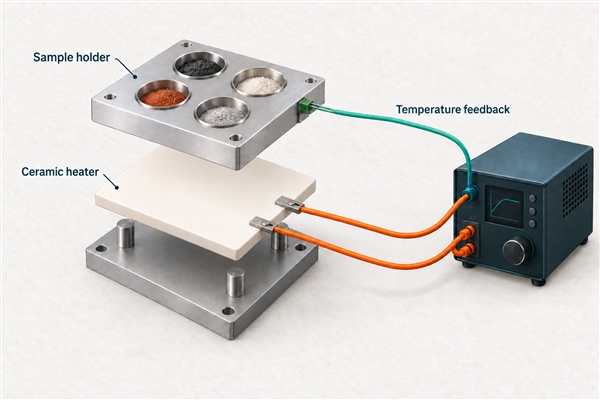
A closed-loop controller adjusts heater power from the temperature signal. Sensor placement, heating power and the thermal mass of the holder therefore belong in the same design review. The ceramic circuit is one part of the temperature-control system, alongside the sensor, controller and mechanical assembly.
What Changes When a Ceramic Circuit Operates in Vacuum?
Vacuum operation changes both material selection and heat removal. Neways uses ceramic PCBAs in demanding vacuum applications, where low moisture absorption and low outgassing are useful properties of the substrate.
The rest of the assembly needs equal attention. Polymer adhesives, coatings and component packaging can release volatile substances. Material selection includes the adhesive formulation and cure process, rather than just the ceramic grade. A coating added to protect a board in air may introduce a new contamination source in vacuum.
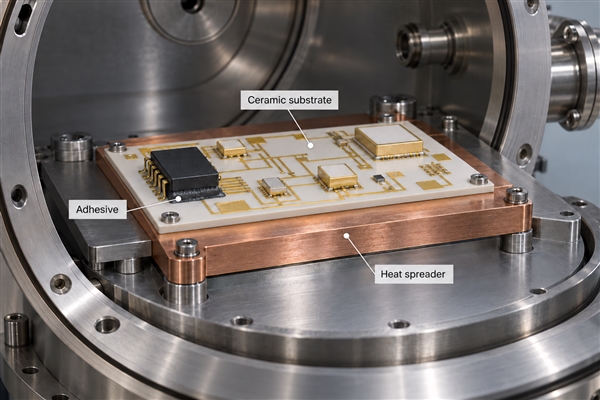
Heat transfer also changes: air convection is unavailable in high vacuum, so conduction into the mounting structure and radiation carry the heat away. A power component may consequently run hotter than it did during an open-bench test. The contact between the ceramic and its support becomes part of the thermal design.
Vacuum qualification is specific to the complete assembly and its operating conditions. For these projects, the material set, cleaning process and environmental tests form part of the agreed manufacturing specification.
Which Pad Finish Fits the Assembly Method?
The pad finish must suit the actual joint: a soldered component, a bonded wire or an adhesive-mounted die. These joints use the metal surface differently, so a finish suitable for one process is not automatically interchangeable with another.
For soldered components, wetting and the integrity of the pad-to-ceramic structure affect the joint. For wire bonding, the finish, cleanliness and selected wire-and-bonding process must work together. Conductive adhesive attachment also depends on the bond-line geometry and cure conditions.
Our DPC ceramic sensor board is an example using 96% alumina, 35 μm copper and an ENEPIG finish. It illustrates a copper-patterned ceramic substrate PCB for sensor circuitry. The finish for a new design is selected with its intended assembly process; the example does not establish compatibility with every wire-bonding method.
How Should a Ceramic Board Be Mounted?
A ceramic board needs support that spreads mechanical load and provides the required thermal path. Ceramic is stiff and brittle, so concentrated clamping pressure or bending from an uneven support can damage it.
For precision instruments, the support surface and board flatness affect both mechanical stress and thermal contact. A screw tightened against an unsupported corner can impose bending even when the board fits the drawing. Clamping arrangements should load supported areas and avoid forcing the ceramic to conform to a distorted metal plate.
Thermal expansion also matters. A metal housing and ceramic board move by different amounts as temperature changes. A rigid attachment can transfer that movement into the board or its joints. Compliant attachment can reduce stress, although any adhesive or interface material must also meet the temperature and environmental requirements.
There is no universal mounting torque for ceramic PCB assemblies. The board geometry, support and fastener arrangement determine the appropriate mechanical validation.
What Advantages Does BSTCeramicPCB Offer Compared with Dutch Suppliers?
Our practical advantages are a choice of ceramic circuit processes, custom board fabrication and the option to combine fabrication with assembly. These services provide an alternative to purchasing a fully developed heater or precision module when a project already has its own circuit design.
Different circuit processes for different layouts
We offer thick-film, thin-film and DPC circuits. Our thick-film board for scientific equipment uses 96% alumina, a 0.635 mm substrate and 12–15 μm AgPt conductors. Our thin-film circuit for medical equipment also uses 96% alumina and a 0.635 mm substrate, with a different metallization process. These are manufactured product examples, rather than universal specifications for every order.
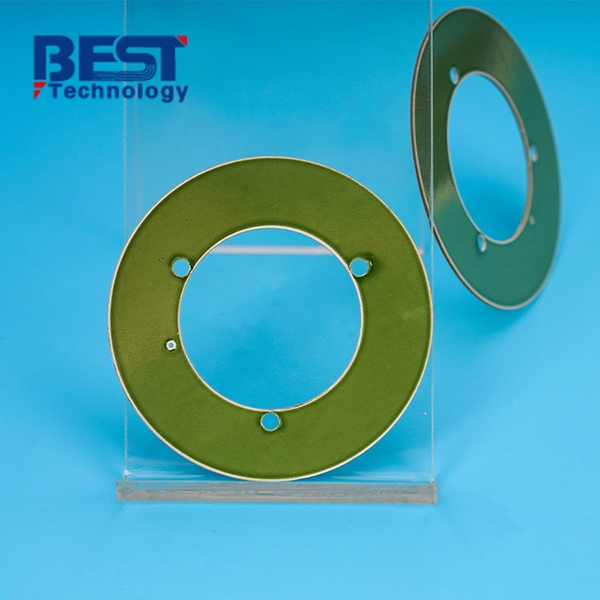
The choice allows an existing layout to be evaluated against an appropriate fabrication process. A printed hybrid circuit and a plated copper circuit do not need to be forced into the same construction.
Fabrication and assembly through one supplier
Our ceramic PCB assembly service includes component sourcing, BOM checks, first-article inspection and functional testing to an agreed test plan. When we supply the populated board, fabrication and assembly can be coordinated before production, including the pad finish and component attachment requirements.
Dutch suppliers also provide integrated services. Our difference in this comparison is the combination of custom ceramic board options and a fabrication-led supply route from China. We can supply the bare circuit to an existing assembler or take the order through component assembly.
Why Choose BSTCeramicPCB for Projects in the Netherlands?
Choose us when your project needs a custom ceramic circuit and a clear choice between bare-board supply and assembly. This suits instrument developers retaining their own product design, as well as manufacturers that already have a local integration and testing process.
For a Dutch company with an established assembly line, we can supply patterned ceramic boards for that line. When outsourcing the populated circuit is more practical, our fabrication and assembly services can be combined. That flexibility lets the circuit supply fit the existing product-development process.
For Ceramic PCB Netherlands projects involving specialist functions such as a calibrated heater or a vacuum-qualified module, the required circuit and assembly work should be defined together with the final system validation. We review our manufacturing scope against that design before committing to production.
FAQ
1. Is a ceramic heater the same as a ceramic PCB?
A ceramic heater uses a resistive circuit to generate heat. A ceramic PCB may instead carry interconnections and components, although both functions can be integrated on a suitable substrate. Their performance requirements differ: heater resistance and temperature distribution are not the same as signal-routing requirements.
2. Is every ceramic PCB suitable for vacuum?
No. The ceramic material is only one part of the assembly. Adhesives, coatings, components and cleaning residues also affect vacuum compatibility. The complete assembly needs evaluation for its operating environment.
3. Can alumina be replaced by AlN without redesigning the circuit?
Not automatically. AlN generally provides higher thermal conductivity, but the change also affects fabrication compatibility and thermal behavior. In a heater, spreading heat more effectively can change the power and control response. The replacement needs evaluation in the complete design.
Conclusion
BHC and Neways offer established Dutch routes for ceramic heaters and precision electronic assemblies. At BSTCeramicPCB, we provide custom ceramic circuit fabrication in China with optional component sourcing and assembly. Contact sales@bstceramicpcb.com to discuss the manufacturing route for your project.
 Products
 About us
 Contact us