




















































 HOME


-

Aluminum Nitride Thermal Conductivity vs Temperature
2026 10,21 -
Wire Bonding EPIG Thickness: Selecting Pd/Au for Ceramic Bond Pads
2026 10,19 -
When Does a Thin-Film Circuit Need a Polished Alumina Substrate?
2026 10,18 -
Ceramic PCB for Humanoid Robot joint actuators
2026 04,07 -
LTCC PCB Surprises: What Most People Miss
2025 12,09 -
Step-by-Step Guide to DPC PCB Design for Sensor Systems
2025 12,03 -
Ceramic PCBs Essential Benefits and Applications
2025 12,01 -
How Al2O3 DPC Ceramic Substrate PCB Enhances Heat Dissipation in Modern Electronics?
2025 11,28 -
How to Choose Between Ceramic, FR4, and Metal Core PCBs
2025 11,27 -
DPC Ceramic PCB Materials: Surprising Science Inside
2025 11,26 -
Wire bondable 2-layer Alumina substrates PCB | Bstceramic PCB
2025 09,22 -
Silicon Nitride Substrate, Silicon Nitride Ceramic Substrate Formula
2025 05,08 -
What is thick film ceramic PCB?
2023 08,02
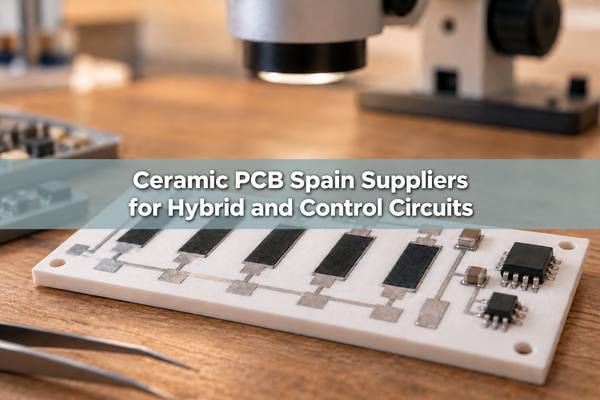
Ceramic PCB Spain Suppliers for Hybrid and Control Circuits
Published:
Ceramic PCB Spain suppliers include specialists in thick-film hybrids and resistive control elements. HYBtronics develops custom hybrid circuits in Vitoria, while ACP in Tarazona produces thick-film potentiometer tracks and related components. At BSTCeramicPCB, we manufacture custom ceramic circuits in China, offering thick-film, thin-film and DPC options with component sourcing and board assembly.
What Makes Ceramic PCB Sourcing in Spain Difficult?
The main difficulty is identifying which functions are built into the substrate. In a thick-film hybrid, printed resistors may form part of the working circuit. In a potentiometer, the printed track is a moving-contact surface. Neither is equivalent to a ceramic board carrying only metal interconnections.
Spain's HYBtronics and ACP illustrate these different requirements. HYBtronics combines hybrid circuit manufacture with assembly and trimming, while ACP specializes in resistive tracks for position sensing and controls.
- A printed resistor carries a functional specification: Resistance value, temperature behavior and power loading affect the circuit. Matching only its outline is insufficient.
- A contact track needs a mechanical interface: Wiper geometry, contact force and repeated movement affect performance alongside electrical resistance.
- A calibrated circuit needs a defined test condition: Adjusting an output while the circuit is powered differs from measuring an isolated resistor.
For a custom ceramic board, the required printed functions and assembled components determine the manufacturing route. We review the circuit construction before selecting thick-film, thin-film or copper-patterned fabrication.
Top Ceramic PCB Suppliers in Spain
HYBtronics and ACP provide relevant local expertise in ceramic-compatible thick-film electronics. Their products serve different purposes, so the comparison separates hybrid circuit manufacturing from resistive component specialization.
| Supplier | Location and role | Relevant capabilities | Best-matched project scope |
|---|---|---|---|
| HYBtronics Microsystems | Vitoria, Spain; hybrid electronics manufacturer | Custom thick-film circuits, screen printing, laser trimming, chip-on-board and SMT processes | Hybrid circuits with integrated printed functions and assembly |
| ACP / Aragonesa de Componentes Pasivos | Tarazona, Spain; resistive component specialist | Thick-film potentiometer tracks, paste processing, screen printing, trimming and automated testing; substrates include alumina and other materials | Position-sensing tracks, potentiometers, switches and controls |
| BSTCeramicPCB | China; custom ceramic PCB manufacturer | Thick-film, thin-film and DPC circuit fabrication, component procurement and PCB assembly | Custom ceramic control and sensor circuits supplied bare or assembled |
HYBtronics is relevant to a complete hybrid circuit, including adjustment of its electrical behavior. ACP's strength is the resistive element and its control function. Our service focuses on custom ceramic circuit fabrication and optional component assembly for the customer's electronic design.
What Is the Difference Between Resistor Trimming and Circuit Calibration?
Resistor trimming adjusts a printed resistance value. Circuit calibration adjusts a measured output of the operating circuit. The two can use the same laser-trimming operation but have different measurement targets.
HYBtronics describes both adjustment of printed resistors and trimming a completed, powered circuit to obtain an intended output, such as voltage or frequency. This is useful when the final output depends on more than the nominal value of one resistor.
| Method | Measurement during adjustment | What the result establishes |
|---|---|---|
| Resistance-value trimming | Resistance of the element or network | The measured resistance under the specified test conditions |
| Functional trimming | Output of the powered circuit | The selected circuit output under the calibration conditions |
A circuit can contain an accurately trimmed resistor and still have output error from an amplifier, reference source or another component. Functional adjustment can account for some combined errors at the calibration point. Temperature drift and long-term changes still require their own evaluation.
The test connection also matters. Contact resistance or an unstable fixture can affect the measured value and therefore the adjustment. A repeatable measurement setup is part of the trimming process.
How Are Potentiometer Tracks Different from Fixed Resistors?
A potentiometer track operates with a moving contact, whereas a fixed printed resistor normally has stationary electrical terminals. The track must provide the required resistance variation while tolerating contact movement over its working surface.
ACP manufactures thick-film tracks for position sensing and controls. Its applications include actuator feedback and control switches, and its substrate choices include alumina as well as several non-ceramic materials.
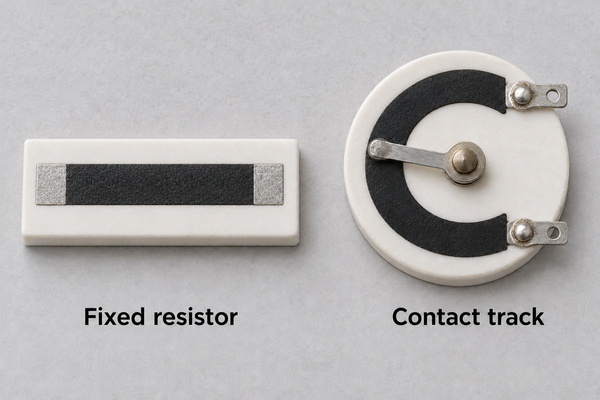
For a position sensor, resistance versus movement is part of the function. Track geometry, resistive material and the wiper arrangement influence the output. Wear, contamination and contact stability can change that output over repeated cycles even if the initial end-to-end resistance is correct.
A fixed resistor network on a ceramic PCB has a different task. It may set gain, divide a voltage or limit current without any sliding contact. Replacing a potentiometer track with a generic printed resistor would omit the mechanical contact and lifetime requirements of the original component.
Can Thick-Film Circuits Be Printed on Metal?
Yes. Thick-film processes can be used on suitable metal constructions as well as ceramic substrates. HYBtronics identifies ceramic, aluminum and stainless steel among its screen-printing routes.
The electrical insulation structure changes with the base material. Alumina is itself an electrical insulator. A conductive metal base needs a suitable insulating structure between the base and any circuit that must remain isolated from it.
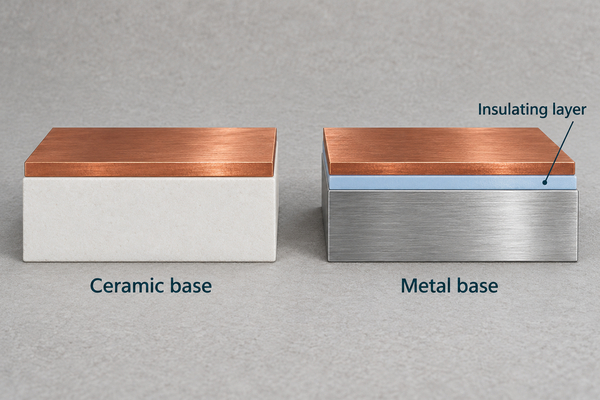
This distinction affects heat flow and electrical testing. A metal-backed circuit may transfer heat effectively into its base, but its dielectric layer becomes part of both the thermal path and the isolation system. A ceramic circuit carries those functions through the ceramic body and its interfaces.
The same printed resistance pattern can therefore behave differently on two substrate constructions. The base material, dielectric arrangement and firing compatibility belong to the process specification. A thick-film circuit printed on steel is not automatically a ceramic PCB.
What Affects the Stability of a Printed Resistor Network?
Temperature, self-heating and the behavior of the individual resistors affect network stability. Trimming sets an initial value; it does not remove those operating effects.
In a voltage divider, the ratio between two resistors can matter more than either absolute resistance. If the two elements change by different proportions with temperature, the output ratio changes. Their temperature coefficients and local thermal conditions therefore influence the circuit together.
Self-heating can also be uneven. A resistor dissipating more power may run hotter than its neighbor, changing the ratio even when both use the same material. Layout and the heat path through the ceramic affect that temperature difference.
For control circuits, stability testing should reproduce the relevant operating load and temperature conditions. A room-temperature measurement made with negligible power establishes only that measurement condition. It does not represent the loaded circuit across its full operating range.
What Advantages Does BSTCeramicPCB Offer Compared with Spanish Suppliers?
We offer several ceramic circuit constructions for custom electronic layouts, together with optional board assembly. This gives a Spanish project another manufacturing route when its requirement is a fabricated circuit rather than a dedicated potentiometer or a specially calibrated finished module.
Thick-film, thin-film and DPC constructions
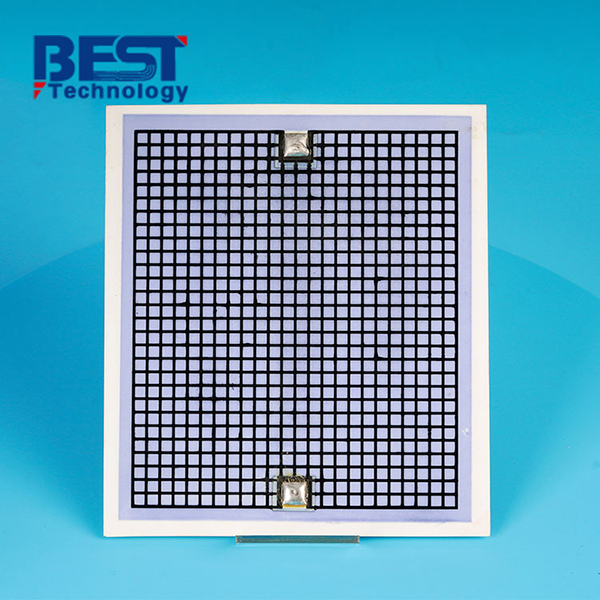
Our thick-film circuit for ozonator equipment uses a two-layer construction on 96% alumina with a nominal 1.0 mm substrate. For another circuit process, our thin-film board for vehicle-control systems also uses a 1.0 mm alumina base. These existing products demonstrate custom ceramic circuit formats for equipment and control applications.
Where the layout calls for plated copper, our DPC sensor board uses 35 μm copper on 96% alumina with an ENEPIG finish. The appropriate route depends on the circuit's printed functions, component connections and assembly method.
Board supply with optional assembly
Our ceramic PCB assembly service includes component sourcing, BOM checks, first-article inspection and functional testing to an agreed plan. The board fabrication and its component assembly can be handled within one order, or the bare board can go to an existing assembly partner.
HYBtronics and ACP have established specialties in hybrid electronics and resistive components. Our advantage for a defined custom-board project is the choice of circuit process and delivery stage, backed by specific ceramic products and assembly services.
Why Choose BSTCeramicPCB for Projects in Spain?
Choose us when your project has a defined ceramic circuit design and needs fabrication, with assembly available if required. That is a practical fit for control equipment combining ceramic circuitry with packaged electronic components.
A Spanish manufacturer can retain final calibration or system testing locally while sourcing the ceramic board from us. Alternatively, we can supply the populated circuit against an agreed assembly and functional-test scope. The populated circuit can then enter the manufacturer's final calibration and system test process.
For Ceramic PCB Spain projects using printed resistive functions, we review the construction and electrical requirements alongside the circuit layout. For copper-patterned sensor or control boards, we review the pads, finish and component assembly route. The manufacturing plan follows the circuit's actual function.
FAQ
1. Can every printed resistor be laser trimmed?
No. The resistive material, geometry, access and allowed adjustment range must suit the trimming process. A design needs enough suitable trim area without compromising its operating requirements.
2. Does functional trimming replace environmental testing?
No. It sets a selected output under defined conditions. Temperature behavior, load response and durability remain separate characteristics to evaluate.
3. Are all thick-film control circuits made on ceramic?
No. Thick-film technology can use ceramic, insulated metal and suitable polymer-based constructions. The paste system and processing conditions must be compatible with the chosen substrate.
Conclusion
Spain's HYBtronics and ACP offer distinct expertise in hybrid circuits and resistive controls. At BSTCeramicPCB, we provide custom ceramic circuit fabrication in China with optional component sourcing and assembly. Contact sales@bstceramicpcb.com to discuss your control or sensor board.
 Products
 About us
 Contact us