






















 HOME
HOME


-

Ceramic PCB for Humanoid Robot joint actuators
2026 04,07 -
LTCC PCB Surprises: What Most People Miss
2025 12,09 -
Step-by-Step Guide to DPC PCB Design for Sensor Systems
2025 12,03 -
Ceramic PCBs Essential Benefits and Applications
2025 12,01 -
How Al2O3 DPC Ceramic Substrate PCB Enhances Heat Dissipation in Modern Electronics?
2025 11,28 -
How to Choose Between Ceramic, FR4, and Metal Core PCBs
2025 11,27 -
DPC Ceramic PCB Materials: Surprising Science Inside
2025 11,26 -
Wire bondable 2-layer Alumina substrates PCB | Bstceramic PCB
2025 09,22 -
Silicon Nitride Substrate, Silicon Nitride Ceramic Substrate Formula
2025 05,08 -
What is thick film ceramic PCB?
2023 08,02
High-Thermal Beryllium Oxide (BeO) Circuit Boards: Powering Germany’s Photovoltaic Future
Published:
As Germany accelerates toward its renewable energy targets, the demand for high-efficiency power conversion has reached a tipping point. For German OEMs, the bottleneck is no longer the solar cell itself, but the thermal management of the power electronics. Beryllium oxide (BeO) circuit boards have become the indispensable core for modern PV inverters and concentrated solar power (CSP) systems.
Superior Thermal Management: Why BeO Leads the German Power Electronics Market
In the rigorous testing environments of German laboratories, Beryllium Oxide consistently outperforms standard substrates. When managing the heat of high-frequency switching, a BeO circuit board provides a thermal conductivity of roughly $285 W/(m·K)$—nearly ten times that of Alumina ($Al_2O_3$) and 50% higher than Aluminum Nitride (AlN).
Comparison of Ceramic Substrate Performance in Solar Inverters
German engineering standards (like DIN EN 821) require precise thermophysical data. Below is how BeO stands against competitors:
| Material Property | Beryllium Oxide (BeO) | Aluminum Nitride (AlN) | Alumina (Al2O3) |
| Thermal Conductivity | ~285 $W/(m·K)$ | 170-200 $W/(m·K)$ | 24-30 $W/(m·K)$ |
| Dielectric Constant | 6.7 (Lower is better) | 8.8 | 9.8 |
| Weight per Volume | 2.85 $g/cm^3$ | 3.26 $g/cm^3$ | 3.9 $g/cm^3$ |
By utilizing BeO substrates, engineers can reduce the footprint of cooling systems, allowing for the miniaturization of outdoor PV units.
Integrating Flexible PCBs and Rigid-Flex Technology in Solar Arrays
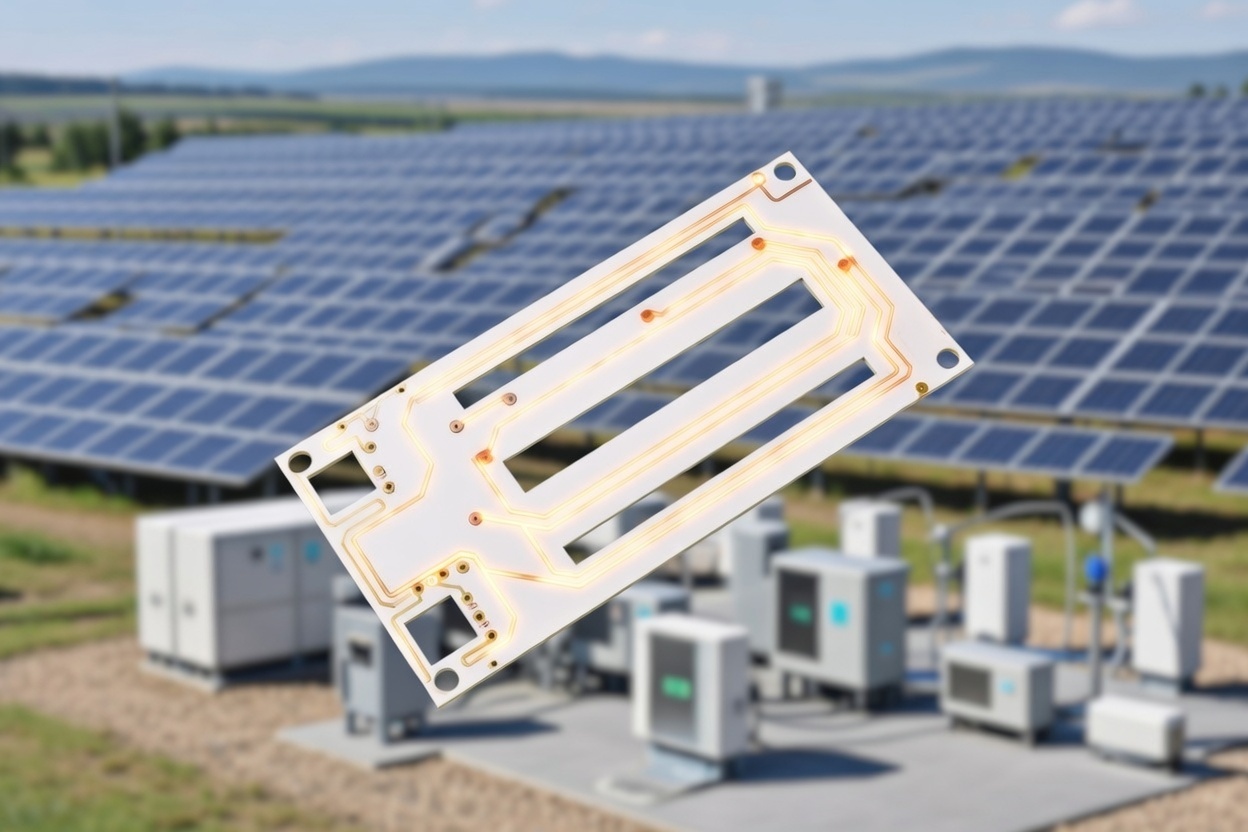
The trend in the German solar market is shifting toward "Integrated Photovoltaics." This requires not just rigid power boards, but versatile Flexible PCBs (FPC) and Rigid-Flex circuit boards that can navigate the complex geometries of curved solar tiles or tracking sensors.
How Rigid-Flex PCBs Enhance Photovoltaic Efficiency
In high-vibration environments like solar trackers, traditional wiring often fails. Rigid-Flex PCBs provide the necessary durability and weight reduction. When combined with a BeO ceramic base in a hybrid configuration, you get the ultimate power module: the heat dissipation of ceramic with the spatial versatility of polyimide flex.
GSC Internal Link: Explore our Rigid-Flex PCB Capabilities to see how we handle complex layer stacking for German renewable energy applications.
Meeting German DIN and ISO Standards for Ceramic Substrates
For a German procurement officer, "Quality" is a technical requirement, not a buzzword. BST Ceramic focuses on the Laser Activation Metallization (LAM) and Direct Bonded Copper (DBC) processes to ensure the highest adhesion for our BeO circuit boards.
Durability in Harsh Environmental Conditions (DIN EN 623)
Germany’s climate ranges from freezing winters to intense summer heat on solar farms. Our BeO boards offer a Coefficient of Thermal Expansion (CTE) that closely matches silicon, ensuring that solder joints remain intact over decades of thermal cycling, reducing the Maintenance Ratio ($MR$) of solar plants.
Why BST Ceramic is the Partner of Choice for German Solar Innovation
With over a decade of experience in ceramic PCB fabrication, BST Ceramic understands the nuances of the European market. From rapid prototyping to mass production of Beryllium oxide circuit boards, we provide the data-backed reliability that German engineers demand.
 Products
 About us
 Contact us