






















































 HOME
HOME

-

Ceramic PCB for Humanoid Robot joint actuators
2026 04,07 -
LTCC PCB Surprises: What Most People Miss
2025 12,09 -
Step-by-Step Guide to DPC PCB Design for Sensor Systems
2025 12,03 -
Ceramic PCBs Essential Benefits and Applications
2025 12,01 -
How Al2O3 DPC Ceramic Substrate PCB Enhances Heat Dissipation in Modern Electronics?
2025 11,28 -
How to Choose Between Ceramic, FR4, and Metal Core PCBs
2025 11,27 -
DPC Ceramic PCB Materials: Surprising Science Inside
2025 11,26 -
Wire bondable 2-layer Alumina substrates PCB | Bstceramic PCB
2025 09,22 -
Silicon Nitride Substrate, Silicon Nitride Ceramic Substrate Formula
2025 05,08 -
What is thick film ceramic PCB?
2023 08,02
Ceramic Circuit Board Quality Standards in the United States — Technical Requirements, Industry Practices, and Supplier Guide
Introduction
In the United States, ceramic circuit boards play an essential role across high-reliability industries such as automotive, aerospace, medical devices, telecommunications, and industrial power electronics. Unlike traditional FR-4 or metal core substrates, ceramic PCBs deliver superior thermal management, dielectric strength, and long-term stability — qualities critical to advanced electronic functions and safety-driven systems.
However, performance begins with quality. Understanding ceramic circuit board quality standards — including dimensions, material purity, metallization processes, and inspection criteria — is foundational to product reliability, compliance, and long-term customer satisfaction.
This article systematically explains U.S. ceramic PCB quality benchmarks, industry-specific requirements, dimensional tolerances (including line width and thickness), and actionable strategies to optimize quality. It also outlines why engineering teams and procurement specialists across the U.S. choose BSTCERAMICPCB as their quality-first supplier.
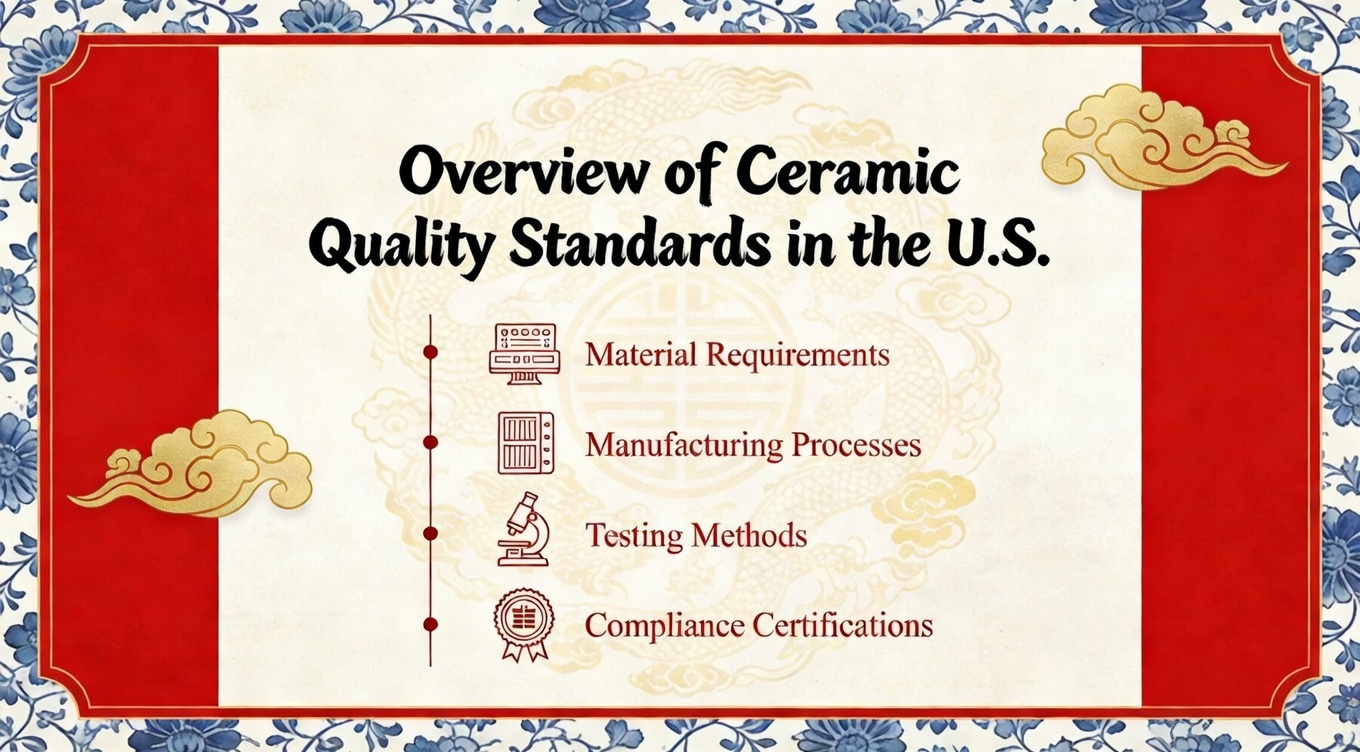
Overview of Ceramic Circuit Board Quality Standards in the U.S.
American electronic manufacturers expect quality levels that are measurable, repeatable, and aligned with international or industry-specific certifications. Unlike some traditional PCB quality frameworks that rely on generic laminate specifications, ceramic PCBs require quality standards that account for material homogeneity, thermal conductivity, electrical insulation, and precision manufacturing.
What Defines Ceramic Circuit Board Quality
At its core, ceramic circuit board quality is determined by how well a board meets its functional and reliability objectives under expected operating conditions. Key quality dimensions include:
- Material integrity: absence of cracks, porosity, or inclusions in the ceramic substrate
- Dimensional accuracy: tolerances on thickness, flatness, and geometric features
- Metallization adherence: strength and conductivity of copper or silver layers
- Electrical performance: dielectric strength and insulation resistance
- Thermal performance: ability to dissipate heat without degradation
Each of these aspects must be quantified through industry-accepted testing and inspection methods to ensure boards meet design and reliability goals.
Why Quality Standards Matter for Critical U.S. Industries
In sectors such as medical devices or automotive safety electronics, quality lapses are not just performance issues — they are safety hazards. Minor defects in ceramic boards can accelerate failure, compromise insulation resistance, or induce thermal runaway in power modules.
U.S. customers commonly require quality data that include:
- Process control statistics (SPC)
- Material batch traceability
- 100% visual and electrical inspection
- Thermal cycling test results
- Documentation compliant with automotive or medical quality systems
These requirements extend beyond simple pass/fail checks and become essential elements of supplier qualification and procurement decisions.
Regulatory Benchmarks and Industry-Referenced Standards
While ceramics have unique properties compared with organic PCBs, many U.S. organizations adapt or reference internationally recognized standards for quality frameworks. These include:
- IPC-6012 / IPC-6018 series: PCB quality frameworks adapted for ceramics
- UL certification categories where applicable
- ISO 9001 / IATF 16949: Supplier quality system expectations, particularly for automotive electronics
- ISO 13485: For medical device supply chains
For U.S. buyers, compliance with these frameworks — backed by documented evidence — is often a prerequisite for supplier selection.
Key Performance Metrics: Reliability, Precision, and Compliance
In the U.S. context, quality standards are more than checklists. They are engineered into the design and production lifecycle, requiring continuous measurement and supplier transparency. Data points such as dimensional variation charts, failure rates under thermal stress, and metallization adhesion strength must be traceable and auditable.
BSTCERAMICPCB incorporates these quality benchmarks into its process controls and customer deliverables, ensuring U.S. customers receive ceramic PCBs they can confidently integrate into mission-critical systems.
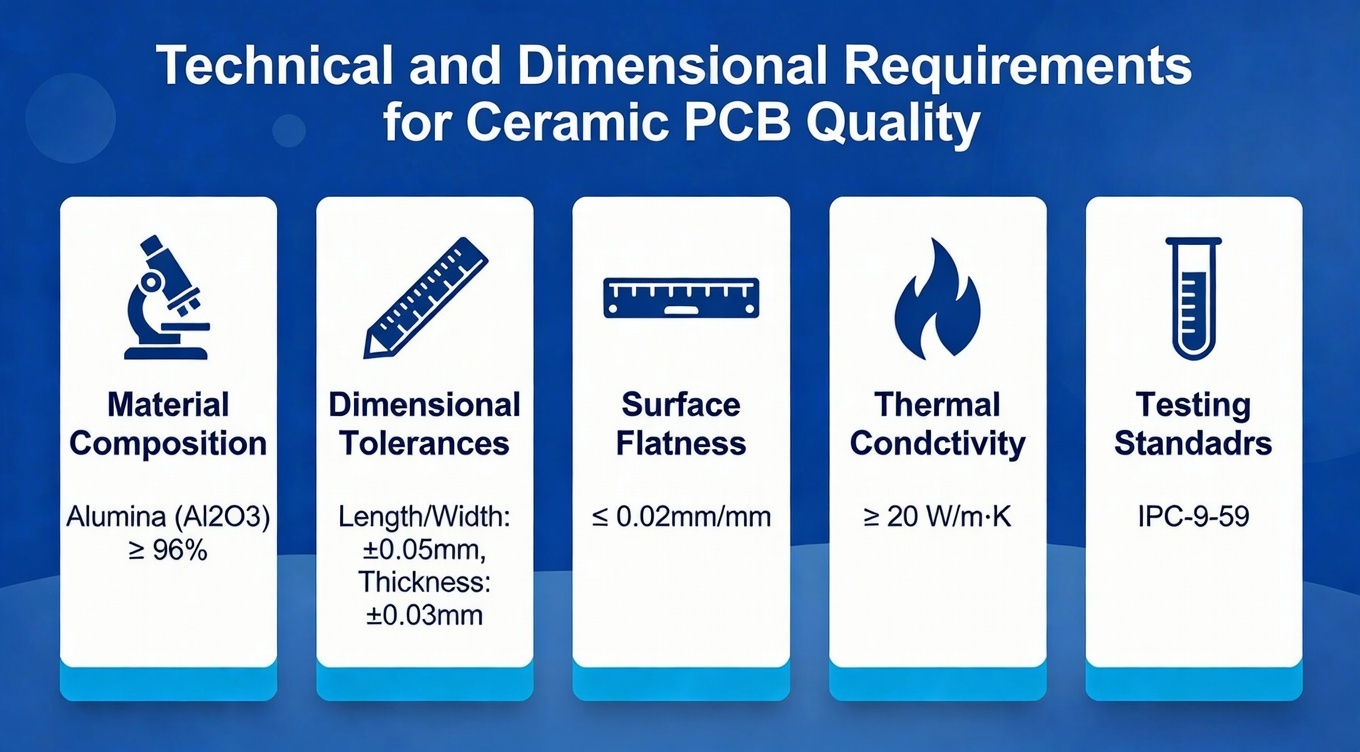
U.S. Technical and Dimensional Requirements for Ceramic PCB Quality
Ceramic PCB performance begins with material selection and precision manufacturing. In the U.S. market, dimensional standards such as thickness tolerance, line width, spacing, and planarity are all tightly linked with operational reliability and manufacturability.
Material Quality and Ceramic Substrate Specifications
Two primary ceramic substrates dominate the quality conversation:
- Alumina (Al₂O₃): More economical with solid electrical insulation and moderate thermal conductivity — ideal for many industrial and control applications.
- Aluminum Nitride (AlN): Higher thermal conductivity which supports high power density applications (e.g., automotive power electronics, high-brightness LED arrays).
Material quality criteria consider:
- Purity level (typically ≥ 96% for alumina substrates)
- Grain size and uniformity
- Microstructural integrity
Material integrity affects thermal conductivity, mechanical strength, and how well metallization bonds to the ceramic surface.
Dimensional Tolerance, Thickness & Linewidth Standards
In the U.S. quality ecosystem, dimensional accuracy is a fundamental requirement for integration and reliability. Typical parameters include:
- Thickness tolerance: Ceramic board thickness may need to adhere to ±10 µm or better for certain high-precision applications.
- Line width and line spacing: Precision copper or silver patterns often require tolerances within ±5-10 µm, particularly for high-frequency or high-density designs.
- Planarity: Surface flatness requirements ensure soldering quality and component seating integrity.
These dimensions are not arbitrary numbers; they are engineered to ensure that when the board is integrated into a system, it maintains signal integrity, current carrying capability, and thermal performance.
BSTCERAMICPCB documents all dimensional tolerances in manufacturing reports and provides inspection data with every batch, giving U.S. customers measurable assurance.
Surface Finish, Metallization, and Coating Requirements
Ceramic boards often use copper metallization with surface finishes (ENIG, HASL, or others) depending on end-use requirements. Quality standards cover:
- Adhesion strength
- Thickness of metallization
- Compatibility with soldering temperatures
- Environmental stability
These characteristics influence solder joint reliability and long-term electrical performance, especially under thermal cycling or humidity exposure.
Inspection, Test Criteria, and Quality Certification
Quality certification evidence is a cornerstone in U.S. procurement. Typical quality verification includes:
- Visual inspection under calibrated lighting
- Dimensional measurement through CMM (coordinate measuring machines)
- Electrical continuity and isolation tests
- Thermal cycle stress tests
- Solderability tests
BSTCERAMICPCB integrates these tests into standard production flows and provides detailed test results with every shipment.
Industry-Specific Quality Standards and Best Practices
Different U.S. industries impose specific quality expectations on ceramic PCBs. Below we break down these requirements and practical approaches for compliance.
Automotive Electronics (Automotive Grade & Functional Safety)
Automotive electronics suppliers in the U.S. require adherence to IATF 16949 processes and functional safety (ISO 26262) guidelines. Ceramic PCB quality standards in this context emphasize:
- Consistent traceability
- Failure mode analysis
- Long-term reliability under vibration and thermal cycling
Design considerations include controlled line widths for current capacity and thicker substrates for thermal stress redistribution. Ceramic PCBs for powertrain and ADAS modules typically require tighter dimensional and electrical tolerances.
BSTCERAMICPCB supports automotive customers with documented processes and PPAP deliverables aligned with quality expectations.
Medical Devices and Life-Critical Electronics
In medical device electronics, ceramic PCBs often function in imaging systems, surgical tools, or monitoring gear where failure is not an option. Quality imperatives include:
- Biocompatible material handling
- Highly accurate dimensional control
- Minimal tolerance variation
All material and inspection documentation must support FDA or equivalent regulatory submission practices.
Telecommunications & RF Applications
Telecom modules used in 5G and high-frequency systems require precise line width and spacing control to maintain signal integrity and impedance profiles. Ceramics’ dielectric constant stability makes them suitable, but quality demands:
- Tight geometry control
- Dielectric consistency across batches
- Surface finish optimized for high-frequency solder joints
BSTCERAMICPCB's RF and high-speed ceramic boards undergo specialized electrical testing to ensure compliance.
Power Electronics and Industrial Control
Industrial power modules demand ceramic boards with high thermal capacity and stable electrical isolation. Quality benchmarks here apply to creep distance, voltage withstand capabilities, and thermomechanical durability.

Design Trade-offs, Manufacturability, and Quality Optimization
Engineering teams must balance performance with manufacturability. Strict quality standards sometimes require design trade-offs.
Linewidth and Spacing vs Production Stability
Fine line widths and spacing increase design density but can elevate production risk. U.S. customers often choose slight relaxations of the minimum feature sizes to achieve higher yields and lower production defects. Early DFM (Design For Manufacturability) collaboration with suppliers like BSTCERAMICPCB ensures realistic manufacturable designs.
Thickness vs Thermal Performance vs Cost
Ceramic board thickness influences rigidity, heat dissipation, and cost. Thicker substrates improve mechanical stability and thermal capacity but may add to material expense. U.S. customers optimize thickness based on application needs rather than defaulting to maximum values.
DFM/DFT Review and Yield Improvement Strategies
Design reviews should address tolerances, copper balance, soldermask interaction, and heat path optimization. BSTCERAMICPCB’s engineering team routinely conducts DFM/DFT reviews with customers to improve early-stage designs and reduce late-stage redesign.
Traceability, Documentation, and Compliance Records
Quality records are a core part of U.S. sourcing. Supplier documentation packages typically include material certificates, inspection reports, process control summaries, and test results aligned with frameworks such as ISO 9001 or IATF quality systems.
Choosing BSTCERAMICPCB as Your Quality-Driven Supplier in the U.S.
When sourcing high-quality ceramic circuit boards in the U.S., BSTCERAMICPCB distinguishes itself through:
Engineering Support and Collaborative DFM
BSTCERAMICPCB provides early design consultation to ensure quality specifications are balanced with manufacturability, reducing time-to-market and improving yield.
Quality Management and Inspection Capabilities
Through SPC, dimensional inspection, electrical testing, and thermal performance measurement, BSTCERAMICPCB delivers boards that meet U.S. quality expectations with documented evidence.
U.S. Customer Success Cases and Certifications
Leading U.S. customers in automotive, medical, and telecom rely on BSTCERAMICPCB for boards that meet industry-specific quality thresholds. Supplier certifications and quality documentation support customer compliance processes.
Contact and RFQ Best Practices
To get a custom ceramic PCB quality compliance quote, submit your design files and target specifications on our Contact BSTCERAMICPCB RFQ page (insert internal link here).
For design consulting on feature tolerances, dimensional standards, or certification support, see our Ceramic PCB Capabilities & DFM services page (insert internal link here).
Conclusion
Understanding and meeting ceramic circuit board quality standards is essential for success in the U.S. electronics industry. From automotive safety systems to medical devices, telecommunications, and power electronics, quality influences performance, compliance, and reliability.
By combining rigorous material controls, precise dimensional tolerances, comprehensive inspection protocols, and industry-aligned documentation, BSTCERAMICPCB empowers U.S. customers to confidently integrate ceramic PCBs into high-value applications.
Contact BSTCERAMICPCB today for specialized guidance and quality-driven ceramic PCB solutions tailored to your American market needs.
 Products
 About us
 Contact us