











































 HOME
HOME


-

Ceramic PCB for Humanoid Robot joint actuators
2026 04,07 -
LTCC PCB Surprises: What Most People Miss
2025 12,09 -
Step-by-Step Guide to DPC PCB Design for Sensor Systems
2025 12,03 -
Ceramic PCBs Essential Benefits and Applications
2025 12,01 -
How Al2O3 DPC Ceramic Substrate PCB Enhances Heat Dissipation in Modern Electronics?
2025 11,28 -
How to Choose Between Ceramic, FR4, and Metal Core PCBs
2025 11,27 -
DPC Ceramic PCB Materials: Surprising Science Inside
2025 11,26 -
Wire bondable 2-layer Alumina substrates PCB | Bstceramic PCB
2025 09,22 -
Silicon Nitride Substrate, Silicon Nitride Ceramic Substrate Formula
2025 05,08 -
What is thick film ceramic PCB?
2023 08,02
Green Micro-Machining of Ceramic Substrates in Europe — Technical Standards, Sustainability, and Application Solutions
Published:
In recent years, European manufacturers and design engineers have increasingly focused on sustainable and high-precision manufacturing processes. One such domain gaining traction is green micro-machining of ceramic substrates — especially for ceramic PCBs used in high-reliability applications such as automotive power electronics, LED lighting systems, medical devices, and RF modules.
Unlike traditional subtractive machining that relies on abrasive or chemically intensive processes, green micro-machining combines precision material removal with low environmental impact. This includes technologies like dry micro-drilling, laser micromachining with minimal waste, and hybrid additive/subtractive techniques that reduce material usage and manufacturing energy consumption.
In the European context, especially within the UK, Germany, Sweden, and the Netherlands, sustainability regulations are increasingly influencing design and procurement decisions. Ceramic substrate manufacturers must meet not only tight dimensional tolerances and performance benchmarks but also environmental metrics, energy efficiency, and waste-reduction standards.
This article explores the technical frameworks, industry standards, process considerations, and practical solutions behind green micro-machining of ceramic substrates — and how BSTCERAMICPCB supports European clients with sustainable, high-precision ceramic PCB manufacturing.
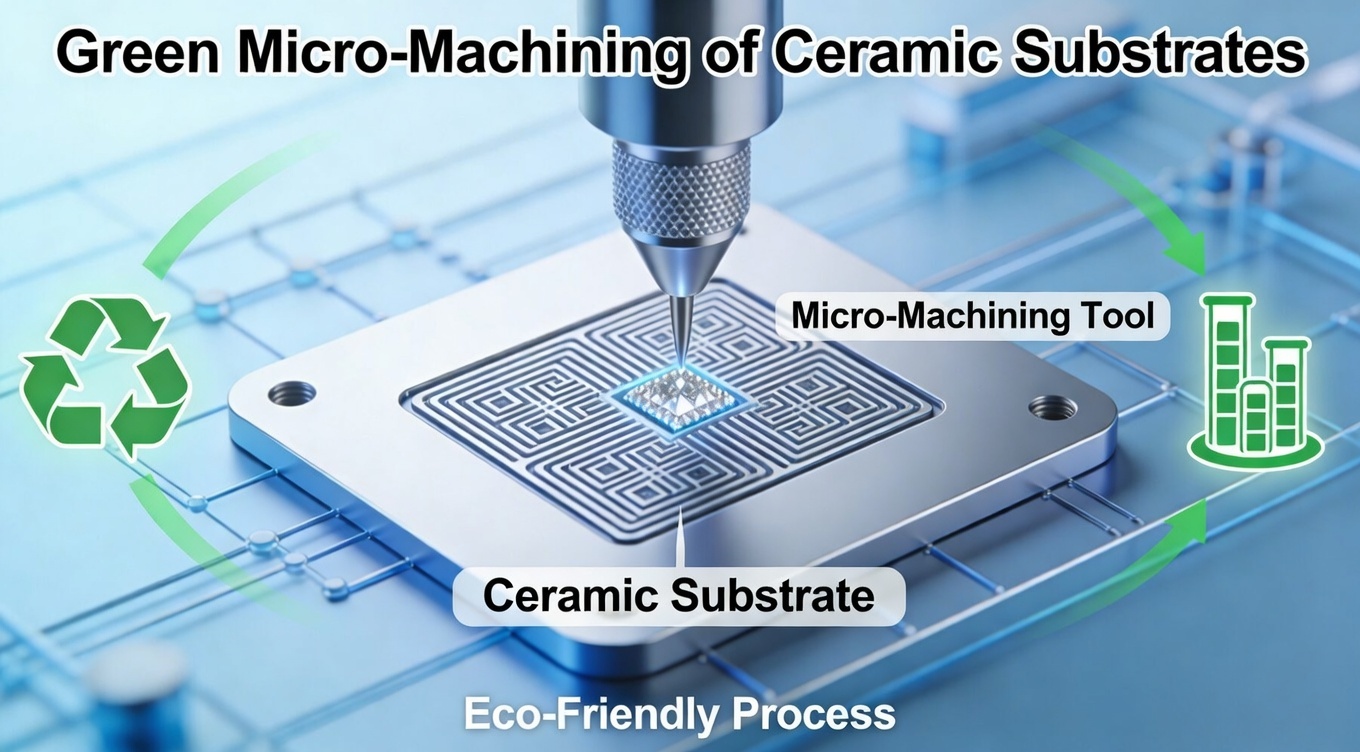
What Is Green Micro-Machining of Ceramic Substrates and Why It Matters in Europe
Green micro-machining refers to precision material removal techniques that are optimized for minimal environmental impact, reduced energy consumption, and lower waste generation — while still achieving sub-micron precision and high surface quality on ceramic substrates.
Definition of Green Micro-Machining in Ceramic Manufacturing
Green micro-machining encompasses methods such as:
- Laser micromachining with closed-loop energy optimization
- Dry micro-drilling and micro-milling
- High-precision ultrasonic or micro-abrasive processes utilizing minimal consumables
- Hybrid additive/subtractive processes that reduce machining steps
These methods significantly reduce:
- Chemical etching waste
- Large quantities of coolant fluids
- Abrasive slurry disposal
- Excessive machining time
The result is a manufacturing cycle that is not only precise but also eco-efficient.
Environmental and Technical Drivers in Europe
Europe has some of the world’s most stringent environmental regulations, including:
- European Green Deal directives aimed at carbon neutrality
- RoHS and REACH restrictions limiting hazardous substances
- Energy efficiency targets for industrial processes
- Waste reduction mandates for manufacturing facilities
Ceramic substrates — widely used in high-power density and high-temperature electronics — traditionally require energy-intensive processes. The adoption of green micro-machining aligns with European sustainability goals while enabling precision features essential for:
- High-reliability LED thermal interfaces
- Automotive power modules with microfluidic cooling structures
- Medical implantable ceramic components
- High-frequency RF printed ceramic guides
How Green Micro-Machining Improves Ceramic PCB Quality
Beyond sustainability, green micro-machining improves core ceramic PCB performance by enabling:
- Sharper edge definition with minimal chipping
- Improved surface finish enabling better solderability
- Reduced microcracks and structural damage that compromise reliability
- Finer control over micro-holes, channels, and via walls
These quality improvements translate to higher first-pass yields, fewer rework cycles, and overall lower cost of ownership — a major benefit for European manufacturers where quality and sustainability are equally weighed.
Sustainability Benchmarks in EU & UK Manufacturing Frameworks
Many European manufacturers align green machining strategies with:
- ISO 14001 Environmental Management Systems
- EU Energy Efficiency Standards for Industrial Machinery
- UK Green Manufacturing Standards
- Circular economy initiatives in automotive and aerospace sectors
Ceramic substrate suppliers are expected to demonstrate not just precision metrics but also documented sustainability improvements, including energy consumption reports and waste reduction data.
European and UK Quality Standards for Green Ceramic Micro-Machining
Quality standards for green micro-machining ceramic substrates span several domains: material properties, geometric precision, surface quality, process efficiency, and environmental impact. Europe’s quality expectations are often stricter than global norms due to regulatory and industrial benchmarking.
Material Purity & Eco-Friendly Process Metrics
European buyers prefer ceramic substrates with:
- Certified purity levels for alumina and aluminum nitride
- Low defect density for micro-machined features
- Documentation of eco-compatible additive or base materials
European procurement often requires suppliers to demonstrate material traceability — linking raw material sources to final performance metrics. This is increasingly part of RoHS / REACH compliance reporting.
Green micro-machining processes must support these material quality requirements without introducing contamination or altering intrinsic properties.
Dimensional Precision, Surface Finish, and Micro-Feature Accuracy
Precision machining standards in Europe (and the UK) do not only focus on accuracy but also repeatability. Typical metrics include:
- Minimum feature size tolerances (e.g., ±5–10 μm for micro-vias)
- Surface roughness values below threshold for solder wettability
- Positional accuracy for complex 3D geometries
Such metrics are often demanded in high-reliability sectors like aerospace and automotive.
Vertical integration of inspection — including optical metrology, profilometry, and CMM scanning — is expected to verify that each batch meets specified tolerances.
Energy Consumption & Waste Reduction Standards
Europe’s green policy landscape increasingly ties quality with environmental performance. Ceramic micro-machining facilities must:
- Record and report energy use per part
- Show reduction trends in coolant, gas, and abrasive consumption
- Maintain closed-loop recycling where possible
These eco-efficiency indicators can influence procurement decisions in automotive, telecom, and industrial automation contracts.
Inspection, Compliance & Traceability Requirements
Inspection frameworks in Europe often integrate:
- Full batch documentation
- Inspection certificates linked to manufacturing data
- Process control charts
- Sustainability reporting documentation
BSTCERAMICPCB’s quality systems incorporate both traditional dimensional inspection and eco-efficiency metrics, providing customers with a comprehensive compliance package.
Industry Use Cases and Application-Driven Requirements in Europe
Green micro-machining of ceramic substrates applies across multiple European industry verticals, each with its own performance priorities and technical demands.
Automotive Electronics — EV Power Modules and High-Heat Components
In Europe’s electrified automotive sector, ceramic substrates are used in:
- Inverter power modules
- BMS thermal interfaces
- High-temperature power stages
Green micro-machining enables optimized thermal channels and precision mounting interfaces without chemical waste or high coolant usage. Tighter tolerances improve electrical reliability critical for automotive functional safety.
LED Lighting and Display Ceramic Substrates
European cities are rapidly adopting LED street lighting and architectural illumination. Ceramic substrates in these applications require:
- High thermal conductivity
- Long-term color stability
- Detailed micro-patterning for LED arrays
Eco-efficient machining reduces production emissions while enabling the fine features required for high power LED mounting.
Medical Device Micro-Ceramic Components
Medical devices demand micro-precision and biocompatibility. Micro-machining must maintain:
- Smooth surface finish
- Precise geometries with minimal microcracks
- Documentation for regulatory compliance
Green machining further reduces chemical exposure risks in medical device environments.
Telecom & RF Modules: High-Frequency Precision Meets Sustainability
Telecom and RF systems in Europe require ceramic substrates with microscopic features for waveguides and filters. Micro-machining enables:
- Sub-millimeter precision
- Low dielectric loss surfaces
- Eco-friendly processing for high volumes
These capabilities are increasingly required in mmWave and 5G equipment.
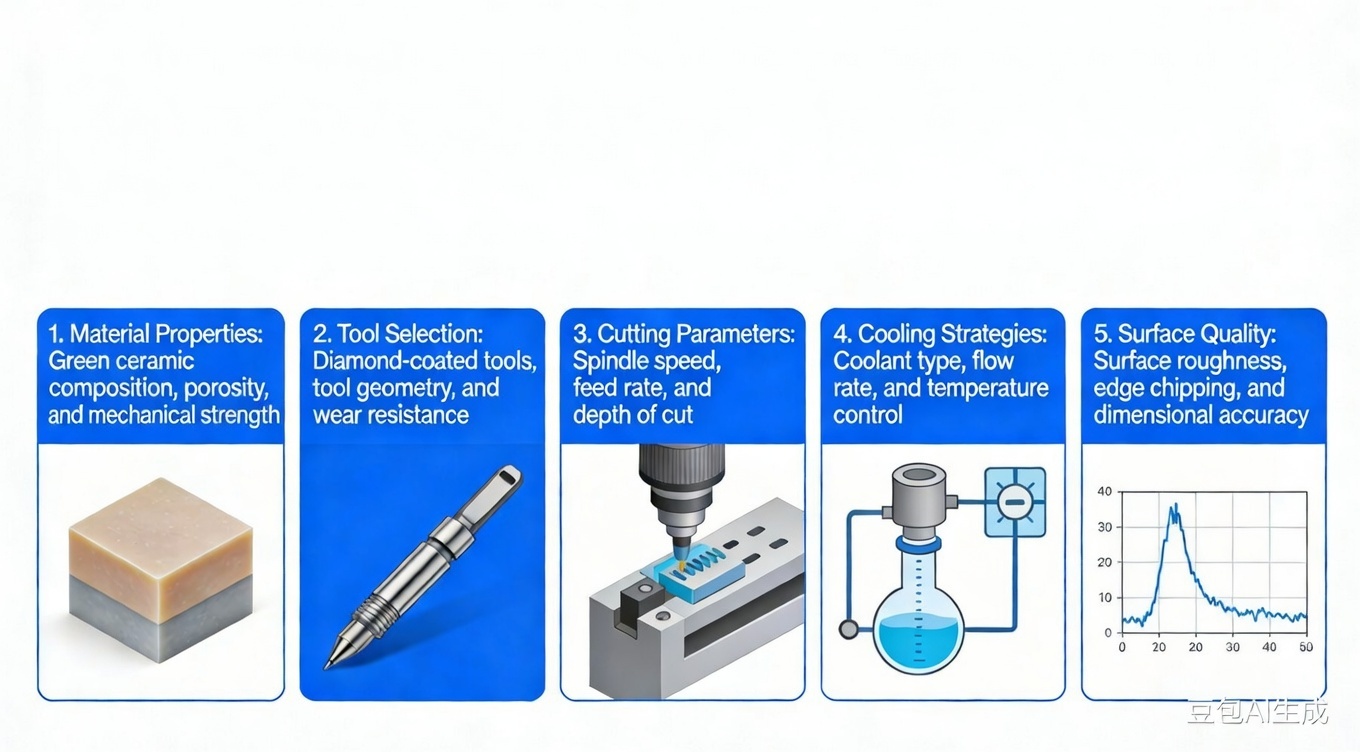
Key Technical Considerations and Process Factors in Green Ceramic Micro-Machining
European buyers evaluate ceramic micro-machining not only on finished geometry but on process robustness, sustainability, and economic viability.
Microstructural Integrity vs Minimal Machining Footprint
Machining ceramics inherently risks microfractures. Green micro-machining mitigates this by:
- Reducing mechanical loads
- Using non-abrasive energy-efficient lasers
- Applying precision vibration control techniques
This ensures structural integrity in the finished substrate.
Micro-Drilling, Laser Scribing & Hybrid Strategies
Different processes have tradeoffs:
- Micro-drilling excels at holes and vias
- Laser scribing is ideal for fine edge definition
- Hybrid additive/subtractive produces complex 3D geometries
Designers must balance feature complexity with achievable precision.
Contamination Control, Tool Wear & Surface Roughness
Tool wear impacts part quality and waste generation. Green machining strategies emphasize:
- Non-toxic tooling materials
- Minimal particulate generation
- Controlled atmospheric machining
This reduces both quality variation and environmental footprint.
Balancing Throughput, Cost, and Sustainability Targets
While green processes may initially require capital investment, long-term benefits include:
- Lower waste disposal costs
- Reduced energy consumption
- Higher first-pass yield
European procurement teams increasingly evaluate total cost of ownership rather than unit cost alone.
Why European Buyers Choose BSTCERAMICPCB for Sustainable Ceramic Micro-Machining
Engineering Support for Precision and Eco-Efficiency
BSTCERAMICPCB provides engineering consultation from design inception through production optimization, including:
- DFM reviews aligned with green micro-machining capabilities
- Simulation for micro-feature stress analysis
- Eco-process optimization reports
We embed sustainability into process planning, not add it as an afterthought.
Quality Assurance, UK/EU Compliance & Traceability
Our quality system delivers:
- ISO-aligned dimensional inspection
- Eco-efficiency metrics tracking
- Full batch documentation for UK/EU audits
Customers receive both technical compliance and environmental performance data.
Case Highlights of Green Micro-Machining Projects
Europe-based clients have leveraged BSTCERAMICPCB for:
- Micro-channel ceramic thermal substrates for EV power units
- High-precision LED substrate arrays with sustainable micro-drilled holes
- RF waveguide ceramic modules with laser-scribed low loss surfaces
These examples demonstrate measurable precision and sustainability improvements.
Contact Pathways & RFQ Best Practices for European Clients
For custom green micro-machining ceramic substrate quotes, submit your design files on our RFQ page.
For consultation on sustainability metrics and green process optimization, visit our Engineering Services & Capabilities page.
Conclusion
Green micro-machining of ceramic substrates is no longer a niche technology — it is an essential strategy for European manufacturers seeking high precision, sustainability, and compliance with evolving environmental and industrial standards.
By combining advanced machining techniques, rigorous inspection, eco-efficiency metrics, and engineering support, BSTCERAMICPCB enables European clients to achieve:
✔ Improved product quality
✔ Reduced environmental footprint
✔ Predictable manufacturing yield
✔ Competitive advantage in EV, LED, medical, and telecom markets
Contact BSTCERAMICPCB today to ensure your next ceramic PCB project combines high performance with green manufacturing excellence.
 Products
 About us
 Contact us